2025: Another Defining Year for OneStock
As retail accelerated under the combined pressures of AI adoption, omnichannel complexity, and rising customer expectations, it became clear very early on in the year that innovation could no longer be episodic.
Retailers need technology partners that can evolve continuously, deliver value faster, and adapt in real time as a response to these market shifts.
The Year of Velocity
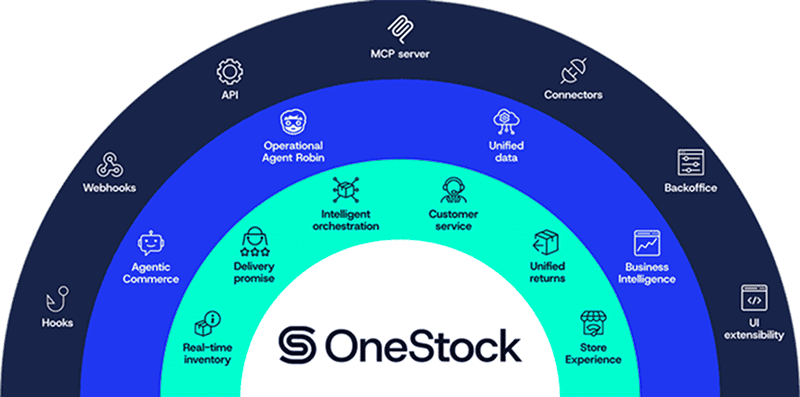
That’s why 2025 became the ‘Year of Velocity’ at OneStock. Throughout the year, OneStock moved beyond the traditional boundaries of Order Management. By strengthening our Open OMS architecture, scaling the platform for enterprise demands, and laying the foundations for AI-first and agent-driven commerce, we transformed the OMS from a passive system of record into an active system of action.
Velocity in 2025 meant reducing time-to-decision, time-to-execution, and time-to-adaptation, empowering retailers to respond instantly to customer intent, operational considerations, and new fulfillment models in an increasingly intelligent commerce landscape. Through the integration of Generative AI and laying the foundations of Agentic Commerce, we have drastically reduced time-to-action for every user, from store associates to developers, transforming the OMS into an active, intelligent partner.
Let’s take a look at these 2025 pivotal advancements through the lens of product innovation in four key areas:
- Connectivity & Extensibility
- Security, Scale, and Resilience
- Maximizing User Efficiency: The “Super User” Experience
- Smarter Orchestration, delivery promise and unified inventory management
1. The “Open OMS” Revolution: Connectivity & Extensibility
In 2025, we doubled down on the philosophy that an OMS should not be a black box.
As such, we opened up the platform to allow for easier integrations, deeper customization, and global compliance in the following ways:
- Gateway to Agentic Commerce (MCP): 2025 saw the beta release of the OneStock Model Context Protocol (MCP). A crucial component for agentic commerce, it enables external AI Agents to securely access OneStock data in real-time. Now, an AI agent on your storefront can check stock, suggest delivery options, or handle returns autonomously, bridging the gap between conversational AI and transactional execution.
- Expanded Ecosystem: We significantly strengthened our presence in the composable commerce ecosystem, with some notable announcements:
- commercetools: OneStock is now officially a commercetools Connect partner. This means we are available directly in their marketplace, thus simplifying deployment for composable architectures.
- Shopify: Our connector has seen continuous evolution throughout the year. Driven by direct feedback from our first live customers, we rolled out numerous updates to enrich the scope of the connector throughout the year.
- UI extensibility: Through one of our key 2025 initiatives, namely our Open & Extensible OMS initiative, clients can now embed custom pages directly into the OneStock Backoffice. Using our new Design System, IT teams and SI partners can build bespoke dashboards or operational tools that feel native to the platform, ensuring a consistent user experience without waiting on the core roadmap.
- North American Expansion (Avalara): We launched an official Avalara Tax Connector to automate complex tax compliance in the US and Canada. It manages Sales Tax Nexus and destination-based rules in real-time, streamlining the path for international growth.
- Global Carrier Connectivity: We aggressively expanded and updated our library of turnkey carrier integrations to support international logistics: DHL, Mondial Relay, GLS, Uber Direct, SF Express, StarTrack, Uparcel, GDEX, and aggregators like ShipStation and Global-e, ensuring faster deployment of new shipping methods worldwide.
- Universal Payment Flexibility: Also noteworthy in 2025, our new Payment Connector allows partners to build custom integrations with preferred providers (like Adyen, Stripe, or Hipay). This maintains standard checkout functionalities while enabling complex flows like direct capture, deferred payments, and pay-by-link.
2. Enterprise-Grade: Security, Scale, and Resilience
As our clients grow, our infrastructure grows with them. 2025 was no different. Last year saw extensive upgrades in platform resilience to support high-volume retailers.
- Hyper-Scalability (10x Growth): The Delivery Promise engine was upgraded to handle up to 10 times the previous volume of requests while maintaining low, stable latency.
- Intelligent Traffic Control: To ensure fair usage and stability during peak trade, we rolled out API Rate Limiting with self-unblocking capabilities. Additionally, our webhook infrastructure now delivers up to 80x more events thanks to smart batching.
- Fortified Security: We introduced Multi-Factor Authentication (MFA) for all users and separated API User Management from human users. API users now utilize secure, auto-generated tokens and IP restrictions, ensuring watertight system-to-system communication.
3. Maximizing User Efficiency: The “Super User” Experience
A powerful platform is nothing without efficient users. In 2025, we obsessed over “reducing cognitive load;” in other words, ensuring that every interaction is faster and more intuitive.
This yields tangible benefits in the areas of customer service, store experience, and configuration experience.
Customer Service: Agility & Context
- 360° Instant History: Agents can now view a client’s total order history directly within an order view, eliminating the need to copy-paste emails to find past interactions.
- Faster Resolution: We introduced ‘1-click bulk status updates’ for line items and the ability to seamlessly change the collection store for Click & Collect orders (automatically re-triggering orchestration), empowering agents to solve tickets in seconds.
- User-Centric UI: From persistent column configurations to improved copy-paste functionality, the interface now adapts to the agent’s workflow.
Store Experience: Accuracy & Traceability
- Address Autocomplete: We integrated Google-powered address autocomplete in the Order In Store module, drastically reducing typing errors and shipping failures.
- Audit & Traceability: A new History Log tab in the Store App provides a clear audit trail of daily actions, helping managers troubleshoot issues and track operations during busy periods.
Configuration Experience:
- Optimized Inventory Buffers: A good configuration is the foundation of reliable operations. We introduced safeguards and actionable recommendations for buffer configuration. The system now guides users on best practices (e.g., limits on item-query buffers) and provides clear notifications when optimization limits are reached, ensuring your stock exposure remains efficient and risk-free.
- Configuration agent: We introduced a conversational AI assistant that cures “blank page syndrome.” Administrators can now chat with OneBot to describe their business goals (e.g., “Prioritize flagship stores for shipping”), and it will generate or edit complex orchestration rulesets automatically.
4. Core Engine Enhancements: Smarter Orchestration, delivery promise and unified inventory management
The heart of OneStock (the logic that balances inventory, calculates promises, and routes orders) got significantly smarter and easier to manage:
- Delivery Promise precision: We completely reworked the Delivery Promise configuration interface to make it more intuitive, reducing setup time. Additionally, the engine now supports dynamic metadata for carriers (crucial for meta-carriers) and can trigger automated notifications to customers whenever a delivery date is updated, keeping them informed at every step.
- Automated Carrier Assignation: Assigning the right carrier no longer requires complex integration scripts. Business users can now configure carrier rules directly in the Backoffice, automatically assigning the best logistics partner based on order fields and stock location characteristics.
- One Order, Multiple Deliveries: We broke the “one order, one shipment” constraint. Customers can now split a single order into multiple delivery methods (e.g., mixing Home Delivery and Click & Collect) or addresses without complex setup.
- Volume-Based Capacity: Capacity management is no longer just about carrier limits. Stock locations now have specific order volume limits. When a store hits its daily packing limit, the Promise engine automatically recalculates dates or reroutes orders to prevent store burnout.
- Advanced Orchestration Logic: New Candidate Exclusion and sequential targeting allow the system to exclude previously rejected stores and propose orders to the “best” candidates one by one, increasing acceptance rates.
But… Velocity was never the end goal. It is the prerequisite.
In 2025, OneStock proved again that modern order management can move at the speed required by today’s retail environment. Faster decisions, faster execution, and faster adaptation are no longer competitive advantages; they are the baseline for operating in a world shaped by AI, real-time customer intent, and increasingly complex fulfillment networks.
But as intelligence becomes embedded deeper into the commerce stack – and as AI agents begin to act directly on behalf of customers – speed alone is no longer enough. Every promise exposed to a customer, whether through a website, a store associate, or an AI-powered interface, must be accurate, consistent, and executable in the real world.
The foundations laid in 2025, from enterprise-grade scalability and security to open, extensible architectures and the building blocks of Agentic Commerce, were deliberately designed for this next phase. They enable not just faster action, but confident commitment.
As OneStock moves into 2026, the focus naturally evolves from how fast retailers can move, to how accurately and reliably they can make (and keep) their promises in an AI-driven world. Velocity makes this possible. But now, we must look at ‘Customer Promise’ to make it meaningful.