Extensibility
The perfect balance of speed and flexibility
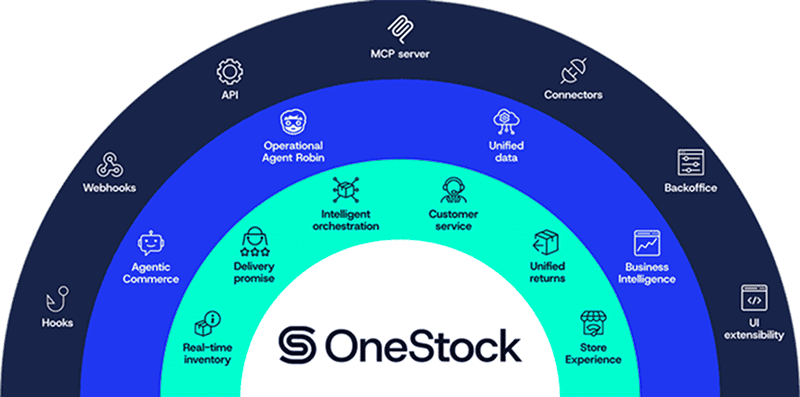
We’re experts in OMS for commerce so the product already does most of what you need. But for anything else, the extensibility framework has all the flexibility you could need.
Extend OneStock to meet your specific needs, easily and risk-free
Adapt to your business process
Customize orchestration and business rules: create, modify and deploy bespoke order flows and custom data fields (pre-orders, subscriptions, made-to-order) while preserving OneStock’s core stability and upgradeability.
Innovate faster and autonomously
Let product teams and integrators build and ship features independently using extension points. Reduce time‑to‑market for new shopping experiences and free IT to focus on high‑value initiatives.
Scale with confidence
Grow functionality at your pace: add markets, channels and capabilities without costly migrations. Maintain consistent SLAs and operational continuity as transaction volume increases.
Stay independent, risk-free
Use APIs, webhooks and defined hooks to run business logic on your infrastructure. You keep control of rules and data while OneStock’s core stays locked and upgradeable—no risky core edits required.







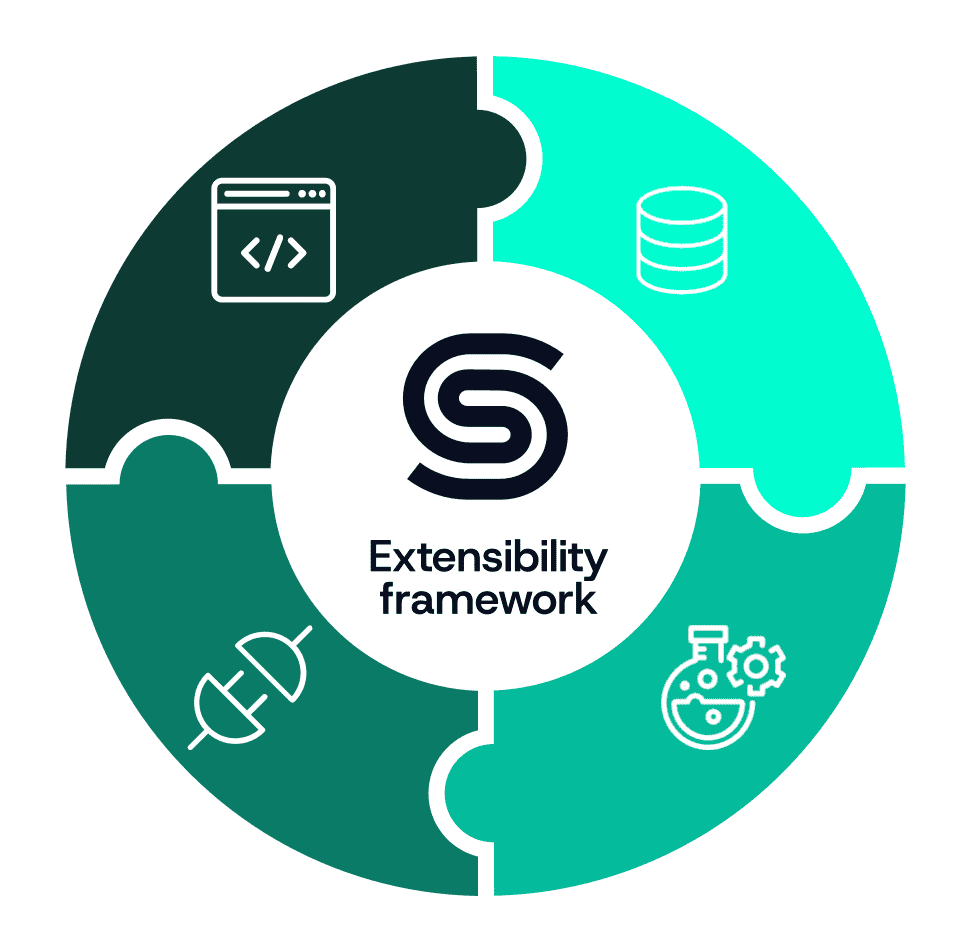
The key components of an extensibility framework
A comprehensive framework for enterprise customization
Hooks
Hooks are defined injection points in OneStock that let you run custom business logic without changing core code. They accept controlled inputs, execute isolated logic, and return standard outputs, preserving upgradeability, security and platform stability while enabling runtime customization.

APIs — full platform coverage
OneStock provides secure, RESTful APIs with full platform coverage — orders, inventory, returns, promises, payments and reporting. Built for real‑time orchestration, bulk operations and deep integrations, APIs include authentication, rate limits and semantic versioning for stability and upgradeability.
Webhooks — event-driven integrations
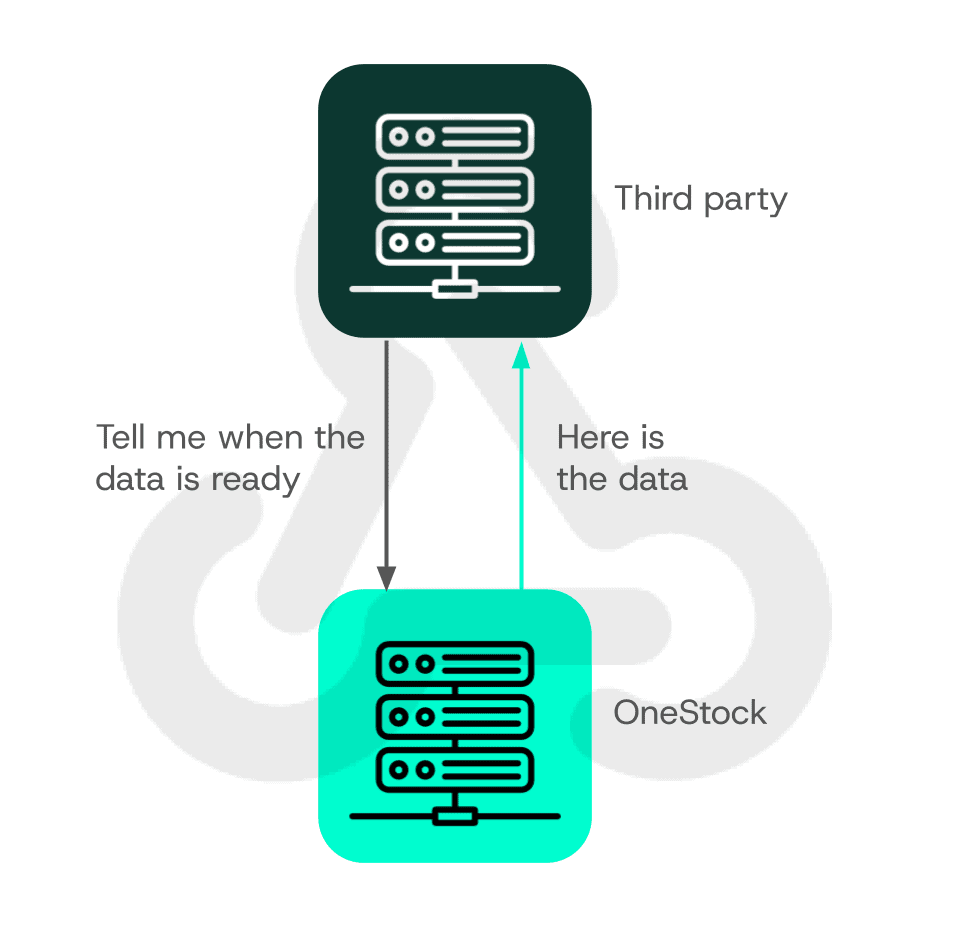
Push events to your systems in real time. Trigger downstream automation, update third‑party services instantly and reduce integration latency for critical operational events.

Flexible data model & attributes
Add custom attributes to native objects—order, customer, product, store—without source code changes. Extended data flows through UIs, APIs, workflows and reports to enable richer decisioning and faster feature rollout.
Extensibility Use Cases
Enriched order view for customer service
Add financial and third‑party data to the customer‑service order view for faster triage, payment reconciliation and dispute resolution—reducing handling time and improving customer satsisfaction.
Data-driven fulfilment candidate selection
Use external signals (traffic, weather, carrier KPIs, local stock and loyalty) to score and rank fulfilment candidates. Improve promise accuracy, on‑time performance and routing efficiency.
Non‑native payment connector
Integrate a third‑party payment provider for deferred capture, refunds and reconciliations directly from OneStock. Keep payment events synchronized with order states and reduce manual reconciliation.
Bulk operations for customer service
Enable bulk actions (status updates, cancellations, mass tagging, refunds) across selected orders in the customer‑service app. Reduce repetitive work, accelerate backlogs and increase team throughput.
How Extensibility Works
Define custom requirements
Identify business-specific needs that standard OMS configurations cannot address. Document custom data fields, workflow variations, integration requirements, and UI modifications needed across your organization.
Develop extensions
Use OneStock’s technical enablers to create custom fields, design workflows, build connectors and configure UI extensions.
Test in staging
Deploy extensions to pre-production environments. Validate functionality, performance, and integration points. Use configuration versioning and environment management to ensure changes work correctly before production deployment.
Deploy to production
Promote validated extensions to production using controlled deployment packages. Monitor extension performance through comprehensive troubleshooting tools.
Maintain
Extensions remain compatible with platform upgrades.
What is OMS extensibility and why does it matter for enterprise retailers?
OMS extensibility enables retailers to customize order management functionality to meet specific business requirements without modifying core platform code. This matters because it eliminates technical debt, preserves upgradeability, reduces maintenance costs, and accelerates time-to-market for new capabilities while maintaining platform stability and reliability.
How does OneStock’s extensibility framework differ from custom code modifications?
OneStock provides safe injection points, APIs, webhooks, and visual workflow tools instead of requiring core code changes. Extensions remain isolated from the core platform, ensuring that OneStock upgrades don’t break customizations. This approach reduces technical debt, simplifies maintenance, and enables business users to configure capabilities without developer resources.
Can I extend OneStock to integrate with my existing ERP and WMS systems?
Yes. OneStock’s connector extensibility enables you to build custom integration adapters for ERP, WMS, CRM, payment providers, carriers, tax engines, and promotion systems. Connectors leverage OneStock’s robust API and webhook infrastructure and can be hosted within OneStock’s secure environment or deployed externally based on your requirements.
What happens to my custom extensions when OneStock releases platform updates?
Extensions built using OneStock’s framework remain compatible with platform upgrades because they use defined extension points rather than modifying core code. OneStock maintains backward compatibility for APIs, webhooks, and extension interfaces. This ensures your customizations continue working after updates without requiring code rewrites or extensive testing.
Do I need developers to create extensions in OneStock?
Many extensions can be configured by business users using visual tools, state diagrams, and no-code configuration interfaces. Complex integrations and custom connectors may require developer resources, but OneStock provides comprehensive documentation, APIs, and a design system that significantly reduce development time compared to traditional custom coding approaches.
By business model
By Scenario









Learn how retailers increase availability, streamline fulfilment and grow with OneStock.