

How TFG London Transformed Their Tech Stack to Drive Agility and Efficiency
In a recent discussion, Romulus Grigoras, CEO of OneStock, sat down with Alex Priscott, Group CTO at TFG London—the powerhouse behind brands like Phase Eight, Whistles, and Hobbs. The conversation centered on TFG London’s journey from rigid legacy systems to a modern, flexible architecture. Central to their strategy was the adoption of composable commerce for omni-channel retail, a move designed to unify operations, empower teams, and ultimately deliver a superior customer experience.
For retailers managing multiple brands and markets, the pressure to innovate while maintaining operational efficiency is immense. TFG London’s experience offers a roadmap for navigating this complexity. By shifting toward composable commerce for omni-channel retail, they selected best-of-breed components rather than a single monolithic suite. This transformation has not only streamlined their supply chain through advanced order orchestration but has also future-proofed their business against an unpredictable market.
Key Takeaways
- Move away from monoliths: Transitioning to composable commerce for omni-channel retail architectures allows for faster integration and the flexibility to swap out components as business needs change.
- Unified stock is critical: Pooling inventory from warehouses and stores into a single view increases availability and sales.
- Stores as fulfillment centers: Implementing ship from store capabilities transforms physical locations into distribution hubs, moving product faster and reducing waste.
- Partners over suppliers: Success in a complex integration environment relies on building trust-based relationships with vendors who share the risk and the vision.
- Drastic reduction in cancellations: By optimizing inventory visibility, TFG London’s brand Hobbs reduced order cancellation rates from nearly 2% to under 0.5%.
- Culture drives technology: Empowering teams with the right tools and “guide rails” is just as important as the software itself.
The Challenge: Aging Systems and Fragmented Data
Before their transformation, TFG London faced the classic dilemma of established retail groups: a portfolio of successful brands (Phase Eight, Whistles, Hobbs) operating on legacy systems that were often decades old. These systems were complex, not tightly integrated, and relied on “monolithic” structures where changing one component could risk breaking the entire chain.
The primary operational challenge was unifying processes across these disparate brands. Customer data and inventory were scattered, making it difficult to offer a consistent experience. In the modern retail landscape, customers expect to shop whenever and wherever they want, demanding the same level of service across all touchpoints. TFG London realized that continuing with legacy tech would not support the agility required for true composable commerce for omni-channel retail. They needed a way to break down these silos to drive operational efficiencies and support their apparel and fashion brands without being held back by technical debt.
What Good Looks Like: Agility and Customer-Centricity
For TFG London, success meant creating an architecture that was invisible to the customer but highly effective for the business. “Good” looked like a unified, real-time view of inventory that allowed them to sell stock regardless of where it physically sat—whether in a central warehouse or a store backroom.
From a technical perspective, success was defined by agility. The goal was to build a future-proof tech stack where the “how” (integration and architecture) mattered more than the “what” (specific vendors). This focus is a hallmark of successful composable commerce for omni-channel retail strategies, ensuring that if a vendor changes focus or goes out of business, the retailer can pivot quickly without disrupting operations. Ultimately, the metric for success was a five-star, personalized customer experience supported by a backend that delivered on every promise.
The Approach Explained: Adopting MACH Principles
To achieve this vision, TFG London leaned heavily into the principles of the MACH Alliance (Microservices, API-first, Cloud-native, Headless). This approach advocates for an open enterprise technology ecosystem where businesses can choose the best tool for each specific job.
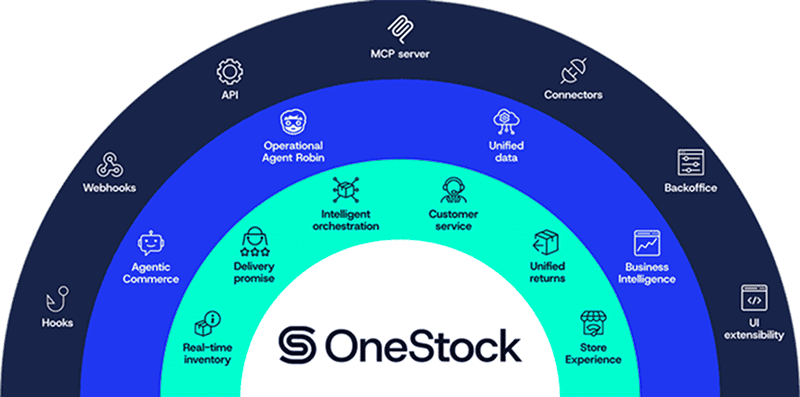
Instead of buying a single, giant software suite that does everything adequately but nothing perfectly, TFG London curated a stack of specialized partners. They utilized OneStock for order management, diverse partners for payments and Point of Sale (POS), and a specialized Customer Data Platform (CDP).
Crucially, Priscott emphasized the shift in mindset from managing “suppliers” to collaborating with “partners.” In an environment built on composable commerce for omni-channel retail, where 14 to 15 different systems must integrate seamlessly with up to 150 data flows, transparency is non-negotiable. Partners must be privy to the strategic vision and challenges to help the retailer succeed.
Deep Dive: Unlocking Inventory with Unified Stock
The engine room of TFG London’s strategy is unified inventory. In the fashion industry, product depth is often limited, and stock is expensive. TFG London uses OneStock to combine all stock pools—warehouse and store inventory—into a single “unified stock” figure available to all channels.
This approach prevents the dreaded “out of stock” message online when the item is actually sitting on a hanger in a store. By using stores to fulfill online orders, TFG London essentially turns every store into a mini-distribution center.
- Increased Availability: Merchandise previously trapped in stores is now visible and sellable online.
- Efficiency: The system uses intelligent orchestration to decide the best location to fulfill an order, minimizing split shipments and distance.
- Store Engagement: Store teams use a user-friendly app to “claim” orders. This gamification drives engagement, as stores compete to fulfill orders during quieter footfall periods, optimizing workforce management.
The results speak for themselves. For their brand Hobbs, implementing this accurate inventory visibility drove cancellation rates down significantly, ensuring that when a customer makes a purchase, the brand keeps its promise.
Deep Dive: Future-Proofing via Composable Commerce for Omni-channel Retail
The decision to adopt a modular architecture was driven by the need for longevity. In a monolithic setup, the business is often beholden to the upgrade cycle of a single vendor. By embracing composable commerce for omni-channel retail, TFG London ensures they can innovate at their own pace.
A prime example of this agility is the launch of “Inside Story,” a homeware brand developed internally. Despite being a startup-sized entity within the group, it was launched on the same enterprise-grade platform as the larger brands. It inherited the power of a £100 million business infrastructure, giving it the best possible tools to succeed from day one.
Furthermore, integrations that used to take months are now achieved in days. Priscott noted that a developer was able to integrate a new POS with their cloud infrastructure in less than a day—a feat deemed impossible a decade ago. This speed allows the business to experiment, fail fast, and find value quickly without heavy sunk costs—a key advantage of composable commerce for omni-channel retail.
Practical Implementation Plan
Based on TFG London’s journey, here is a practical framework for retailers looking to modernize:
- Audit Your Architecture: Identify where legacy monoliths are slowing you down. Focus on integration capabilities rather than just feature lists.
- Break It Down: Do not attempt a “big bang” replacement. Break the transformation into smaller component parts (e.g., start with the OMS or POS) to deliver value regularly.
- Select MACH-Certified Partners: Look for vendors with open APIs and clear documentation to ensure ease of integration.
- Empower Your People: Provide your teams with the “guide rails” and strategic direction, then trust them to find the best technical solutions.
- Unify Your Stock: Prioritize creating a single view of inventory across all channels to unlock immediate revenue and improve customer promises.
- Iterate and Communicate: Maintain constant communication with your tech partners. Share your roadmap and challenges openly to foster a collaborative problem-solving environment.
Next Steps
The future of composable commerce for omni-channel retail lies in precision. TFG London is now working toward a sophisticated “Delivery Promise,” where shipping times are calculated dynamically based on the specific store fulfilling the order. This level of detail—accounting for local store closing times and carrier pickups—represents the next frontier in customer experience.
For retailers aiming to replicate this success, the first step is evaluating how your current order management setup handles inventory visibility. To see how a modern OMS can serve as the cornerstone of your move toward composable commerce for omni-channel retail, explore our approach to omnichannel excellence.
FAQ
What is the main benefit of Composable Commerce for Omni-channel Retail?
The primary benefit is agility and flexibility. By using a modular approach (“best-of-breed” solutions), retailers like TFG London can integrate new technologies faster, swap out components without disrupting the whole system, and adapt quickly to changing market demands.
How does a “Ship from Store” strategy improve profitability?
Ship from Store turns physical retail locations into fulfillment hubs, allowing retailers to sell stock that is sitting on store shelves to online customers. This increases inventory turnover, reduces the need for heavy discounting to clear store stock, and maximizes the full-price sell-through of products.
Why is the “partner vs. supplier” distinction important in tech projects?
In complex digital transformations involving multiple systems, a “supplier” simply delivers a product, whereas a “partner” shares the strategic vision and risk. TFG London emphasizes that open communication and trust with partners allow for faster problem-solving and better alignment with long-term business goals.
What is the MACH Alliance?
The MACH Alliance is a non-profit organization that advocates for an open and best-of-breed enterprise technology ecosystem. The acronym stands for Microservices, API-first, Cloud-native, and Headless—principles that ensure technology is scalable, flexible, and future-proof.
How did TFG London reduce their order cancellation rate?
By implementing OneStock’s Order Management System, TFG London achieved a unified view of all inventory across warehouses and stores. This accuracy ensured that they only sold items they actually had in stock, reducing the cancellation rate for their Hobbs brand from around 2% to less than 0.5%.
What is a “Unified Stock” view?
Unified Stock is the consolidation of all available inventory from every location (warehouses, distribution centers, and physical stores) into a single pool available for sale. This allows merchandisers to make products available to any channel, significantly boosting product availability for the end consumer.
How does composable commerce support internal startups?
Composable commerce allows new brands or internal startups to plug into an existing, robust enterprise infrastructure immediately. TFG London used this to launch their “Inside Story” brand, giving a small startup access to the same powerful tools and logistics as their established £100m+ brands.
What is a “Delivery Promise” in the context of OMS?
A Delivery Promise provides the customer with accurate, real-time information about when they will receive their order before they check out. It takes into account the specific location fulfilling the order (e.g., a store’s closing time or carrier pickup schedule) to offer a reliable delivery window.