
Insights from OneStock on unifying commerce, improving ROI, and mastering the “bricks and clicks” mode
Executive Summary
The retail landscape has shifted dramatically. As noted by Accenture, the industry experienced a “ten-year acceleration” in technology adoption within just the first five months of the pandemic. For retailers operating a “bricks and clicks” model, this rapid evolution presents both a formidable challenge and a massive opportunity. The divide between physical stores and e-commerce is vanishing, and the key to survival lies in unifying these channels through a robust Omnichannel Order Management System (OMS).
In this webinar, Alice (UK Marketing and Business Development Manager) and Joe Till (Sales Director for UK & Nordics) at OneStock discuss the critical role of this technology. They explore how an Omnichannel Order Management System (OMS) unifies inventory visibility across all locations—warehouses, stores, and distribution centers—to unlock significant revenue, improve sustainability, and help retailers compete with pure-play giants like Amazon.
The discussion moves beyond theory into practical application, detailing how an Omnichannel Order Management System (OMS) acts as the brain of modern retail. By intelligently orchestrating orders and turning physical stores into fulfillment hubs, brands can meet heightened consumer expectations for speed and convenience while protecting their margins.
Key Takeaways
- Retail is accelerating: The market has moved forward technologically more in recent months than in the previous decade, driven by COVID-19, Brexit, and supply chain crises.
- Consumer behavior has changed: 43% of UK consumers will now consider buying products online that they previously would have bought in-store.
- Inventory visibility is key: 63% of consumers have experienced stock shortages recently. An Omnichannel Order Management System (OMS) helps combat this by exposing inventory from across the entire network, not just the warehouse.
- Stores are a strategic asset: Unlike Amazon, which has a limited number of distribution centers (approx. 21 in the UK), traditional retailers often have stock much closer to the consumer via their store network.
- Sustainability matters: Optimizing logistics through better order orchestration can reduce transportation costs by roughly 1% and significantly lower carbon emissions.
- ROI is proven: Retailers adopting these technologies have seen e-commerce revenue increases of 15% to 25%, with some reaching up to 300%.
The Challenge: Silos and Stockouts
The core problem facing many retailers today is the existence of operational silos. Typically, e-commerce stock sits in a warehouse, while store stock sits on shelves, and “never the two shall meet.” This fragmentation leads to missed sales and frustrated customers. A robust Omnichannel Order Management System (OMS) is required to break these silos, ensuring that if a warehouse is out of stock, the website doesn’t simply say “sold out” when the item is sitting on a hanger in a store nearby.
Simultaneously, customer expectations are higher than ever. Shoppers demand flexibility—they want to buy online and pick up in-store, reserve items to try on, or have goods shipped to their homes rapidly. If a retailer cannot offer these delivery options, 60% of customers will simply go to a competitor.
What Good Looks Like: Unified Commerce
Success in this new environment is defined by “Unified Commerce.” This goes beyond just having a website and a store; it means creating a single, real-time view of all inventory and customer interactions.
A comprehensive Omnichannel Order Management System (OMS) enables retailers to:
- Never miss a sale: If stock exists anywhere in the business (store, warehouse, or supplier), it is available for sale.
- Optimize fulfillment: Smart logic determines the best location to ship from based on cost, speed, and sustainability.
- Empower store staff: Associates can use technology to fulfill web orders or order out-of-stock items for in-store customers.
The Approach: The Unified Commerce Equation
OneStock simplifies the concept of unified commerce into a clear equation:
Unified Stock + Order Orchestration + Omnichannel Services = Unified Commerce
- Unified Stock: This involves aggregating inventory data from every possible location—distribution centers, physical stores, drop-ship vendors, and third-party logistics providers.
- Order Orchestration: This is the logic layer. The Omnichannel Order Management System (OMS) uses business rules to decide how to fulfill an order. For example, if a warehouse is out of stock, the system automatically routes the order to the nearest store that has the item, triggering a <a href=”https://www.onestock-retail.com/solutions/ship-from-store/“>ship from store</a> process.
- Omnichannel Services: These are the customer-facing benefits, such as Click and Collect, Reserve and Collect, and In-Store Returns.
Deep Dive: Financial ROI and Performance
Implementing an Omnichannel Order Management System (OMS) is not just an IT project; it is a revenue generator. The webinar highlighted several compelling statistics regarding the return on investment:
- E-commerce Growth: Activating ship-from-store capabilities typically results in a 15% to 25% increase in website revenue. OneStock has seen client uplifts as high as 300%.
- Store Revenue: Stores acting as fulfillment centers or utilizing “endless aisle” ordering (selling stock they don’t physically have) see revenue increases of 3% to 8%.
- Upsell Opportunities: When customers come into the store for Reserve and Collect </a> or Click and Collect, there is a 10% to 20% cross-sell rate.
- Returns conversion: Customers returning online items in-store generate an additional sales uplift of nearly 30% during their visit.
Deep Dive: Success Stories
Real-world examples illustrate the power of this technology:
- Ted Baker: This leading fashion brand utilized an Omnichannel Order Management System (OMS) to enable ship-from-store and Click and Collect. They now process over 30,000 orders per month via stores, representing 13% of their total UK e-commerce turnover. In a single day, stores shipped over 4,000 orders.
- Pets at Home: Utilizing intelligent orchestration, they launched a 1-hour Click and Collect service. Orders are often ready in 30 minutes. Since going live, they have taken over 1 million orders through this channel, representing 20% of their online orders.
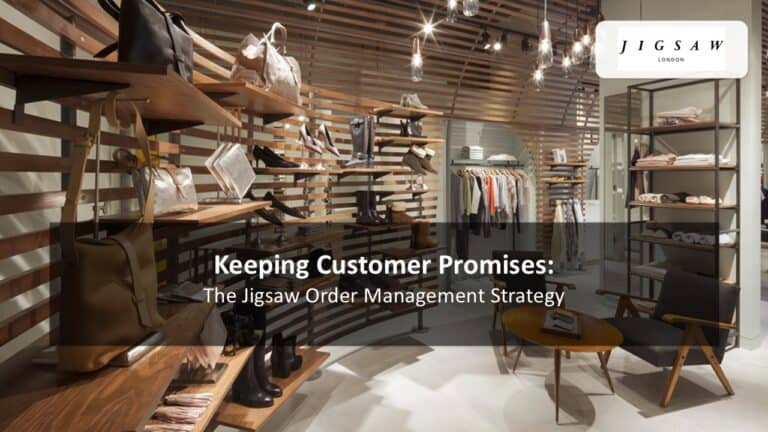
- Jigsaw: Facing the need for speed, Jigsaw implemented their solution in just 4.5 months. The result was a 32% monthly increase in online sales.
Practical Implementation
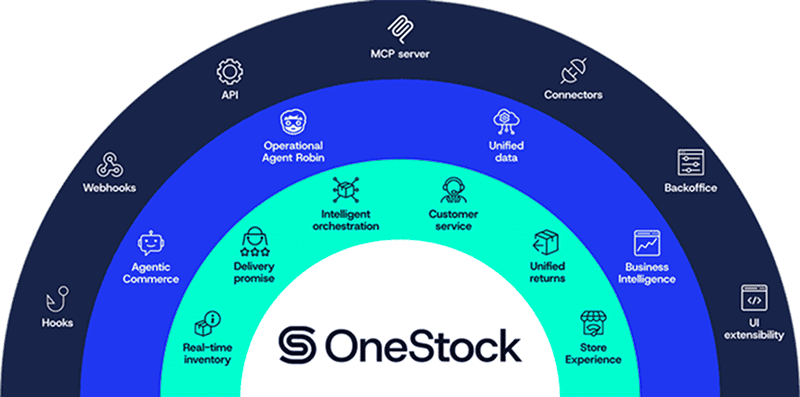
Implementing an Omnichannel Order Management System (OMS) does not require ripping out existing systems. The solution sits in the middle of the tech stack.
- Inputs: It connects to sales endpoints (websites, marketplaces, mobile apps) and stock locations (warehouses, stores, ERPs).
- The Brain: The OMS aggregates this data to create a unified inventory view.
- Outputs: It pushes accurate stock levels back to the e-commerce platforms and sends fulfillment instructions to the appropriate logistics partners or store associates.
For store staff, the interface is crucial. Staff use intuitive apps on tablets to receive pick-lists for web orders, print labels, and manage carrier handovers. This simplicity ensures that store teams can handle e-commerce volume without disrupting their primary duty of serving in-store customers.
Next Steps
The distinction between “online” and “offline” retail is obsolete. To thrive, retailers must leverage their entire asset base—especially their stores.
If you are considering how to better utilize your inventory and improve your customer promise regarding delivery and availability, evaluating your current order management capabilities is the first step.
- Review your inventory data: Are your online and offline stocks siloed?
- Analyze your lost sales: How often do you mark items as “out of stock” online when they are actually available in your network?
- Consider the store role: Could your locations serve as mini-distribution centers?
For a broader understanding of how these systems fit into the global market, you can read more about Order Management Systems here.
Frequently Asked Questions (FAQ)
Can unified stock be purchased as a standalone service if we already have an OMS?
Yes, it is technically possible. While it depends on the complexity of your current tech stack, many retailers operate with multiple layers of technology. Solutions like OneStock can sit on top of existing systems to provide better customer stock visibility without replacing the entire legacy infrastructure.
How do retailers pay for the retail part of e-commerce sales (Ship from Store)?
This varies by retailer, but successful implementations often attribute the sale (or a portion of it) to the fulfilling store to incentivize staff. Some retailers use “competitive allocation,” where stores compete to claim orders, ensuring the fastest fulfillment for the customer while motivating store teams.
Does the OMS manage the restocking of inventory?
Generally, no. Restocking and replenishment are typically handled by demand planning or merchandising software within an ERP. An Omnichannel Order Management System (OMS) focuses on making existing stock visible and sellable across channels, rather than predicting future inventory purchase needs.
Do you have exact stock visibility in stores in real-time?
The system usually takes a stock file at the start of the day and updates it with “deltas” (changes) as sales occur. However, best practice involves building in a “safety buffer.” This accounts for items that might be in a customer’s physical basket in-store or being tried on, ensuring the system doesn’t oversell inventory that isn’t truly available.
Can resellers or distributors without their own stores use Ship from Store?
Yes, because modern SaaS solutions are browser-based. As long as the distributor or third-party partner has internet access and a printer, they can access the interface to accept orders, pick, pack, and dispatch goods just like a branded retail store.
Is it possible to display delivery information directly on product pages?
Yes, utilizing a delivery promise module allows retailers to display accurate delivery timeframes and options (including green/eco-friendly choices) on the Product Detail Page (PDP). This helps manage customer expectations and can influence conversion by showing the most efficient or sustainable delivery methods upfront.
How does the “Order in Store” service work?
Retail associates use a tablet (like an iPad) to access the full web and store inventory. If a customer wants a size or color not available on the shelf, the associate can order it via the tablet for home delivery or order in store for collection. This prevents the customer from leaving empty-handed and buying from a competitor.
Does the system connect to existing loyalty programs?
Yes, the platform can integrate with existing CRM and loyalty systems. This allows for a more personalized experience, such as recognizing a VIP customer during an in-store appointment or applying loyalty benefits to omnichannel orders.