Introduction
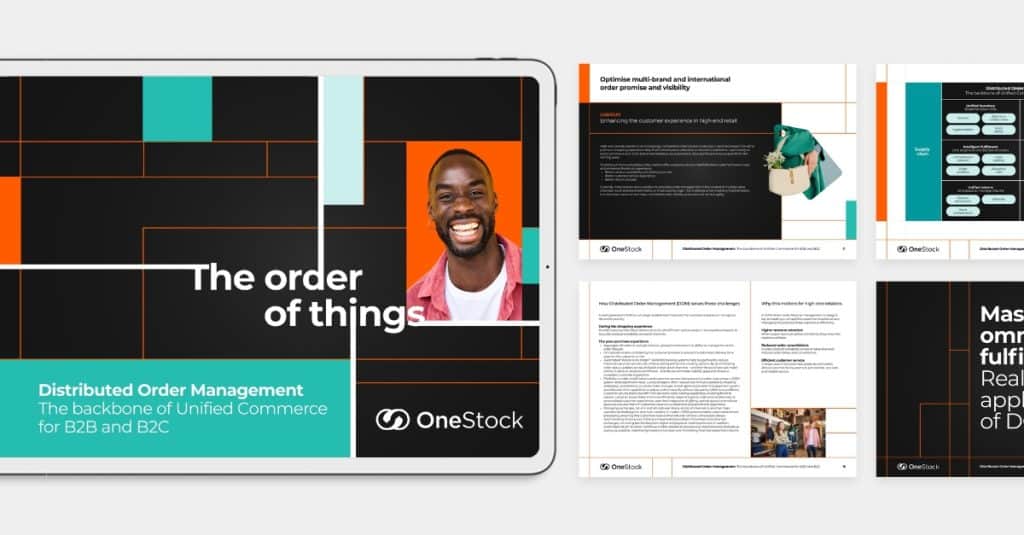
This white paper explores the critical role of Distributed Order Management (DOM) in powering unified commerce strategies for both B2B and B2C businesses. It examines how omnichannel maturity has accelerated while operational complexity has followed, with a significant percentage of consumers encountering out-of-stocks, leading to inconsistent shopping experiences.
The paper highlights the difficulty brands face in providing visibility across sales and fulfilment channels, and explains how unified commerce differs from omnichannel commerce by ensuring every part of the business operates from a single, shared system of record.
Achieving unified commerce requires a DOM solution that can centralise inventory visibility, dynamically route orders and deliver an accurate customer promise every time. The paper also addresses how B2B businesses face growing complexity in order management and why forward-looking organizations are investing in cloud-native, composable, and best-of-breed Order Management Systems (OMS).
In this white paper, we’ll explore:
- Why unified commerce hinges on real-time data and operational consistency
- How legacy systems fall short when it comes to inventory, fulfilment and order visibility
The paper also shares expert insights from Karthik Marudur, chief strategist and industry expert, who outlines the strategic and operational advantages for retailers — especially those serving both B2C and B2B segments — of adopting a unified commerce strategy powered by a single OMS.
Finally, two real-world scenarios are presented:
- A complex B2B distribution network where fulfilment agility and inventory allocation are mission-critical
- A high-end retail environment where customer service, real-time promises and order lifecycle visibility drive loyalty
These use cases show that while the challenges may be different, the path forward is common. Brands that unify their order logic, visibility and execution will be able to deliver better experiences, operate more profitably and build a more scalable commerce foundation.
1 GT Nexus, The Global Out-of-Stock Crisis; 2 IFOP, Consumer Expectations of Delivery
Beyond omnichannel: Unified commerce, the foundation that powers every enterprise retail and B2B business
Omnichannel commerce has been a major step forward in improving the customer experience, giving shoppers the ability to browse, buy and return across multiple channels. But delivering a consistently great experience across these channels requires more than just connecting touchpoints. It requires a fully aligned operational infrastructure behind the scenes.
Unified commerce builds on the omnichannel ambition by creating a single, intelligent platform for managing every aspect of the commerce operation. Rather than connecting disparate systems, it brings together all core functions – inventory, customer data, product information, logistics and order fulfilment – on a single foundation. This ensures consistency not only in what the customer sees, but also in how each order is processed, fulfilled and supported.
Consistent experience
At the heart of this approach is order management. A Distributed Order Management solution does more than just route orders. It serves as the control centre of a unified commerce architecture – connecting every channel to every fulfilment node, in real time, with complete transparency.
The commerce experience is consistent across all channels
Product data, such as pricing, descriptions and availability, is uniform and accurate wherever the customer engages. Promotions are the same online, in-store and through marketplaces, creating a trusted and familiar brand experience.
Inventory is centralised and smart
Real-time inventory visibility across all warehouses, stores and partners enables brands to allocate inventory with precision. This improves availability, supports flexible delivery options and helps reduce waste or overstocking.
Customer profiles are accessible and reliable
Whether a customer is shopping on an e-commerce website, in a retail store, or through a B2B portal, they benefit from the same loyalty rewards, account history and personalised service. Every interaction is informed by a single view of the customer.
Order fulfilment is driven by a single orchestration engine
All orders, regardless of origin, follow the same fulfilment logic and service standards. This simplifies operations, increases agility and ensures that customer promises – in terms of timing, availability and service – are consistently delivered.
From fragmented systems to fully connected commerce
Unified commerce gives brands a powerful operational foundation to scale with confidence, adapt quickly and deliver consistently across all channels. It moves the organisation beyond coordination to true integration, where all commercial logic, systems and touchpoints operate from a single source of truth.
Rather than maintaining separate rules engines, pricing models or inventory pools for each channel, brands benefit from a common platform that supports global execution and local flexibility.
Promotional strategies are centrally managed and easily tailored by region, customer segment or business model. Loyalty data becomes a strategic enabler, allowing brands to personalise experiences with precision in both B2B and B2C environments. Product and pricing decisions are consistent across the business, yet adaptable to local currencies, regulatory requirements and market dynamics.
Meanwhile, inventory is intelligently allocated across channels based on demand forecasts, live sales data, customer priority and fulfilment strategy. Whether fulfilling a retail purchase, a marketplace order, or a high-volume B2B shipment, every decision supports both customer satisfaction and operational efficiency.
Unified commerce fails without a modern DOM. Here’s why.
To realise the full potential of unified commerce, brands need more than a shared vision or centralised data – they need a system that can execute in real time across every touchpoint. This is where Distributed Order Management (DOM) comes in.
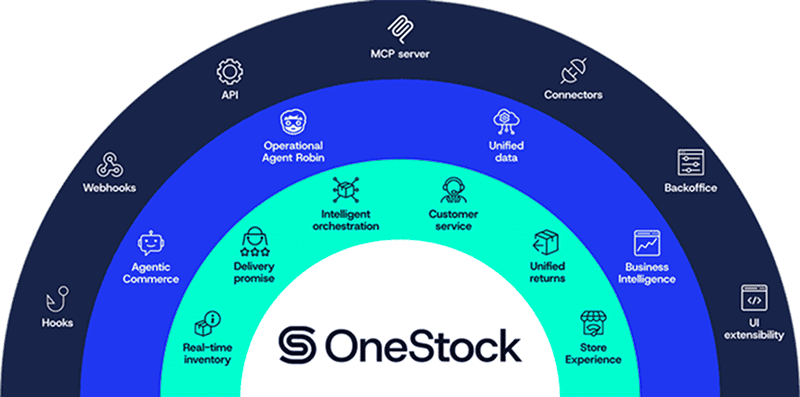
DOM is the operational engine that brings unified commerce to life. Much more than just routing orders, it is the central intelligence layer that links inventory, fulfilment, logistics and customer promise across all channels. By continuously analysing demand, availability and business rules, DOM ensures that every order is fulfilled from the most strategic location, at the right time and with complete visibility.
This orchestration is what makes unified commerce actionable. It enables brands to offer accurate delivery options at checkout, dynamically manage inventory across warehouses and stores, and support a positive post-purchase experience. From a single order placed on a DTC website to a complex multi-line B2B transaction, DOM ensures that each step is handled with precision and efficiency.
In short: Unified commerce defines the strategy and DOM delivers it. It is the technology layer that translates the promise of a unified customer experience into everyday operational excellence.
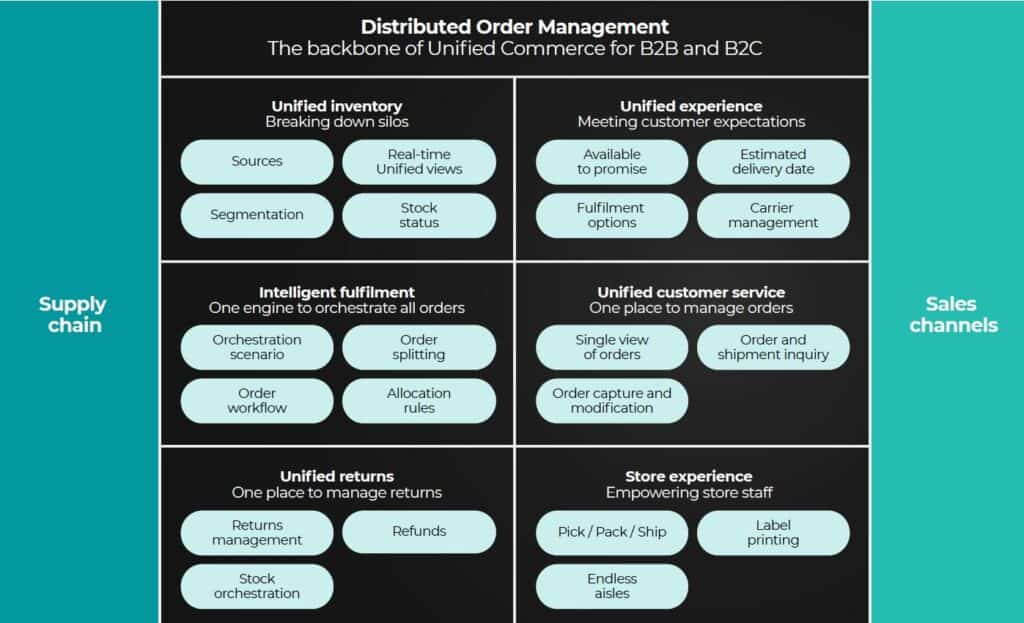
Distributed Order Management
The backbone of Unified Commerce for B2B and B2C
The strategic advantage to adopt a single OMS for B2B and B2C

Today’s B2B businesses face growing complexity in order management, yet many still rely on outdated systems—ranging from traditional ERPs and custom-built tools to manual workarounds like spreadsheets. These legacy solutions struggle to meet the rising expectations of today’s digitally savvy B2B customers.
Forward-looking organizations are investing in cloud-native, composable, and best-of-breed Order Management Systems (OMS) that drive agility and growth. These modern OMS solutions can handle B2B specific requirements like:
Connecting multiple sales channels to the OMS
EDI, e-mail, B2B commerce, Sales rep tool
Configuring inventory availability across multiple sales channels
- Managing different type of quantities for inventory: palette, carton, linear meter, weight
- Segmenting inventory, ensuring it is appropriately allocated based on your business requirements
- Providing real-time inventory views to any channel, considering on hand, in movement and future inventory
Automating order orchestration
- Processing large orders with 100s or even 1000s of order lines
- Considering the promise in the allocation process, to ensure the estimated time
- Managing complex fulfilment scenarios: orders with multiple delivery addresses, order allocation per order line, orchestration per wave, consolidation
- Being flexible in terms of inventory and order workflows to accommodate changes like: ETA changes on incoming Purchase Order, changes in delivery date needs, buyer approval etc.
Delivering personalized experience
- Providing a tailored promise with available delivery options exclusively for specific customer segments
- Manage inventory availability and allocation rules specific to customers – Fill or kill, requested delivery date, min fill rate % etc
- Prioritizing certain customers over others during the order allocation process
- Allocating orders for certain customers to specific stock location depending on items attributes (like lot number, country of origin)
Centralizing order management
- Managing B2B specificities on order management: displaying large quantities of orders lines, supporting large or bulk order modifications / cancellations
- Real time customer communications for critical changes like delivery date
B2B order management includes managing and fulfilling the orders for:
- Multi-channel retail brands – from their wholesale customers
- Manufacturers, distributors and CPG companies – from their business customers
For retailers operating across both B2C and B2B channels, adopting a unified commerce strategy powered by a single OMS brings several strategic and operational advantages:
Enhanced Inventory Visibility
A centralized OMS provides real-time, enterprise-wide inventory visibility. This enables more accurate fulfillment promises and reduces stockouts or overstocking scenarios.
Increased Inventory Exposure
Shared inventory pools between channels allow you to expose the same stock to both B2C and B2B buyers, increasing sell-through rates and reducing excess inventory.
Reusable Services and Architecture
By building order and inventory services on a common architecture, retailers can leverage modular, reusable components—accelerating time-to-market for new features and reducing duplication of effort.
Lower Total Cost of Ownership (TCO)
Maintaining a single OMS platform reduces infrastructure, integration, and support costs compared to managing separate systems for each channel.
Unified Data and Real-Time Control Tower
A single data repository enables advanced analytics, real-time performance dashboards, and centralized exception handling. This acts as a “control tower” to proactively manage supply chain, customer experience, and service levels.
Enabling smart order orchestration in a B2B distribution network
CONTEXT. The complexity of automotive parts fulfilment
Automotive parts distribution is one of the most operationally complex B2B environments. Unlike traditional retail, where delivery speed is important but not always critical, in the automotive industry, every order is time-sensitive. A delayed part doesn’t just inconvenience a customer, it immobilises vehicles, disrupts workshop schedules, and impacts revenue for garages, dealerships and resellers.
To meet this demand, distributors operate within multi-node fulfilment networks, leveraging a mix of:
- Regional and national warehouses, each holding different stock levels
- Supplier dropshipping, allowing direct fulfilment from manufacturers when internal stock is insufficient
- Third-party logistics (3PL) networks, offering additional distribution capabilities
While this structure provides flexibility, it also introduces significant operational challenges, particularly in inventory visibility, order allocation and logistics execution.
Key challenges in automotive parts fulfilment
Fragmented inventory visibility across the network
Inventory is dispersed across warehouses, supplier stock pools, franchise-owned locations and retail hubs. Inventory levels are not synchronised in real time, leading to inaccurate inventory availability across sales channels. Garages, dealers and distributors rely on instant stock lookup tools. If a product isn’t available in time or if an order cannot be fulfilled, customers will source the part from a competitor.
Multiple types of sales channels with limited transparency & agility
Multiple sources of sales channels to manage, including e-commerce, EDI, punch-out, sales tools and mail. Traditional ERP-driven fulfilment was designed for batch processing, not to provide a real-time customer promise. API response times are critical – garages, dealers and resellers perform live stock checks before placing orders, and if the system can’t instantly provide an accurate delivery promise for their chosen fulfilment method, the order is lost to a competitor.
Logistics complexity & delivery route optimisation
Unlike standard B2B fulfilment, parts distribution follows fixed logistics routes, where orders must align with pre-defined transport schedules rather than simple shipping preferences. Orders must be assigned not only based on stock proximity but also on logistical feasibility, ensuring they can be delivered within tight turnaround times.
Missed revenue opportunities due to inefficient order allocation
High-priority orders should be fast-tracked, but without intelligent automation, many orders are processed without considering customer tiering or urgency. Inventory is often reserved in the wrong locations, leading to unnecessary inter-warehouse transfers, increased costs and delayed deliveries.
How DOM systems transform automotive parts fulfilment
A Distributed Order Management (DOM) system provides an actionable, high-level solution to these critical challenges, ensuring every order is allocated, fulfilled and delivered in the most efficient way possible, while enabling customer service to manage all orders through a single solution.
Actionable steps for B2B automotive parts distributors:
Unify inventory across all fulfilment nodes
- Aggregate real-time inventory data from warehouses, suppliers, 3PL partners and franchise-owned stock pools into a single system of truth.
- Create multiple views of inventory by integrating existing available stock and future stock. Each view should be associated with a specific channel or group of channels, enabling precise definition of the distribution strategy.
- Ensure that garages and resellers can only see and order available stock, preventing miscommunication and backorders.
- Implement live customer promise calculations, ensuring customers always get multiple delivery options with an accurate fulfilment lead time for each one.
Implement intelligent order routing
- Choose to orchestrate per order or orchestrate each order line separately. The order line strategy enables prioritisation of specific inventory locations without considering the overall content, thereby optimising delivery times.
- Dynamically assign orders not just based on proximity, but considering logistics feasibility and other criteria that ensures each order is routed in the most effective way to guarantee the customer promise.
- Enable multi-criteria prioritisation, allowing certain customers (dealerships, preferred garages) to be allocated parts faster based on contractual SLAs and urgency levels.
Optimise logistics execution
- Choose to orchestrate immediately to ensure delivery time, or to orchestrate per wave to optimise logistic costs by aggregating multiple orders in a single delivery, or to prioritise orchestration of premium customer orders.
- Activate intelligent fulfilment, consolidating all items in an order at a single stock location before shipping to the customer to reduce transport costs.
- Integrate carrier networks and transport planning tools directly into the DOM system, ensuring every order is dispatched based on real-world transport constraints rather than generic shipping rules.
Ensure seamless ERP integration without system overhaul
- A DOM system sits alongside existing ERP systems, reducing reliance on expensive ERP customisation while modernising the shopping experience.
- The API-first architecture ensures that garages and dealerships receive instant, accurate stock responses, reducing lost sales due to slow processing times.
- Enable a scalable fulfilment model where new distribution centres, suppliers and warehouses can be onboarded seamlessly.
Leverage a single repository for all orders
- Ensure the order lifecycle is managed by a unified solution, enabling quick responses to “Where is my order?” enquiries.
- Enable customer service to modify orders dynamically, improving flexibility without increasing operational complexity.
- Solve orchestration issues by automatically or manually reorchestrating orders.
Why this matters for automotive parts distributors
A DOM-driven order orchestration strategy does more than just streamline fulfilment – it creates a competitive advantage in an industry where reliability, speed and cost efficiency determine success.
Higher revenue retention
When customers trust delivery timelines, they return for repeat purchases.
Lower operational costs
Reduced warehouse transfers, optimised logistics routing and better stock allocation lower overall fulfilment expenses.
Greater supply chain agility
The ability to dynamically adjust order fulfilment ensures resilience against demand spikes, transport disruptions and stock fluctuations.
Efficient customer service
Provide service teams with a single view of all customer orders.
For distributors in the automotive parts industry, implementing Distributed Order Management is an operational necessity to meet growing customer expectations and thrive in a competitive landscape.
Optimise multi-brand and international order promise and visibility
CONTEXT. Enhancing the customer experience in high-end retail
High-end brands operate in an increasingly competitive international landscape. Customers expect the same premium shopping experience they find in boutiques to extend to e-commerce platforms – particularly as social commerce and multi-brand marketplaces are expected to drive significant revenue growth for the coming years.
To stand out from competitors, they need to offer a superior service that fulfils their customer’s every need and enhances the brand experience:
- Better product availability and delivery promise
- Better customer service experience
- Better returns process
Currently, many brands lack a solution to centralise order management in the context of multiple sales channels, multi-brand environments, or multi-country logic. The challenge is not inventory fragmentation, but real-time customer promises, centralised order visibility and customer service agility.
Key challenges for high-end brands
Inconsistent and unreliable customer promises
Ensuring real-time accuracy in product availability across multiple sales channels is crucial to prevent order cancellations. Estimated Delivery Time (EDT) accuracy is critical to customer satisfaction, yet many brands struggle to integrate real-time logistics data.
Limited real-time order visibility across channels
Shoppers expect to be able to modify and track their orders from purchase to delivery, but many retailers struggle to maintain a real-time view of customer orders. “Where is my order?” (WISMO) requests represent a significant portion of customer service calls due to delayed or inaccurate updates.
Lack of flexibility for customer service teams to update orders
High-value customers frequently request order cancellations and last-minute changes, but legacy solutions lack real-time modification capabilities. Gifts, samples and promotions are critical to retaining premium customers, but most systems do not allow for seamless post-purchase customization.
Inefficient returns & refunds
Luxury shoppers expect real-time return status updates and instant refunds, but many brands still rely on slow, manual reconciliation processes.
How Distributed Order Management (DOM) solves these challenges
A next-generation DOM is a strategic enabler that improves the customer experience throughout the entire journey:
During the shopping experience
Provide a precise estimated delivery time for all fulfilment options early in the experience based on accurate product availability across all channels.
The post-purchase experience
- Aggregate all orders in a single solution, giving brand teams the ability to manage the entire order lifecycle.
- Orchestrate orders considering the customer promise to ensure the estimated delivery time given to the customer is met.
- Automated “Where Is My Order?” (WISMO) tracking systems help to significantly reduce inbound customer service calls while enabling self-service tracking options.
- Flexibility in order modifications and customer service interactions is another area where a DOM system adds significant value. Luxury shoppers often request last-minute updates to shipping addresses, cancellations, or partial order changes.
- Customer service teams benefit from dynamic order editing capabilities, enabling them to resolve customer issues faster and more efficiently.
- Managing exchanges, returns and refunds seamlessly across all channels. A modern DOM system enables automated refund processing, ensuring that customers receive their refunds without unnecessary delays.
- Synchronising in-store and online purchase histories enables frictionless cross-channel exchanges. Automated return-to-stock workflows enable retailers to process and resell returned products as quickly as possible.
Why this matters for high-end retailers
A DOM-driven order lifecycle management strategy is key to creating a competitive customer experience and managing the post-purchase experience efficiently.
Higher revenue retention
When customers trust delivery timelines, they return for repeat purchases.
Reduced order cancellations
Accurate product availability across all sales channels reduces order delays and cancellations.
Efficient customer service
A single view of all customers, products and orders allows customer-facing teams to provide fast, accurate and reliable service.
Conclusion
The case studies explored in this white paper illustrate a fundamental truth: the complexity of modern fulfilment cannot be managed with legacy systems alone. Traditional ERP systems were designed for single-channel, batch-processed fulfilment, where inventory was static and sourcing was linear.
To unlock true fulfilment agility, precision and profitability, brands must embrace the next generation of DOM that includes:
- API-first and event-driven orchestration, enabling real-time decision-making across complex fulfilment networks
- Real-time, dynamic inventory management that ensures every unit of stock is fully optimised across all fulfilment locations
- Predictive delivery promise capabilities, adjusting fulfilment decisions proactively rather than reactively
- Advanced business rules and AI-driven recommendations, ensuring every order is fulfilled at the lowest cost with the highest service level
- Reverse orchestration, dynamically adjusting fulfilment flows based on demand fluctuations, customer preferences and operational constraints
Retailers and B2B distributors that fail to evolve their DOM capabilities will continue to struggle with lost revenue, operational inefficiencies and eroding customer trust. Those that invest in the next generation of order orchestration will gain a lasting competitive advantage, ensuring that every order, across every channel, is fulfilled with precision, efficiency and profitability.
The evolution of order management is the only way forward for brands looking to scale, optimise operations and win in a hyper-connected commerce landscape.