Enterprise commerce has become harder to manage. Customers move between websites, apps, marketplaces, and stores, but still expect accurate stock information, a choice of fulfillment options, and a consistent experience after they buy. Retailers have to keep pace without rebuilding the underlying technology every time they add a channel or introduce a new service.
Getting this to work requires a great deal of behind-the-scenes coordination. Details regarding orders, inventory, fulfillment, and customers must be shared among the commerce platform, the order management and warehouse systems, the stores, and the logistics partners.
The more systems involved, the more dependencies there are. Consequently, introducing a new element may require altering several other parts of the arrangement.
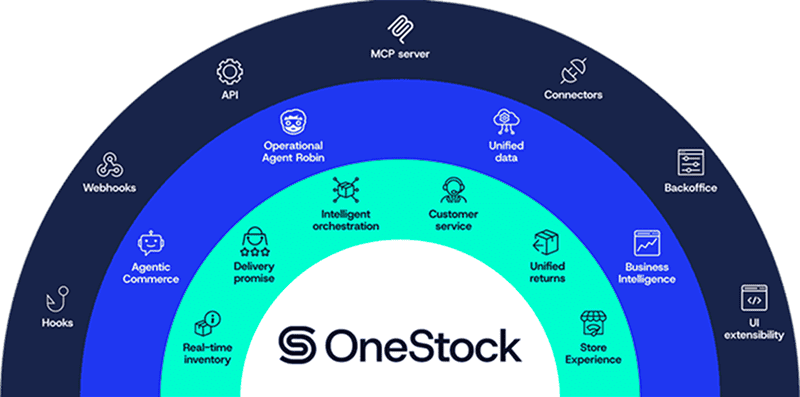
Composable commerce breaks the various functions of commerce down into individual components. Each of these capabilities can be added, modified, or scaled without altering the rest of the platform.
This shift is important for enterprise order management. As commerce ecosystems become more modular, the order management system (OMS) serves as the orchestration engine that connects orders, real-time inventory, routing, store fulfillment, and customer-facing channels.
For CIOs and IT managers, the challenge is just as much about operations as it is about architecture. It involves improving how commerce operations work together while maintaining the agility needed to respond to changing business and customer requirements.
What role does composable commerce play in enterprise order management? It allows companies to assemble their order management from separate components rather than purchasing a single platform, with the OMS holding it all together. Modularity is the means, not the result: what matters is the lower cost and risk of changing any one capability.
What Is Composable Commerce in Enterprise Order Management?
In a composable commerce environment, the technology stack consists of individual components rather than a single platform that controls all aspects. Each component can be developed, deployed, scaled, or replaced without requiring changes to any other part of the stack. The various systems exchange data and work together through APIs.
This goes beyond what is known as headless commerce.
In headless commerce, the customer-facing experience is separated from the commerce platform itself, whereas composable commerce divides the system further. Different systems can be used to manage inventory, order orchestration, store fulfillment, and returns. Businesses are then in a position to select the appropriate technology for each function rather than being restricted by the capabilities of a single platform.
When it comes to enterprise order management, the OMS need not function as a stand-alone, all-encompassing system. It can interact with inventory platforms, fulfillment services, ERP systems, storefronts, carriers, and other technologies via defined interfaces.
Broad adoption has already occurred at the enterprise level. The MACH Alliance’s 2025 Global Annual Research, a survey of senior IT decision-makers at large enterprises, found that 87% of organizations had widely implemented MACH technologies. The gap between adopting composable technology and operating a mature composable environment is where most of the practical difficulty lies.
MACH (Microservices, API-first, Cloud-native, and Headless) provides one technical framework that can support this model. It acts as an enabler rather than the objective. The strategic value lies in creating an order management environment that can adapt as business requirements change.
Why the OMS Is the Core Engine of a Composable Commerce Ecosystem
Retailers gain more flexibility when they use separate components, although the components still need to function together. For example, a large retailer might take orders through several storefronts, keep stock in various locations, and work with a mix of fulfillment and logistics partners.
The OMS brings these components together. It takes the order, checks the available stock, and then determines where it should be sent for fulfillment. It also monitors the order as it progresses, relaying updates between the customer-facing channel and the systems responsible for executing the order.
This gives the OMS a broader role in a composable environment. It links sales channels to the ERP, WMS, and other inventory or fulfillment systems without requiring direct connections between all platforms. If one element of the technology stack changes, the OMS helps to reduce the impact on the entire order process.
Consider an enterprise selling through ecommerce, physical stores, marketplaces, and B2B wholesale portals. Each channel may have a different customer experience, but orders can still pass through a shared management layer that applies consistent inventory, routing, and fulfillment rules.
The OMS therefore provides operational unity without requiring every commerce capability to come from the same platform or vendor. For enterprises, the objective is to ensure best-of-breed capabilities remain interoperable and operate as a unified environment.
By keeping order, inventory, and fulfillment data flowing between independently evolving systems, the OMS helps turn composability from an architectural model into an operational commerce model.
Why the Order Record Cannot Be Decomposed
Most of the features in a composable stack can be swapped out. Inventory, routing, returns, and notifications all have well-defined inputs and outputs, which is why they can be replaced without affecting anything else.
The order record is different. Every component in the ecosystem needs to agree on the state of an order, because a storefront showing “dispatched,” a warehouse acting on “allocated,” and a returns service expecting “delivered” are all reading the same fact. If two systems hold their own version of that state, the ecosystem has no way to reconcile them, and the customer sees the difference before anyone else does.
That’s why the OMS is the engine of a composable architecture, not just another module. It coordinates the other components, but more importantly, it owns the order’s lifecycle and the set of statuses every system relies on, such as “allocated,” “dispatched” and “delivered.” These are the one part of the architecture that has to stay in a single place: split them across systems, and the ecosystem stops working.
Composable vs Monolithic Order Management
Composable and monolithic order management differ chiefly in how their capabilities fit together. In a monolithic setup, order capture, inventory, routing, fulfillment, and returns are usually built into the same wider platform.
Keeping all the features in one place makes them easier to own. The drawback is that changing one part may mean changing or testing a great deal of the platform. In a composable arrangement, these capabilities are kept more distinct, allowing a retailer to add or replace a specialist service without reworking the entire order management system.
This affects how the two models cope with change:
| Monolithic | Composable | |
|---|---|---|
| Changing one capability | Requires a platform release cycle | Contained to the service and its contract |
| Scaling | Whole platform scales together | Services scale to their own workload |
| Technology selection | Decided at platform level | Decided at capability level |
| Upgrade path | Full-platform transformation | Incremental replacement |
| Vendor roadmap | Functionality follows one suite | Specialist capabilities added as needed |
| Integration ownership | Largely vendor-owned | Largely enterprise-owned |
This doesn’t mean that every OMS function should be turned into a separate service. Many companies aim for partial composability, keeping capabilities that work well while modernizing areas where greater flexibility and capacity are beneficial.
The Main Benefits of a Composable OMS
When the MACH Alliance asked enterprise IT leaders what benefits implementing MACH had delivered, the three most common answers were a better customer experience (55%), improved systems and process integration (54%), and greater organizational agility (50%).
All three are order management outcomes.
Consistent availability and delivery information improves the customer experience. Integration depends on order, inventory, and fulfillment data moving between systems without human involvement. Agility means changing routing or fulfillment rules without a platform project.
Greater Flexibility & Faster Change
One of the main benefits of composable order management is that it enables changes to specific capabilities without interrupting the entire commerce stack.
For example, an enterprise introducing a new fulfillment model, carrier, channel, or unified returns capability can integrate that functionality through APIs rather than redesigning its core platform. This makes the OMS more adaptable to changing operational requirements.
Independent Scalability
Enterprise order volumes may fluctuate considerably, particularly during promotions and seasonal peaks. In a modular environment, services can be scaled according to their individual demand. Order routing, inventory checks, and customer notifications do not necessarily need the same capacity at the same time.
This can provide a more targeted approach to performance and scaling than treating the OMS as a single, indivisible system.
Scaling services independently does not remove the peak constraint, however. An order path that touches inventory, allocation, routing, and the carrier makes several network calls where a monolith made none, and the path is only as fast as its slowest hop. Under Black Friday load, a sourcing decision that takes milliseconds in memory can take considerably longer across services, and the failure mode is a timeout rather than a slow response.
Composable environments handle this with caching at the boundaries, asynchronous handling of anything not needed to confirm the order, and defined behavior when a dependency does not answer in time. Those decisions must be made during design, because peak is when they are tested, and peak is the worst moment to discover them.
Faster Innovation
Composable architecture also changes how enterprises deploy new capabilities. When functionality is separated by well-defined interfaces, teams can work on different areas with fewer dependencies across release cycles. This allows new services to be introduced while existing components continue to operate.
The benefit goes beyond deployment speed. It allows order management to evolve as customer expectations, fulfillment models, and channel strategies change.
The constraint moves rather than disappearing. Building becomes easier when teams own separate services, but verification gets harder, because a change to one service can break a path that crosses five others, and no single team owns that path end-to-end.
Contract testing between services, environments that behave like production, and explicit ownership of the end-to-end order journey are what keep release cycles fast after the first year. Programs that skip them usually see their velocity decline once the number of independent services exceeds a handful.
Greater Technology Choice
With composable commerce, companies can decrease their reliance on a single platform by choosing specialized services to meet particular needs. Vendor lock-in does not disappear completely, since dependencies may still arise with proprietary APIs, data models, or individual services. However, businesses have more opportunity to make technology decisions at the level of individual capabilities rather than for the entire platform.
What Makes an Enterprise OMS Composable?
Several architectural concepts help enable this modular operating model.
APIs & Interoperability
APIs provide the connective tissue between the OMS and the wider commerce ecosystem. They enable order information to flow across storefronts, inventory platforms, ERP systems, fulfillment services, carriers, and customer-facing applications.
Interoperability should therefore be considered just as important as modularity. As more components are added or reconfigured, enterprises need to ensure that systems can exchange data reliably without creating a growing web of difficult-to-manage point-to-point integrations.
For the OMS, this means keeping consistent connections with inventory, ERP, warehouse, fulfillment, and customer-facing systems, while keeping order and inventory data synchronized as individual technologies change or are replaced. Integration platforms such as iPaaS can support this by centralizing and managing data flows between components, rather than relying on individual point-to-point connections.
API-first design makes integration a fundamental part of a capability rather than an additional layer added later. At enterprise scale, this also makes API governance important. Versioning, documentation, testing, and change management help prevent individual service changes from disrupting dependent systems.
Microservices & Packaged Business Capabilities
Microservices allow functionality to be separated into independently deployable services. Packaged Business Capabilities (PBCs) group related functionality into business-oriented components that can be assembled into a wider commerce architecture.
For order management, some seams hold better than others. Inventory, routing, returns, and notifications separate cleanly, because each has defined inputs and outputs and can be reasoned about on its own.
Order state, allocation, and the delivery promise do not, because those decisions have to be made together and against the same position at the same moment. Splitting them would distribute a decision that needs to remain atomic.
The practical rule is to decompose where a capability can fail or change independently without leaving an order in an unresolvable state. Anything that cannot pass that test belongs inside the orchestration layer rather than beside it.
Event-Driven Architecture
Order management involves continuous changes: an order is placed, inventory is reserved, payment is confirmed, fulfillment begins, a parcel is dispatched, or an exception occurs.
Event-driven architecture permits services to respond to these changes without requiring every system to be tightly connected. This helps coordinate distributed components while preserving their independence.
Data Ownership & Canonical Models
Modularity fails on data before it fails on architecture. Every component holds a view of the order, the customer, and the stock position, and those views drift unless ownership is explicit.
Three decisions matter most:
- Which system owns the order record and its status vocabulary.
- Where the authoritative inventory position lives and how often it refreshes.
- How each component maps its own model to the shared one at the boundary.
Getting this wrong yields the worst outcome for composability: a distributed architecture with no agreed-upon version of the truth. Defining the canonical order and inventory models before adding components is cheaper than reconciling them afterward.
How Composability Supports the Enterprise Order Lifecycle
The role of composability becomes clearer when seen through the lens of actual order operations.
Inventory Visibility
Enterprise inventory may be distributed across warehouses, stores, suppliers, and third-party logistics providers. A composable OMS can unify these inventory sources to create an available-to-promise (ATP) view used during order orchestration. Accurate inventory information helps the business decide where an order can be fulfilled and what promise it can make to the customer.
Because inventory is connected to the OMS rather than necessarily embedded within it, enterprises can evolve their inventory capabilities without rebuilding the entire order management environment.
Order Routing & Allocation
Order orchestration determines how demand should be matched with available inventory and fulfillment capacity.
Routing decisions may consider stock availability, customer location, delivery promise, fulfillment capacity, carrier options, and business rules. The OMS serves as the decisioning layer, while warehouses, stores, and logistics partners handle physical fulfillment.
Whether that logic is configurable determines how quickly the business can respond. A retailer protecting margin in January weights sourcing differently from one protecting delivery speed in December, and if changing that weighting requires a development cycle, the rules stop tracking the business.
Modern OMS platforms solve this by giving operational teams direct control over sourcing, routing, and fulfillment rules through configuration rather than code, with governance over who can change what.
This matters more in a composable environment than in a monolithic one. Routing is the decision that consumes everything the other components provide: inventory position, capacity, and carrier options, along with the promise made at checkout. Add a fulfillment location or a carrier and the routing logic has to account for it, which makes routing the capability most exposed to change elsewhere in the stack.
Omnichannel Order Management
Composable order management can provide a common orchestration layer across ecommerce, stores, marketplaces, and other channels. Rather than creating separate order management logic for every touchpoint, channels can connect to shared OMS capabilities through APIs. This helps enterprises apply consistent inventory, routing, fulfillment, and status rules while allowing individual customer experiences to evolve separately.
This coordination also delivers a more consistent customer experience across channels. When order, inventory, and fulfillment information flows through a shared orchestration layer, customers receive more consistent availability, delivery, and order-status information regardless of where the process begins.
Fulfillment & Returns
Modern fulfillment models include Ship from Store, Click & Collect, split shipments, multiple carriers, and distributed fulfillment locations.
A modular OMS environment allows enterprises to integrate specialist fulfillment or returns services as requirements evolve. The OMS coordinates those capabilities so that the overall order journey remains coherent even when individual components come from different providers.
For returns, that orchestration can extend across channels, warehouses, and stores, coordinating the return journey and feeding returned products back into available inventory where appropriate. This is particularly important in distributed commerce environments, where the original sales channel may not be where an item is returned or processed.
Better coordination between inventory, routing, and fulfillment can also support more reliable delivery promises and greater flexibility in how orders are fulfilled and returned.
Challenges of Composable Order Management
Composable architecture introduces flexibility, but it also transfers more responsibility for integration and coordination to the enterprise.
Integration & Data Complexity
A distributed OMS must exchange reliable data with multiple systems. Orders, inventory positions, customer information, and fulfillment updates need consistent definitions and dependable data flows. Without strong integration and data governance, modularity can create fragmentation rather than flexibility.
Partial Failure Across Distributed Services
In a monolithic platform, a failed step is rolled back within a single transaction. Composable environments lack a shared transaction, so an order can succeed in one service but fail in the next.
Payment is taken, but allocation fails. Stock is committed, but the fulfillment service does not acknowledge it. A carrier booking times out after the customer has been given a delivery date. None of these are edge cases at enterprise volume, and each leaves the order in a state no single component can resolve on its own.
Handling this is what separates a working composable environment from a fragile one. It requires idempotent operations, so a retried message does not commit stock twice. It requires compensating actions, so a captured payment can be reversed when allocation cannot be met. And it requires the OMS to hold the authoritative view of what actually completed, rather than each service assuming its own step succeeded.
This is the cost that rarely appears in a composable business case, which is why the orchestration layer has to be treated as infrastructure rather than another replaceable component.
Operational Complexity
More independent services can mean more systems to monitor, more interfaces to manage, and potentially more vendor relationships. Observability, API governance, incident management, service ownership, and well-defined operational responsibilities therefore become increasingly important as the environment becomes more distributed.
Observability deserves particular attention, because the first question in any incident is where an order stopped, and in a distributed environment that is not obvious. Answering it requires a correlation ID attached at order capture and propagated through every subsequent call, plus somewhere to query the full path for a single order. Without that, support teams reconstruct the journey by checking each system in turn, which is slow at any volume and impossible at peak.
Skills & Governance
Composable OMS environments require teams capable of managing APIs, distributed services, integrations, cloud infrastructure, and data contracts. The organizational model matters as much as the technical architecture. Enterprises need clear ownership of individual capabilities alongside governance that protects the reliability of the end-to-end order journey.
Security & Compliance
Every API and service connection introduces another interface that must be secured. Authentication, authorization, API security, data access controls, auditability, and regulatory requirements need to be managed consistently across the ecosystem rather than only at the boundary of one central platform.
Total Cost of Ownership
Composable architecture should not automatically be assumed to reduce costs.
Initial implementation can involve integration work, multiple services, additional governance, and greater internal engineering requirements. The business case depends on whether benefits such as faster change, independent scaling, and a lower cost of future modification justify those investments.
TCO should therefore be evaluated over the lifecycle of the architecture rather than on implementation cost alone. The largest variable is the cost of future change.
A composable approach may require greater investment in integration and governance, but independently evolving capabilities can reduce the scope and disruption of future upgrades, integrations, and capability changes. The business case should weigh that long-term flexibility against the additional complexity of operating a distributed environment.
When a Composable OMS Is Not the Right Choice
Composability earns its cost where change is frequent and currently constrained, but it does not earn it everywhere. An organization with a single channel, one fulfillment location, and stable routing rules will pay integration and governance costs for flexibility it has no use for.
The same applies where there is no permanent engineering capacity to own the services after go-live, or where the existing platform meets the requirements and the pressure to change is driven by architectural preference rather than business need.
The test is whether a specific business constraint exists today that modularity removes. If that constraint cannot be named, the case has not been made.
Moving Toward a Composable OMS
For many enterprises, the most practical route to composable order management is incremental rather than wholesale.
Moving toward composability does not necessarily require transforming the entire commerce ecosystem within a single program. Enterprises can progressively modernize capabilities where the current architecture creates the greatest constraints, while retaining systems and functions that continue to meet business requirements.
The first step is to identify where the existing OMS creates genuine constraints. These might include difficulty launching new channels, limited visibility into inventory, inflexible routing rules, scaling limitations, slow integration with fulfillment partners, or excessive dependence on a single platform.
Enterprises can then prioritize capabilities where decoupling would create the greatest value. A phased approach could include:
- Map existing capabilities and dependencies. Identify systems of record, integration points, and architectural constraints.
- Prioritize high-value opportunities. Focus on capabilities where greater flexibility, scalability, or configurability addresses a clear business requirement.
- Establish data and API foundations. Define contracts, governance, ownership, and integration standards before adding complexity.
- Modernize incrementally. Launch new capabilities in manageable phases rather than attempting to transform the entire commerce ecosystem simultaneously.
- Measure operational impact. Assess whether the changes improve flexibility, reliability, scalability, or delivery speed before expanding further.
Common Migration Patterns
Three patterns account for most incremental moves.
A façade in front of the existing OMS provides a stable API for new channels and services, while the legacy system runs behind it. New capabilities integrate with the façade rather than the legacy data model, limiting how far the old system’s constraints extend.
Strangler replacement moves one capability at a time behind that façade. Routing, inventory, or returns are redirected to a new service while everything else stays put. The legacy system shrinks in scope until what remains is small enough to retire or leave alone.
Dual running keeps old and new paths live for the same capability and reconciles the outputs before cutover. It costs more during transition, but it is the only pattern that proves the new service handles the exception cases before it owns them.
The objective is an order management architecture that can evolve at the pace the business requires, with the right balance between modularity and operational simplicity. Component selection should therefore consider not only functionality but also interoperability, implementation effort, maintainability, and long-term strategic fit.
The amount of modularity required will depend on the level of operational complexity and the degree of technological maturity. An enterprise that operates in multiple markets, has various fulfillment locations, and uses multiple channels will need a different degree of modularity from one with a simpler order management setup.
Where Composable Commerce Creates Value
The ultimate aim of composable commerce in enterprise order management is to make order operations more adaptable without losing coordination. As commerce ecosystems become more modular, the OMS is growing in importance as the system that links customer demand to inventory, routing, and fulfillment, as well as to the wider enterprise technology environment.
Composable architecture allows organizations to evolve individual capabilities more independently, scale them in line with demand, and choose technologies to fit specific requirements. But those benefits depend on effective orchestration, integration, governance, and organizational capability.
For most enterprises, the best strategy is selective, step-by-step modernization built around an agile OMS that can coordinate a developing ecosystem while maintaining a consistent order journey.
That is where composable commerce creates real value in enterprise order management: not simply by breaking systems apart, but by allowing the commerce ecosystem to change without breaking the order operations that hold it together.
FAQs
What is composable commerce in order management?
It is an approach where order management is assembled from separate, API-connected components rather than bought as one platform. Inventory, routing, fulfillment, and returns can each be added, changed, or replaced independently, while the OMS orchestrates them and keeps the order journey consistent.
Is a composable OMS better than a monolithic OMS?
Not automatically. A composable OMS makes it cheaper and less risky to change individual capabilities, but it shifts integration and governance work to the enterprise. A monolithic OMS can be the better choice for organizations with few channels, stable routing rules, and limited engineering capacity.
Why is the OMS central to a composable architecture?
Because the order record cannot be split. Every component must agree on the state of an order, and the OMS holds that single, authoritative view while connecting channels, inventory, and fulfillment systems.
How do you move from a legacy OMS to a composable one?
Incrementally. Most enterprises put a façade in front of the existing OMS, move one capability at a time behind it, and run old and new paths in parallel before cutover, starting where the current system creates the greatest business constraint.