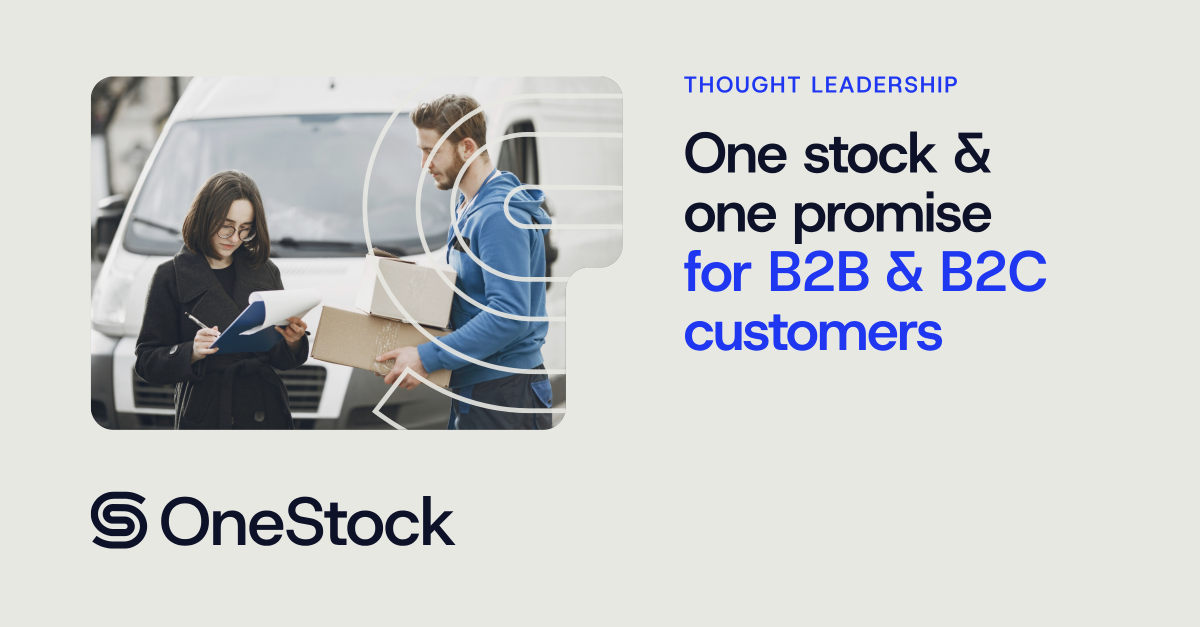
Traditionally, B2B and B2C have lived in separate worlds. Trade customers ordered through account managers, EDI or a dedicated portal, fulfilled from the warehouse by a back-office system. Consumers bought online and in stores, served by a different set of tools. That separation, however, is becoming blurred. Distributors and manufacturers are selling direct to consumers, brands that started online are opening wholesale accounts, and trade buyers expect the same convenience that they get as consumers.
Should B2B and B2C orders therefore run on the same order management platform? For a growing number of businesses, the answer is yes. Running two systems splits your inventory, makes promises inconsistent and ramps up the effort of every change. One platform, with different rules for different customers, gives you a single view of stock and a single way of keeping promises across every channel.
In its 2026 Magic Quadrant™ for Distributed Order Management, Gartner® states “The macro trend is a convergence between B2B and B2C order management. This is occurring in both directions, with online-only brands expanding into wholesale and B2B customers investing in a growing direct-to-consumer model. For many clients, running two sets of applications for these channels is no longer feasible because inventory can become siloed and order promises can be inaccurate.”[1]
The lines between B2B and B2C are blurring
B2B buyers expect a B2C experience
A workshop owner ordering parts, or a store buyer restocking shelves, is also a consumer outside work. They expect real-time availability information, accurate delivery dates and visibility of where their order is. For B2B businesses, these are no longer nice-to-haves. For them, when a spare part is late, an operation stops.
Brands are selling to both
The movement goes both ways. B2B distributors are launching direct-to-consumer channels to reach end customers and protect margin. Direct-to-consumer brands are adding wholesale and marketplace partners to grow. Either way, the same inventory now serves very different customers.
The cost of running two order management worlds
Siloed inventory
When B2B and B2C orders sit in separate systems, each sees only part of the stock. Items can sit unused in one channel while the other reports them out of stock, or the same units can be promised twice. Businesses compensate with buffer stock, which ties up working capital.
Inconsistent promises
If each system calculates availability and delivery dates its own way, customers get different answers depending on how they order. A trade customer may be told an item is available while a consumer is told it is not, or the reverse. Neither builds trust.
Double the effort
Two platforms mean two sets of integrations, two sets of rules and two upgrade cycles. Every new carrier, warehouse or channel has to be connected twice, and every change has to be made twice.
What one platform for B2B and B2C needs to handle
One view of inventory across every location
The foundation is a single, real-time view of stock across warehouses, regional hubs, distribution centers, stores and branches. With one source of truth, every channel draws on the same accurate picture, and inventory can be allocated where it creates the most value.
Different rules for different customers
One platform does not mean one process. B2B and B2C orders have different lifecycles, priorities and service levels. A configurable workflow engine lets you define order lifecycles, approval workflows and exception handling for each type of customer, without custom development. (For more on configuration over customization, see Adapt Without Rebuilding.)
Complex B2B orders
B2B orders are often larger, with more lines and longer lead times. The platform needs to manage split shipments and multi-leg sourcing, and to support pre-orders and backorders with delivery dates based on expected stock receipts.
Promises both types of customer can rely on
Whether the customer is a consumer waiting for a parcel, or a business waiting for a part, the promise has to be accurate. Calculating delivery dates from real-time inventory, fulfillment routes and operational capacity gives every customer a date they can plan around. (See A Promise You Can Keep.)
Two systems vs. one platform
| Separate B2B and B2C systems | One platform for both | |
|---|---|---|
| Inventory | Split across systems, with buffer stock in each | One real-time view, shared across channels |
| Delivery promise | Calculated differently in each system | One consistent promise logic |
| Customer-specific rules | Built separately in each system | Configured per customer type on one platform |
| New channels and partners | Connected twice | Connected once |
| Changes and upgrades | Two projects, two cycles | One platform to maintain |
Does this apply to you?
- You sell to trade customers and consumers from the same stock.
- B2B and B2C orders run on different systems that don’t share inventory in real time.
- Trade customers ask for the order tracking and delivery dates consumers already get.
- You are launching a direct-to-consumer channel alongside wholesale, or a wholesale channel alongside D2C.
- You hold extra stock in each channel because you can’t see across both.
What this looks like in practice
LKQ, a leading distributor of automotive aftermarket parts with around 900 branches Europe-wide, shows the B2B-to-D2C shift clearly. Its UK business wanted to lead in direct-to-consumer as well as B2B. Its legacy model routed every online order through a tiered network of distribution centers and branches, so it adopted OneStock to orchestrate each order from the best location in real time, based on proximity, availability and speed.
Retailers are moving in the other direction too. Imperial uses OneStock for B2B Ship from Store alongside Click & Collect and Order in Store, and Groupe SEB has partnered with OneStock to accelerate its global direct-to-consumer growth.
Find out more about order management for B2B spare parts.
Conclusion: one stock, one promise, every customer
As B2B and B2C converge, the case for running them on separate order management systems gets weaker. A single platform gives you one view of inventory and one way of keeping promises, while still letting you set different rules for different customers. It is the logical next step for businesses that already sell to both, and the right foundation for those planning to.
FAQs
Can one order management system handle both B2B and B2C orders?
Yes. A modern distributed order management system can manage both on one platform, using shared inventory and promise logic, with configurable workflows for each type of customer.
Why not keep separate systems for B2B and B2C?
Separate systems split your inventory, give customers inconsistent availability and delivery dates, and double the cost of integrations and changes.
Do B2B customers need delivery promises?
Yes. Business customers plan around delivery dates, often for critical parts or stock. An accurate promise based on real-time inventory and capacity is as important in B2B as it is in B2C.
What is the first step toward unifying B2B and B2C order management?
Start with inventory. A single real-time view of stock across all locations and channels is the foundation for shared promises, orchestration and customer-specific rules.
[1] Source: Gartner, Magic Quadrant for Distributed Order Management, Chap Achen, Max Panther Hammond, Oscar Sanchez Duran, 12 November 2026. GARTNER and MAGIC QUADRANT are trademarks of Gartner, Inc. and/or its affiliates.