
Agentic Commerce Hub
AI agents don’t browse. They commit. And when they do, one question determines everything: can your operation keep that promise?
At OneStock, we believe the next decade of retail will be won by merchants whose operations are honest enough to back up every promise an agent makes on their behalf. This is where we build that case — through research, analysis, and the strategic conversations retail leaders are having right now.

Agentic Commerce Hub
Protocols are accelerating the agentic commerce infrastructure. But they solve the connection problem — not the truth problem. Here's why operational truth is the real battleground.
OneStock Editorial
A customer tells an AI assistant: “Running shoes, size 10, here before Saturday — order the best option.” They don’t open tabs. They don’t compare. They delegate. The agent does the work: discovering options, validating constraints, committing to a purchase across dozens of retailers simultaneously, in real time.
Your marketing team, your homepage, your curated product imagery — none of it was consulted. The decision inputs were availability, delivery promise, fulfilment options, and policy constraints. And the outcome — the trust your brand earns or destroys — was determined entirely by whether your operation could back up what your systems said.
The experience starts with a conversation. It ends in your warehouse.
In early 2026, agentic commerce stopped sounding speculative. Google and Shopify announced the Universal Commerce Protocol at NRF. Major platforms began positioning AI assistants as a primary commerce interface. The market is moving fast toward standardised ways for agents to discover products, compare options, and initiate transactions.
That’s real. And it matters. But protocols solve the connection problem — not the truth problem.
An agent can connect to your systems flawlessly and still commit to a delivery date that can’t be met, inventory that doesn’t exist, or a fulfilment option that isn’t executable. When that happens:
Connection without operational truth doesn’t just create exceptions. It industrialises them.
How protocols are reshaping the market — and what they can’t fix
In agentic commerce, the promise isn’t supporting information. It is the product. Agents don’t respond to brand storytelling. They evaluate signals. And the signal that matters most — the one that determines whether your product gets selected, committed to, and delivered — is whether your promise is real.
Promise integrity means being as ambitious as your operation allows, and committing to nothing it can’t deliver. It’s not a conservative posture. It’s the discipline that turns reliability into a growth strategy.
And it introduces a competitive dynamic most retailers haven’t priced in yet: algorithmic trust ranking. As agents interact with more retailers at scale, reliability becomes visible, comparable, and decisive. The retailers who can’t sustain promise integrity won’t just disappoint customers — they’ll be selected less often, automatically, by systems that have learnt to route around them.
An OMS that serves as the system of truth for inventory availability, customer promise and order execution becomes the foundation for truly intelligent, agentic commerce.
Klarissa Marenitch, Retail CTO, Cognizant
Agentic readiness isn’t a single capability — it’s the intersection of three reinforcing pillars. Build all three or you’re building a failure engine with better marketing.
High-intent signals from AI-mediated journeys only convert when promises are calculated, contextual and executable. Not estimated. Not generic. Grounded in your real operational state, right now. The agent must be able to act on truthful, real-time commerce signals — not best-effort approximations.
Internal friction becomes external failure at agentic scale. Manual workarounds, fragmented system views, slow exception resolution — all of it surfaces as broken commitments when agents are executing thousands of decisions an hour. In agentic commerce, operational efficiency is no longer a cost story. It is a prerequisite for reliability.
Order management can’t be reactive in an agentic market. Buffers, routing rules and promise windows need to self-optimise against real performance signals — so you can be aggressive on promise without being reckless on cost. The DOM evolves from transactional processing to a margin-intelligent, self-tuning engine.
Agentic readiness exists on a spectrum. Four levels define the journey from experimentation to full competitive advantage — and the threshold that matters sits between Level 2 and Level 3.
| Level | Name | What it means |
|---|---|---|
| 1 | Conversational experimentation | AI answers questions. It can't make commitments. Promise logic is not connected. |
| 2 | Connected agents | Protocols are live. Agents can initiate transactions. But promises are inconsistent and errors scale. |
| 3 | Operationally grounded agents | Real-time truth. Calculated promises. Governed execution. Agents can be trusted to commit. |
| 4 | Predictive autonomous commerce | Dynamic buffers. Continuous promise tuning. Margin-intelligent routing at scale. |
Most retailers today are at Level 1 or 2. The window to reach Level 3 before the market rewards only those already there is open now — and it won’t stay open.
10 questions to assess your agentic commerce readiness
When an agent makes a promise, one system determines whether it holds. Not your AI interface. Not your protocol integration. Your OMS.
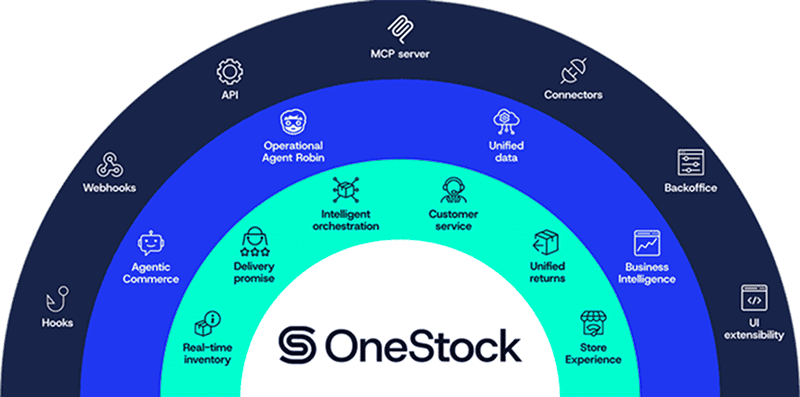
In the agentic era, distributed order management becomes the engine that makes commitments credible: real-time unified inventory, calculated delivery promises, intelligent fulfilment orchestration, lifecycle visibility that holds up after checkout — all exposed through governed, agent-accessible capability layers.
This is what separates a retailer who participates in agentic commerce from one who competes in it. Protocols make the interface scalable. Intent layers make execution usable. The OMS makes outcomes trustworthy.
White Paper
The full strategic argument — from protocol architecture to maturity model to leadership actions.
Access your readines
10 questions to assess your agentic commerce readiness across inventory, promise, orchestration and fulfilment.







By business model
By Scenario









Learn how retailers increase availability, streamline fulfilment and grow with OneStock.