Executive Summary
Retail is experiencing a fundamental structural shift. As AI conversational agents become a scalable interface for shopping, commerce shifts from a browsing environment to one based on intent and execution: customers state their wishes and desired outcomes, and systems act.
From the outset, this means that the integration of extensive product data, accessible to AI, is a de facto requirement. If attributes, variants, pricing, and rich descriptions aren’t accurate, structured, and readable by AI, the right items won’t even be discovered, so they can’t be recommended, compared, or promised with confidence.
Furthermore, agents do not behave like people. They do not tolerate ambiguity or interpret marketing language. They decide using signals such as product information, availability, delivery promise, fulfillment options, and policy constraints – in combination.
When this information is unavailable, unreliable, or unclear, agentic experiences can fail quickly and visibly. In this environment, credibility replaces persuasion.
From experimentation to infrastructure
This shift is accelerating because agentic commerce is moving from experimentation to infrastructure.
Shopper habits could rapidly change at any given inflection point. From a technical standpoint, the emergence of protocols designed to help standardize agent–commerce connectivity underlines how participation will become easier and more repeatable.
As connectivity improves, it stops being a differentiator. Advantage moves behind the interface towards the operational truth that determines whether an agent can make a promise and keep it.
The Customer Promise and Promise Integrity
That is why promise integrity will become the key battleground. In agentic commerce, the promise is not supporting information; it is what the agent optimizes for. Winning retailers will be those that balance ambition with feasibility: fulfilling customer wishes and making commitments that are as attractive as possible, while remaining deliverable at scale.
Crucially, agentic commerce tends to fail less at the conversation layer than at the fulfilment layer: connection without truth simply scales exceptions, reversals, and leads to trust erosion.
The system most central to promise integrity is distributed order management (DOM). In the agentic era, distributed order management evolves from transactional processing into a strategic trust engine: surfacing the right products, validating real-time availability, calculating credible delivery commitments, orchestrating fulfilment across nodes, handling exceptions, and maintaining post-purchase visibility.
These are not protocol problems, they are execution challenges; and the way a retailer handles this will determine whether they earn trust within the context of agentic commerce.
The Question of AI Maturity
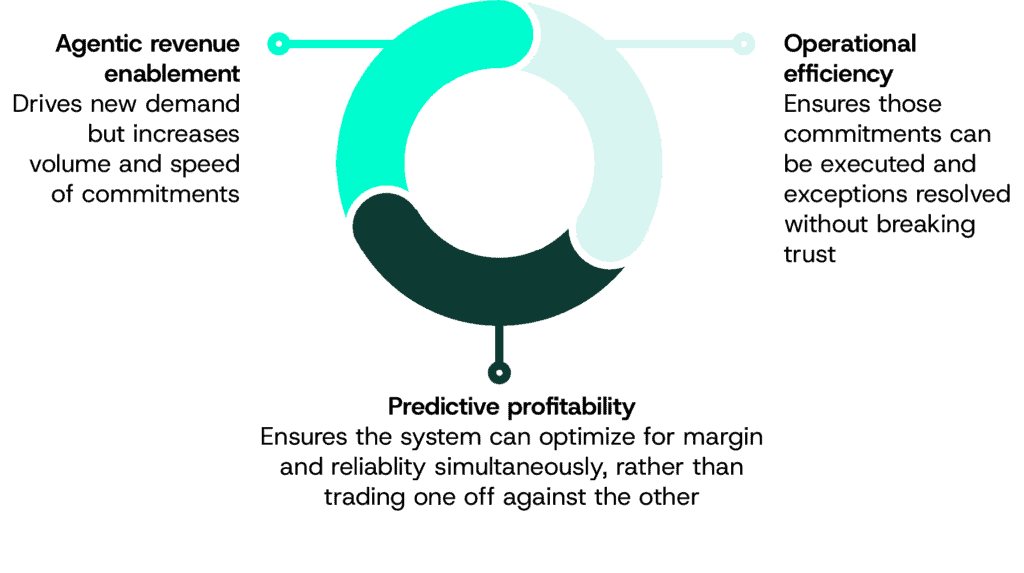
Being able to determine AI maturity therefore becomes important and it should be defined and measured by outcomes. There are three main reinforcing pillars to consider upfront:
- Agentic revenue enablement: Making sure that higher intent signals from customer convert through executable promises),
- Operational efficiency amplification: Removing internal friction that becomes external failure at agentic scale), and
- Predictive profitability optimization: Fine-tuning parameters, promises, and routing using performance signals and true cost, so service remains sustainable).
Together, these pillars define agentic readiness: the ability to deliver outcomes that are executable, repeatable, and profitable. Delivering this maturity requires an architectural shift.
APIs remain essential, but they alone are not sufficient for dynamic, multi-step execution by intelligent clients.
The emerging pattern is an intent/capability layer that encapsulates APIs and exposes discoverable, governed “tools” for agents – reducing fragility, enabling controlled orchestration, and scaling execution without surrendering security or control.
In parallel, protocols standardize participation; capability layers standardize execution; and DOM guarantees operational truth.
Looking Forward
This emerging world means the question moves away from merely how to capture search traffic to become: “How do we become the agent’s go-to recommendation when a customer asks for the best product to match a specific wish?”
In agentic commerce, prompts naturally zero in on product attributes and price – and retailers will need to prioritize availability and speed of delivery, because an agent can only recommend what it can confidently source and fulfil.
For leaders, then, the agenda is clear: treat reliability as a growth strategy; audit promise integrity before scaling agentic channels; elevate DOM as strategic infrastructure; build AI-native execution layers rather than brittle point integrations; prepare for protocol pluralism; strengthen operational data discipline; and evolve KPIs toward promise accuracy, exception prevention, recovery performance, and margin-per-promise.
Introduction: From Browsing to Intent
How the Rules of Shopping Are Being Rewritten
Today’s emerging shopper
It’s a Tuesday evening, and a customer is thinking about the half-marathon that they spontaneously and ambitiously committed to a few weeks back. They suddenly realize that they ought to get hold of some new running shoes, as this has bubbled up as a bigger concern. So, they need a size 10 – and they need them before Saturday.
In our familiar and traditional world, this triggers a recognizable routine: open a few (many) retailer websites, compare options, check delivery estimates, maybe abandon a number of carts when the “arrives by” date looks uncertain.
But, in the emerging model, the customer does something else entirely. They tell an AI assistant what they want in one sentence: “Find me running shoes in size 10 that will arrive before Saturday, and order the best option.” In other words, the customer doesn’t browse. They state intent.
The agent does the work: discovering options, validating constraints, and increasingly acting on the customer’s behalf.
However, most conversations are much more complex than this. As such, it is necessary to consider how an end-to-end conversational experience would be supported. Typically, a ‘conversational funnel’ has a number of stages:
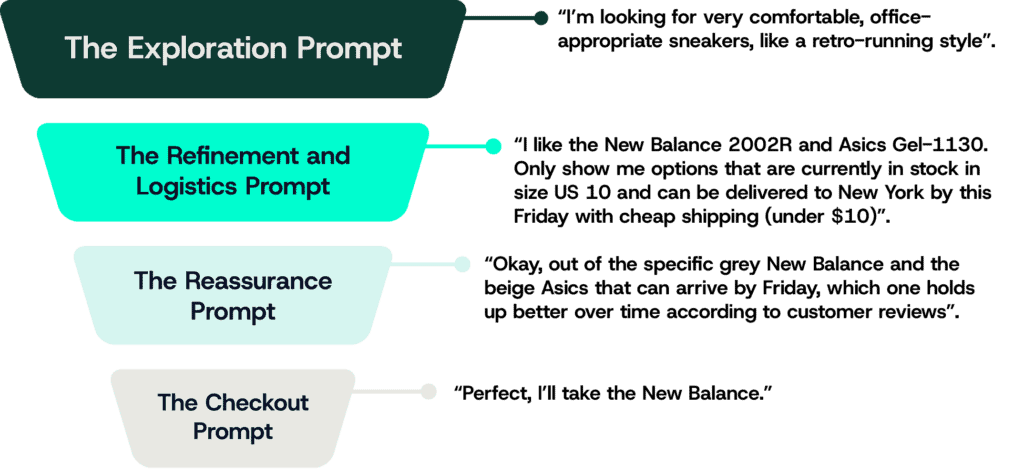
This is a major shift that sits at the heart of agentic commerce: shopping moves from navigation to outcomes, from browsing to execution. In other words, in agentic commerce the “journey” becomes a dialogue, not a click path.
The conversational funnel is how intent gets progressively clarified and turned into an executable order – and at each stage, different truths and systems decide whether the agent can keep going confidently, or has to hedge, ask again, or fail.
When it comes to retailers being able to operate in this new world, this distinction is hugely important because it plays out differently at every stage of the agentic journey.
Upstream, it determines whether your products can be found and recommended at all: if product attributes, variants, pricing and content aren’t accurate, consistently structured, and readable by AI, an agent can’t confidently shortlist you for a specific need.
Mid-funnel, it determines whether an agent can validate and commit to a promise: availability, fulfillment options, cut-offs, capacity and policy constraints become the gating signals that turn “interest” into an executable choice.
Downstream, it determines whether the experience holds up after checkout: order lifecycle truth, exception handling, returns and service policies must be exposed in a way an agent can understand and act on, or the agent can’t resolve issues and the burden snaps back to human teams.
In other words, this shift has direct implications for the accessibility and reliability of your data, for the technologies you choose to operationalize “truth” across channels, and ultimately for brand reputation and competitiveness because in agentic commerce, credibility isn’t a message; it’s something the system has to prove, repeatedly, in real time.
The central tension: connection is not the same as truth
Protocols, of course, improve connection. But, in relation to the statement we made about behaviour above, they cannot guarantee that the information that an agent relies on is true. Therefore, agentic commerce amplifies a long-standing issue in retail: operational uncertainty.
If an agent confidently commits to a delivery date that can’t be met, or sells inventory that isn’t actually available, the failure isn’t just a bad transaction; it damages trust in the agent experience and, consequently, in the brand behind it.
That leads to a simple conclusion: The winners in agentic commerce will be those that are as ambitious as possible in the promises made to customers, while balancing that with committing only to what they can deliver reliably and consistently.
The new role of order management: from processing orders to protecting promises
To make agentic commerce work at scale, retailers need a source of truth behind the conversation. That role belongs to order management.
What this paper covers
With all that in mind, this white paper examines how AI and agentic commerce are reshaping retail through one core lens: as decisions become automated, execution and promise integrity becomes the differentiator. This paper will:
- Explain why the emergence of protocols signals acceleration – and why that is necessary but insufficient.
- Define promise integrity as the new battleground for trust and performance in agent-mediated commerce.
- Present a model of AI-driven retail maturity across three domains: agentic revenue enablement, operational efficiency, and predictive profitability; and
- Explore the architectural shift toward intent-based integration layers (MCP-style capability exposure) that make operational systems usable by agents at scale.
Chapter 1: Protocols Shake Up the Market
1.1 How the market is responding
In early 2026, agentic commerce stopped sounding like a speculative concept and started looking like a market direction. The trigger was not a single launch, but a broader pattern: major platforms positioning AI assistants as a new commerce interface, while the industry began investing in the infrastructure needed to make agent-led shopping viable at scale.
Meanwhile, PwC and other recent reports suggest that agentic AI in retail and ecommerce is expected to grow to $175.1 billion by 2030 with 88% of executives saying they plan to increase AI budgets due to agentic AI.
Recent developments around protocols and agent-enabled commerce reflect that shift clearly, but they should be understood as signals of a wider structural change rather than as the final shape of the market.
What matters most is not which specific protocol gains the most momentum at any given moment, but what their emergence tells us: the market is moving toward more standardized ways for agents to discover products, evaluate options, and initiate transactions.
In other words, agentic commerce is moving from experimentation toward infrastructure.
1.2 What protocol uncertainty means for retail leaders
We are entering a period of protocol evolution, coexistence, and overlap, with different approaches emerging for different parts of the journey and for different ecosystems. Some standards may gain broad adoption; others may remain ecosystem-specific; still others may evolve significantly over time.
For merchants, that uncertainty is not a side issue. It is the operating context. The industry isn’t standardizing a single protocol; it’s assembling a protocol stack – different standards operating at different layers, each solving a different bottleneck.
- Commerce interaction protocols (e.g., UCP, ACP): Standardize how an agent engages a retailer’s commerce flow – for example, discovering products and comparing options.
- Tooling and context protocols (e.g., MCP): Standardize how an agent connects to the systems behind commerce – turning services like catalog, pricing, inventory, order status, and policies into callable tools with consistent inputs/outputs. This is what makes “truth systems” accessible to agents without bespoke integrations.
- Agent-to-agent coordination protocols (A2A): An open standard introduced by Google and partners under the Google Cloud platform in 2025. Designed as a complement to MCP, A2A enables communications between AI agents. For example, as MCP queries databases regarding product and inventory information, it might use this information with an internal agent, which can use A2A to further communicate with external agents.
In agentic commerce, it’s also useful to distinguish between externally owned agents and internally owned agents, because they have different implications in terms of control and trust.
Externally owned agents are run by third parties – a platform, device OS, marketplace, or AI provider – and they act as the customer’s interface, deciding what to surface and where to transact. Merchants can participate by exposing products and actions through standardized protocols, but they have limited control over the agent’s ranking logic, conversation design, or how alternatives are presented.
Internally owned agents are operated by the retailer (or their technology partners) and sit inside their digital estate, where they can be tightly connected to the systems of record for catalog, inventory, promise, policies, and order lifecycle.
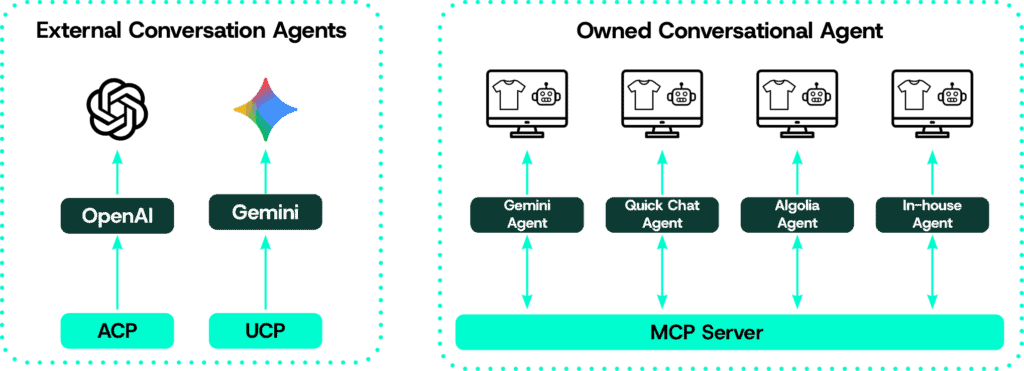
This matters because the same customer intent produces very different outcomes depending on who owns the agent: externally owned agents raise the stakes on being discoverable, machine-readable, and reliably executable across many ecosystems, while internally owned agents let retailers differentiate through truth, orchestration, and service, protecting promise integrity and brand experience even as the interface shifts from websites to conversations.
Merchants will need to assume a world in which multiple external interfaces may need to be supported over time: different product feed requirements, different checkout patterns, different agent ecosystems, and changing rules of participation.
Trying to solve that volatility through point integrations alone will create fragility. Each new protocol or ecosystem shift could trigger rework, duplicated logic, and a growing risk of inconsistency.
What becomes more important, therefore, is the system that sits behind those interfaces and provides a stable source of truth. In practice, that means ensuring the Order Management System (OMS) or DOM is capable of acting as the operational backbone for agentic commerce: centralizing inventory visibility, calculating credible delivery promises, orchestrating fulfilment across locations, managing order lifecycle events, and exposing those capabilities in a way that can be adapted to different external standards as they evolve.
In this environment, unified inventory is not just an efficiency feature. It becomes a strategic requirement. If agents are to make decisions on behalf of customers, they need signals that are current, consistent, and executable.
Fragmented stock views, disconnected fulfilment logic, or inconsistent promise calculations do not simply create operational complexity; they undermine the credibility of the retailer in agent-mediated journeys.
The same is true of architecture. Merchants should prepare for protocol pluralism by ensuring flexible capability layers rather than tying business logic too tightly to any single external format. External standards should be treated as adapters; the durable asset is the internal truth-and-execution layer that can serve many of them.
That means working with technology partners that have both the integration experience to handle evolving ecosystems and a roadmap that explicitly anticipates AI-driven commerce, rather than treating it as a temporary channel trend.
It is for these reasons that the next phase of agentic commerce will be won by merchants that can combine adaptability at the edge with operational truth at the core. And that is precisely why order management is becoming more strategic, and urgent, in the AI era.
1.3 Why ‘connection without truth’ is dangerous in agentic commerce
Even if the market converges around stronger standards over time, protocols alone cannot guarantee that the information an agent relies on is true, current, and executable in the real world of fulfillment.
When an AI agent commits on behalf of a customer, it does so with confidence. If the commitment proves incorrect (if the item cannot ship, cannot arrive on time, or cannot be fulfilled as promised) the failure is amplified:
- Trust erodes faster, because the agent’s credibility is at stake as well as the retailer’s.
- Bad data scales, because the same flawed signal may drive thousands of automated decisions.
- Reliability becomes algorithmic, as agents can learn which merchants produce consistent outcomes and which do not.
In short, agentic commerce does not merely expose operational weaknesses. It is in danger of industrializing them. This is why the central strategic risk of the next phase of commerce is not the absence of connection.
It is the presence of connection to unreliable reality.
1.4 The shift protocols create: execution becomes the differentiator
Protocols will accelerate adoption. But by making connectivity easier, they also shift the competitive battleground. When connection becomes standardized, differentiation moves to:
- the quality of promise signals
- the reliability of fulfillment execution
- the speed and intelligence of exception handling
- the integrity of post-purchase visibility
In other words, the market will stop rewarding the retailers who connect first and start rewarding the retailers who execute best. This is where order management becomes strategic.
1.5 The missing foundation: operational truth behind the protocol
If protocols represent the interface layer for agentic commerce, retailers still need a system that can answer the questions that matter to agents, truthfully, and in real time:
- Can this be fulfilled in a way that matches the customer’s intention? (not just ‘is it listed?’)
- Where should it ship from? (not just ‘what’s nearest?’)
- When can it arrive? (not just ‘what’s the estimate?’)
- What happens when conditions change? (delays, substitutions, splits, reroutes)
These questions sit at the intersection of inventory, promise calculation, routing logic, and lifecycle management, domains typically governed by the OMS and distributed fulfillment capabilities.
This leads to an early conclusion that we will explore in the rest of this paper: Protocols enable the conversation. Operational truth enables the outcome.
In the next chapter, we define why promise integrity – the ability to commit only to what can be delivered and deliver it consistently – becomes the decisive competitive signal in agent-driven commerce.
Chapter 2: The New Competitive Battleground – Promise Integrity
As discussed in the previous chapter, protocols are arriving, so the next question is where will that take us? As protocols reduce the friction of connection and once agents can reliably access commerce systems, the market will increasingly judge retailers on whether their systems can reliably commit.
In agent-driven journeys, the traditional click so dominant in the old world will no longer be the decisive moment as it once was. So where do the determining factors of success move?
In this new environment, it is the commitment. This follows the logic that an AI agent is not simply recommending, it is increasingly selecting, scheduling, and initiating actions based on whether an outcome can be achieved within a customer’s requirements or constraints.
This is why promise integrity will become the competitive battleground: the ability to make commitments that are ambitious, operationally true, context-specific, and consistently executable.
2.1 In the agentic era, the promise becomes part of brand identity
A ‘promise’ in commerce always comes with a degree of supporting information, such as ‘in stock, arrives by Friday, free returns, pick up in two hours.’ Customers can interpret these statements probabilistically and with some discretion. They may still buy, but with a mental discount applied to certainty and therefore some cushion to disappointment.
Alternatively, a retailer may opt to be more conservative in the promise being made, to ensure that, in the event of a better scenario, a customer remains delighted. Agents behave differently.
What were once more flexible informational statements become decision inputs: structured signals that determine which option is feasible.
As a result, the promise itself becomes the differentiator: it is what the agent evaluates, compares, and ultimately optimizes for.
In practical terms, an agent’s decision loop depends on whether a retailer can provide credible answers to questions such as:
- Is this item truly available in the relevant location network right now?
- What delivery date can be committed to, given inventory position, carrier performance, capacity, and cut-offs?
- What fulfillment options exist (ship-from-store, ship-from-DC, pickup) and which are actually executable in this context?
- What happens if conditions change: delays, splits, substitutions, reroutes, cancellations?
These are not informational messages. They are operational facts. And in an agentic world, operational facts are the currency of trust.
2.2 Why promise integrity is different from “better estimates”
Promise integrity is not the same as providing more optimistic delivery windows, richer product data, or smoother UI flows. It is the discipline of aligning what is offered at decision time with what can be executed across a complex fulfillment network under real-world variability.
Two things make this harder (and more important) in agentic commerce:
1. Automation increases the cost of error:
In traditional ecommerce, inaccurate promises create disappointment and customer service load. In agentic commerce, inaccurate promises can trigger autonomous commitments at scale.
Bad signals do not just disappoint customers, they drive automated decisions that must then be unwound through exception handling, refunds, substitutions, and trust repair.
2. Agent experiences create comparability:
As agents interact with many retailers, reliability becomes visible and comparable. Agents can learn which merchants consistently keep commitments and which routinely fail to execute.
Over time, this creates a new type of competitive pressure: reliability becomes a performance signal that can influence recommendation, selection, and conversion. This is why the risk is not simply “missed deliveries.” A deeper risk could emerge in the form of algorithmic trust ranking. Retailers that cannot sustain promise integrity may be selected less often. Not because their products are inferior, but because their commitments are unreliable.
2.3 The hidden failure mode: promises without operational reality
The joint Google and Shopify UCP announcement at this year’s NRF 2026 highlights the industry’s attempts to standardize the conversation layer. But also, these initiatives surface what protocols cannot solve: operational truth.
Protocols can help agents connect, discover, and initiate commerce actions, but they do not guarantee accurate availability, reliable promise calculation, intelligent routing, or consistent post-purchase execution.
This creates a hidden failure mode: Agentic commerce will fail if agents are connecting to unreliable operational reality.
In this case, the agent experience can appear smooth while the outcome collapses: orders split unexpectedly, delivery dates slip, inventory proves inaccurate, substitutions are unmanaged, returns become messy, and customer service becomes the last line of defense.
The experience ‘works’ as a conversation but fails as commerce.
2.4 DOM/OMS as promise protection: the emerging trust engine
To deliver promise integrity at scale, retailers need a system that can do more than expose product information. They need a system that can evaluate feasibility, calculate commitments, orchestrate execution, and manage exceptions across the lifecycle.
This is where Distributed Order Management evolves from a transactional backbone into a strategic trust engine. In an agentic world, the DOM becomes the layer that:
- Provides real-time inventory visibility so agents don’t sell what can’t be delivered
- Calculates and manages delivery promise so committed dates can be met
- Optimizes routing and splitting so fulfillment remains executable and profitable
- Orchestrates multi-fulfillment options without introducing hidden risk
- Manages exceptions and lifecycle visibility so changes are handled before trust is lost
Put simply: in agentic commerce, DOM isn’t just there to manage orders; it is there to protect promises.
2.5 External agents, owned agents. Same trust requirement
Whether agentic commerce plays out through external platforms or through agents embedded in a retailer’s own channels, the trust requirement is the same. Agents must be grounded in operational truth before and after purchase.
In external agent experiences, protocols and feeds may enable scalable participation but they also heighten the need for accurate, current promise signals, because the brand is being evaluated alongside many alternatives.
In owned agent experiences, retailers have more control over context and governance, but the agent is still only as credible as the operational systems behind it.
In both cases, the differentiator is not the sophistication of the conversation. It is the reliability of the commitment.
2.6 From persuasion to proof: the new basis of advantage
The long-standing model of digital commerce rewarded persuasion: the best discovery experience, the best messaging, the best personalization. Those capabilities still matter, but agentic commerce changes the balance.
As decisions become automated, the system that wins is the one that can prove feasibility. That is the strategic shift promise integrity introduces: commerce becomes less about what a brand can claim and more about what it can guarantee. And as protocols make connectivity ubiquitous, that guarantee becomes a primary lever of differentiation.
In Chapter 3, we’ll translate this into a practical maturity model built around three domains of capability: agentic revenue enablement, operational efficiency amplification, and predictive profitability optimization: the foundations retailers will need to compete in an agent-mediated market.
Chapter 3: The Three Pillars of AI-Driven Retail Maturity
The macro shift is clear: protocols are reducing the friction of agent connectivity, and promise integrity is becoming the differentiator. The practical question for retail leaders is what to do next.
“Adopting AI” is not a strategy, and neither is launching a chatbot. In an agentic market, maturity is defined by whether a retailer can translate intent into outcomes, reliably, efficiently, and profitably. It is therefore appropriate to consider a definition of maturity by which a strategy can be measured.
This chapter sets out three practical pillars by which AI-driven retail maturity could be assessed. Together, they form a framework for moving from experimentation to scalable execution.
The three pillars are:
- Agentic Revenue Enablement: turning intent into conversion through executable promises
- Operational Efficiency Amplification: reducing internal friction that undermines external reliability; and,
- Predictive Profitability Optimization: evolving order management from reactive processing to margin intelligence
These pillars are interdependent. Agentic front-ends without operational efficiency become expensive failure engines. Operational AI without promise integrity delivers internal savings but does not unlock new channels. Predictive optimization without trusted execution data becomes theoretical. Maturity comes from building the full stack.
Let’s take a look at these in turn.
Pillar 1: Agentic Revenue Enablement
In other words, turning intent into conversion through executable promises. Agentic commerce creates a new revenue paradigm: customers arriving with high intent, expressed in natural language, and expecting an agent to complete the task.
The opportunity is clearly visible: higher conversion, fewer abandoned journeys, and a better experience for time-constrained customers. But there is a non-negotiable requirement for this which we have discussed throughout: the agent must be able to act on truthful, real-time commerce signals, not generic estimates.
From a maturity perspective, agentic revenue enablement means enabling agents (whether external or owned) to access and execute the capabilities that turn intent into outcome:
- Promise as a calculated commitment (not a marketing claim)
- Fulfillment options as executable choices (not static configurations)
- Lifecycle visibility and change management (so the experience remains credible post-purchase)
Agentic commerce will manifest in two parallel forms, external agents and owned agents, and the maturity requirement is the same: the retailer must supply an operationally grounded promise.
Illustrative agentic scenarios (how intent becomes execution):
- External agent transaction: The agent evaluates product availability and feasible delivery windows against the customer’s deadline, then selects an option that can be committed to.
- Owned pre-purchase agent: The agent uses customer context (history, preferences, location) to propose a reorder with a calculated, guaranteed promise.
- Post-purchase agentic service: The agent resolves a disruption by proposing an alternative that is actually executable (rerouting, pickup, split shipment handling) rather than offering apologies and escalation.
The strategic point is that agentic commerce is not a new UX layer. It is better thought of as a new execution channel; and revenue only materializes when the promise is truthful.
Pillar 2: Operational Efficiency Amplification
This can be articulated as reducing the internal friction that undermines external reliability. Indeed, the fastest ROI from AI in retail is often internal. But in an agentic world, operational efficiency is not just about cost reduction, it is foundational to reliability.
Internal friction creates external failure: slow resolution times, manual workarounds, inconsistent decisions, and error-prone exception handling all surface as broken promises when agents are executing at scale.
Operational efficiency amplification focuses on using AI to reduce the “daily grind” across key personas, especially where fragmented systems and manual processes create delay and error.
At maturity, this pillar includes:
- Conversational operational access: enabling business and service teams to query complex operational data and take action using intent-driven interfaces (e.g., natural language order search and bulk actions).
- Cross-system inquiry and action: reducing the integration and swivel-chair burden by allowing agents to assemble a single operational view across DOM, OMS, WMS, carriers, CRM, and more.
- Guided fulfillment and error resolution: translating technical complexity into clear, actionable guidance for store associates and fulfillment teams, reducing fulfillment friction at the edge.
- Faster configuration and change: enabling business users and integrators to define orchestration logic and validate setups without deep specialist knowledge, reducing time-to-value and operational risk.
Illustrative operational scenarios (where AI creates measurable ROI):
- Customer service teams filtering and acting on orders via intent rather than manual queries
- Cross-system status investigation that reduces average handle time and escalation
- Automated recovery flows that transform cancellations into substitutions or alternate fulfillment
- Natural-language configuration support that compresses complex setup cycles
The strategic point: operational efficiency is no longer separate from customer experience. In agentic commerce, it is a prerequisite for it.
Pillar 3: Predictive Profitability Optimization
This assesses the evolution of order management from reactive processing to margin intelligence. It is where AI shifts from assisting humans to optimizing systems. Retail order management has historically been reactive: it records events, applies rules, and routes orders based on fixed logic.
But as promises become the success standard, and as agentic commerce increases the speed of commitments, a reactive model becomes insufficient. The DOM must evolve into a predictive, self-optimizing engine that can balance customer outcomes with profitability in real time.
Predictive profitability optimization means using AI models to anticipate risk, calculate true cost, and adjust operational parameters before problems occur. At maturity, this includes three core control mechanisms:
- Smarter stock reliability: dynamic safety stock and buffer adjustment based on variance patterns and anomaly detection, reducing oversell and undersell risk.
- Promise accuracy optimization: continuous tuning of promise logic using historical and real-time performance signals (carrier outcomes, warehouse throughput, network capacity), improving on-time delivery while staying competitive.
- Profit-optimized routing: real-time sourcing decisions based on true fulfillment cost (including risk cost), margin impact, and service outcomes, not just proximity rules.
In an agentic market, this pillar becomes a strategic differentiator because it enables retailers to do something that is otherwise impossible: offer aggressive, attractive promises selectively but only when they can be fulfilled profitably and reliably. That is the essence of promise integrity at scale.
How the pillars connect: the maturity flywheel
These pillars reinforce one another: This is why AI maturity in retail should not be measured by the number of models deployed or the sophistication of the front-end experience.
It should be measured by whether the retailer can produce outcomes that are:
- Executable (truthful promises)
- Repeatable (efficient operations)
- Economically sustainable (profit-optimized fulfillment)
In Chapter 4, we turn to the architectural question: as agents become the interface, what kind of integration layer is required to expose commerce capabilities safely and at scale? And why intent-based capability layers (such as MCP-style interfaces) represent a shift beyond traditional API-centric patterns.
Chapter 4: The Architectural Shift – From API Stacks to Intent Layers
The first three chapters described what is changing in retail: decision-making is becoming agent-driven, protocols are standardizing connectivity, and promise integrity is emerging as the competitive battleground.
This chapter addresses how the underlying architecture must change to support that reality.
Intent-centric integration
Retail technology stacks were built for humans and applications, not for autonomous agents. Traditional integration patterns assume developers will read documentation, map fields, manage versioning, and handcraft orchestration across multiple systems.
Agents do not work this way. They need a safer, more structured way to discover capabilities and execute multi-step workflows without brittle or bespoke plumbing.
This is where intent-centric integration layers play a role: architectural abstractions that expose capabilities (what a system can do) rather than endpoints (how a developer calls it). In practice, these layers sit above APIs and encapsulate them, translating agent intent into reliable system execution.
4.1 Why API-centric architectures can struggle with agents
APIs have been the universal language of digital commerce for over a decade. They remain essential. But the way they are typically used creates challenges when the “client” is not a human developer or a fixed application but an AI agent performing dynamic, multi-step work.
Four constraints show up repeatedly:
- Endpoint sprawl and fragmentation:
Enterprise commerce stacks accumulate thousands of endpoints across DOM/OMS, WMS, CRM, PIM, marketplace platforms, carrier services, and analytics. Each domain has its own patterns and assumptions. Stitching these together into a coherent agent workflow can be costly and fragile. - Documentation-driven discovery:
Traditional integrations depend on human interpretation of documentation: which endpoint to call, with what payload, in what sequence? Agents need a machine-legible way to ask, “What can you do?” and receive a reliable answer. - Handcrafted orchestration:
Even simple customer intents often require complex orchestration: check availability, compute promise, select fulfillment option, create order, update tracking, manage exceptions. In API-centric architectures, this orchestration is typically written and maintained by developers, increasing time-to-change and introducing operational risk. - Brittleness over time:
Versioning, schema drift, and dependency changes turn integrations into ongoing maintenance projects. Agents executing at scale amplify this brittleness: small breaks create large operational impact.
The result is not that APIs ‘don’t work,’ but that they were not designed for the emerging mode of interaction: intent-driven, tool-based, multi-step autonomy.
4.2 The shift in abstraction: from connectivity to capability
A useful way to understand the new architectural direction is the shift from connectivity to capability. Connectivity asks: “Can these systems talk?” Capability asks: “What can this system do, and how can an agent use it safely?”
In an intent-centric model, systems expose a set of high-level capabilities, such as get availability, calculate promise, create order, reroute fulfillment, retrieve unified tracking. These must be discovered and invoked predictably.
The interface is less about endpoints and more about actions and constraints. This is the architectural idea behind MCP-style layers: a standardized way to expose “tools” that agents can discover and call, while preserving security, governance, and operational constraints.
Two characteristics matter especially for agentic commerce:
- Declarative discovery: Agents can query the system for an explicit menu of capabilities, rather than relying on documentation and custom mapping.
- Intent-to-execution orchestration: The layer can translate a goal (“resolve this delayed order with the best alternative”) into a controlled sequence of actions across underlying APIs and systems, with clear governance boundaries.
4.3 Important nuance: this is not a post-API world
It is tempting to frame this shift as “APIs are being replaced.” That is rarely true in enterprise systems. A more accurate articulation is: APIs will remain the foundational plumbing, but they will be increasingly encapsulated. Intent-centric layers sit above existing APIs and services and act as:
- AI-ready gateways on top of existing infrastructure
- Secure brokers that abstract multiple backends (DOM/OMS, ERP, WMS, carriers) behind unified capabilities
- Federated orchestrators that manage cross-system workflows and lifecycle state consistently
This mirrors prior technology evolutions. When systems become more complex, the winning architectures introduce higher-level abstractions that reduce cognitive and operational load.
For agentic commerce, the abstraction is capability exposure for intelligent clients.
4.4 How this intersects with protocols like UCP
UCP and similar initiatives sit at a different layer of the stack. They are about standardizing agent-to-commerce interaction patterns across the ecosystem. They reduce the friction of connection and participation.
But as we explored in Chapter 1, there is a limitation: protocols alone cannot guarantee that the answers returned are operationally true. That leads to a layered architecture that leading brands will converge toward:
- Protocol layer (e.g., UCP): Standardizes how agents connect and transact. Interoperable participation across platforms
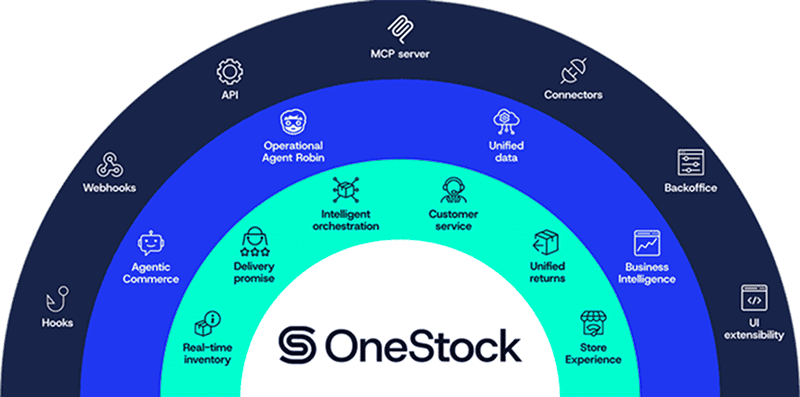
- Intent/capability layer (MCP-style): Exposes machine-legible tools and controlled workflows. Safe, discoverable, reliable execution primitives
- Operational truth layer (DOM/OMS): Computes availability, promise, orchestration, lifecycle truth. Commitments that are executable and consistent
In other words: protocols make the interface scalable; intent layers make execution usable by agents; distributed order management makes outcomes trustworthy.
4.5 Why intent layers become strategic in an agentic market
This architectural shift matters because it changes the speed and safety with which retailers can participate in agentic commerce without creating an uncontrolled integration surface.
Intent-centric capability layers provide four strategic advantages:
- Faster enablement of new agent experiences: Once capabilities are exposed in a standardized way, new agent journeys can be built without rebuilding integration logic each time.
- Governance by design: Capabilities can be permissioned, audited, and constrained (what agents can do, under what conditions), reducing risk compared to ad hoc API exposure.
- Reduced integration fragility: Changes in underlying APIs can be absorbed within the capability layer, reducing downstream breakage.
- Better operational learning loops: When agent actions are executed through a unified tool layer, it becomes easier to observe performance, detect failure patterns, and improve promise and routing logic, supporting the predictive maturity described in Chapter 3.
4.6 The emerging architectural mandate
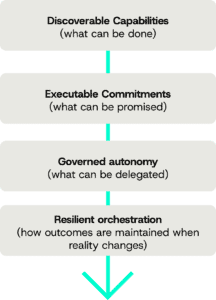
The architectural mandate of agentic commerce is not simply “add AI.” It is to make core commerce systems usable by intelligent clients while maintaining truth, security, and control.
That means designing for:
In Chapter 5, we translate these ideas into a practical retailer maturity model, showing how organizations move from conversational experimentation to operationally grounded agents and, ultimately, looking to the future, to predictive, autonomous commerce.
Chapter 5: A Maturity Model for Retailers
Agentic commerce is often discussed as a front-end shift: new conversational interfaces, new discovery patterns, new shopping experiences.
But as this paper has argued, the determining factor is not how compelling the conversation is. It is whether the retailer can translate intent into outcomes that are ambitious, true, executable, and sustainable.
This is why a maturity model is useful for providing leaders with a way to assess where they are today, what “good” looks like, and what capabilities must be built next. Importantly, the maturity journey is not linear in terms of “more AI.”
It is a progression from conversation to commitment, and from automation to governed autonomy. Let’s consider a four-stage maturity model designed for the agentic era.
Level 1: Conversational Experimentation
“We added AI, but it can’t reliably act.”
At this stage, retailers introduce conversational experiences, often as chatbots or copilots, but these experiences remain largely detached from operational systems.
The AI can answer FAQs, summarize policies, and guide customers, but it cannot calculate a trustworthy promise or execute meaningful actions.
- Typical characteristics: AI primarily provides information and support content. Limited operational integration (at best: read-only, delayed data). Responses frequently default to generic estimates or disclaimers. Exceptions route to human agents quickly.
- Common risks: The experience feels impressive in demos but fails under real conditions. Low confidence prevents users from delegating real tasks. Brand trust can erode if the AI overcommits or gives inconsistent answers.
- Maturity signal: AI is treated as a channel feature, not as a new execution model.
Level 2: Connected Agents
“We can connect, but we can’t always commit.”
Here, retailers begin connecting agent experiences to commerce systems through APIs, feeds, and emerging protocols. This is where ecosystem progress, such as standardization efforts, starts to unlock broader participation. Agents can query product catalogs, initiate carts, and begin transactions in a more structured way.
However, “connected” does not necessarily mean “truthful.” The retailer may still struggle to supply accurate real-time availability, calculate a reliable promise, or manage post-purchase changes consistently.
- Typical characteristics: Agent-to-commerce connectivity is established (protocols/feeds/APIs). Agents can initiate core actions (discovery-cart-checkout). Promise logic is still limited by data quality, latency, or static rules. Post-purchase visibility may be partial or fragmented.
- Common risks: Automated commitments amplify existing operational weaknesses. Failures occur “after” the conversation, making the experience feel deceptive. Customer service burden rises due to exceptions and reversals.
- Maturity signal: The organization is participating in agentic commerce, but reliability is inconsistent.
Level 3: Operationally Grounded Agents
“We can commit because we have a source of truth.”
At this stage, agentic commerce becomes credible because the retailer has an operational truth layer that can support promise integrity. Instead of best-effort signals, agents can access real-time availability, calculate feasible delivery commitments, and execute fulfillment decisions backed by real-time order management logic.
This is where the OMS evolves from transactional processing to promise protection: ensuring that what is promised can be delivered, and managing the lifecycle when reality changes.
- Typical characteristics: Real-time availability and promise calculation are operationally grounded. Order orchestration and exception handling are agent-accessible and governed. Post-purchase visibility is unified and actionable. Internal efficiency workflows reduce friction (service, stores, business ops).
- Common risks: Complexity shifts from “can we do this?” to “can we scale governance?” Multiple systems of record still require careful orchestration design. Change management becomes as important as model quality.
- Maturity signal: Agents can be trusted to act because commitments are executable.
Level 4: Predictive Autonomous Commerce
“We don’t just execute, we optimize.”
The highest maturity level is not about more automation for its own sake. It is about predictive control: systems that anticipate risk, adapt parameters in real time, and continuously optimize for both customer outcomes and profitability.
Here, DOM/OMS and the fulfillment network function as a learning system. Promise windows are tuned dynamically based on performance signals; safety stock buffers adjust based on variance; sourcing decisions optimize for true cost and failure risk, not just proximity.
Agents can then operate with greater autonomy because the system itself is resilient: it can detect issues early, propose alternatives, and execute recovery without breaking trust.
- Typical characteristics: Dynamic buffer and stock reliability optimization. Continuous promise tuning using performance and capacity signals. Profit-optimized routing based on true cost (including risk cost). Exception prevention and automated recovery become standard. Intent/capability layers make controlled autonomy scalable.
- Common risks: Requires strong data discipline and operational instrumentation. Demands clear governance boundaries for autonomous action. Organizations must align incentives across digital, ops, and finance.
- Maturity signal: The retailer competes on reliability and margin intelligence, at scale.
How to use this model: a pragmatic assessment lens
Retailers can use the maturity model as a diagnostic across three dimensions introduced in Chapter 3:
- Agentic revenue enablement: Can agents turn intent into conversion with truthful commitments?
- Operational efficiency amplification: Can teams execute and recover quickly without manual fragmentation?
- Predictive profitability optimization: Can the fulfillment network self-optimize for risk and margin?
The key insight is that maturity is not measured by how “AI-powered” the interface appears. It is measured by whether the retailer can deliver outcomes that are:
- Executable (promise integrity)
- Repeatable (efficient operations)
- Economically sustainable (profit-aware orchestration)
In Chapter 6, we translate this into strategic implications for brand and retail leaders: what to prioritize now, what to measure, and how to prepare for a world where reliability becomes a machine-evaluated competitive signal.
Chapter 6: Strategic Implications for Retail Leaders
Agentic commerce changes the basis of competition. As protocols reduce the friction of connection and agents become a scalable interface to shopping, differentiation shifts away from who has the most compelling conversational experience and towards who can deliver the most reliable outcomes.
In practical terms, retail leaders must treat agentic commerce not as a channel add-on, but as a strategic test of operational credibility.
This chapter outlines the implications for CIOs, CTOs, digital leaders, and operations executives, and the actions that follow.
6.1 Treat reliability as a growth strategy, not an operations metric
In traditional ecommerce, reliability is often managed as an operational KPI: on-time delivery, cancellation rate, return rate, customer service backlog. In an agentic world, these measures take on a new meaning. They could become upstream signals that influence whether agents recommend, select, and commit to a retailer in the first place.
The strategic implication is straightforward: Reliability becomes demand-shaping. Retailers that can consistently keep commitments will be advantaged in agent-driven journeys because agents can learn which brands produce predictable outcomes.
Conversely, retailers with inconsistent promise execution risk an emerging penalty that looks less like customer churn and more like algorithmic exclusion in this scenario: selected less often because they are less dependable.
- Leadership action: Elevate “promise integrity” to an executive growth metric alongside conversion and margin. Instrument where and why promises fail (availability, promise logic, capacity, carrier performance, exception handling).
6.2 Audit promise integrity before scaling agentic channels
Many organizations will be tempted to start with the interface: launch an assistant, connect to a protocol, expose a feed. But the adoption curve will reward retailers that first ensure the foundations are trustworthy.
If an agent can connect but the promise is unreliable, scaling the experience simply scales failures, autonomously.
- Leadership action: Run a “promise truth audit” across top categories and top fulfillment paths. Quantify accuracy gaps between promised and delivered outcomes. Identify where uncertainty enters the system (inventory accuracy, buffer policy, cut-offs, carrier variance, store execution).
6.3 Reposition DOM as strategic infrastructure
Agentic commerce places order management at the center of customer experience. When promises become the success foundation, DOM is no longer a back-office system. It is the layer that validates feasibility, calculates commitments, orchestrates fulfillment across nodes, and manages exceptions before trust breaks.
This also reframes investment logic. Enhancements to inventory visibility, promise calculation, routing intelligence, and lifecycle control are not just operational improvements, they are prerequisites for competing in agent-driven markets.
- Leadership action: Treat DOM capability as a strategic enabler for revenue, trust, and margin (not only for cost control). Align OMS roadmaps with agentic channel plans so promise and execution evolve together.
6.4 Build an AI-native execution layer, not a patchwork of integrations
Protocols will help agents connect to commerce. But retailers still need a safe, governed way to expose capabilities (not just endpoints) to intelligent clients. This is where intent/capability layers (MCP-style abstractions) become strategically valuable: they allow systems to advertise what they can do, enable controlled orchestration, and encapsulate underlying APIs for resilience.
This is particularly important in complex retail stacks where execution depends on multiple systems: DOM/OMS, WMS, ERP, CRM, carriers, marketplaces. Without a higher-level capability layer, agentic experiences tend to create brittle integrations and governance risk.
- Leadership action: Shift from endpoint exposure to capability exposure (discoverable, permissioned “tools”). Define governance boundaries for agent autonomy (what agents can do, under what conditions, with what approvals). Design for observability and auditability of agent actions.
6.5 Prepare for protocol pluralism and ecosystem volatility
UCP is a major signal, but it will not be the only interface standard. Retailers should assume a period of protocol pluralism – multiple formats, evolving expectations, and shifting platform requirements.
The strategic risk is building tightly coupled point solutions that must be rebuilt every time a protocol shifts. The strategic advantage is building a stable internal truth-and-capability foundation that can adapt to external change.
- Leadership action: Treat external protocols as “adapters,” not foundations. Invest in internal operational truth and capability layers that can serve multiple external ecosystems. Design participation models that preserve customization while meeting interoperability needs.
6.6 Align data discipline with delegated decision-making
Agentic commerce increases delegated decision-making. That makes data quality not merely an analytics issue but a transactional risk. Agents depend on structured signals – availability, promise windows, fulfillment options, policies – and inaccuracies will be amplified.
This is not limited to inventory and delivery. Returns policies, substitution rules, eligibility constraints, store hours, carrier cut-offs, and regional exceptions all become operational facts that agents may act upon.
- Leadership action: Expand “data quality” programs beyond product content to operational truth. Define ownership for promise inputs (inventory accuracy, capacity, carrier performance, policy rules). Implement closed-loop learning: when execution fails, the system should learn.
6.7 Rethink KPIs for an agent-driven market
Traditional KPIs remain relevant, but agentic commerce introduces a need for new measures that capture trust and execution credibility. Retailers should expect to manage performance not only at the point of conversion, but across the full promise lifecycle.
Emerging KPI examples:
- Promise accuracy rate (promised date vs delivered date adherence)
- Verified availability rate (displayed availability vs fulfillment reality)
- Exception prevention rate (issues resolved before customer contact)
- Automated recovery success rate (reroutes, substitutions, proactive resolutions)
- Margin per promise (profitability adjusted for service level and risk)
- Leadership action: Establish a promise integrity dashboard as a cross-functional instrument (digital + ops + finance). Tie agentic channel expansion to reliability thresholds, not just engagement metrics.
6.8 The leadership takeaway: move from “AI adoption” to “agentic readiness”
The most common mistake leaders will make is to view agentic commerce as a front-end innovation and treat operations as a downstream concern. The opposite is true. As agents become the interface, operations become the experience and the retailer’s ability to commit becomes the brand.
The strategic transition is from building connected experiences to building credible outcomes:
- From persuasion to proof
- From connection to commitment
- From automation to governed autonomy
In the conclusion, we bring these threads together and summarize the core argument of this paper: protocols will make agentic commerce possible everywhere, but the retailers that win will be those that invest in operational truth and promise integrity, because in an agent-mediated market, reliability becomes the most valuable differentiator.
A word from our consulting and integration partner CLEVER AGE
“From Clever Age’s perspective as a consulting and system integrator company, the Order Management System (or Distributed Order Management) is not just a component, but the key operational backbone for the effective execution of an ambitious Agentic Commerce strategy.
While AI agents are crucial for customer-facing intelligence and decision-making (e.g., personalization, negotiation, pre-purchase optimization), the OMS provides the necessary physical and transactional reality for those decisions – both for real promise exposure and solid logistic execution.
In order to anticipate the future development of Agentic Commerce projects for our customers, we believe the OMS is one of the most critical integration points, as it connects the front-end AI decision-making layer with the physical supply chain:
- Integration Complexity Reduction: the OMS acts as a single, normalized API layer between the disparate systems of record (WMS, ERP, POS, Carrier Management) and the new AI/agent layer. This simplifies the architecture and accelerates the time-to-market for new agent-driven channels.
- Inventory & Order Data Hub: an OMS centralizes all inventory & order-related events and data, creating a clean, structured data set. We will use this data with our customers to train and refine the commerce agents, providing a closed-loop feedback mechanism for autonomous decision-making. As per the product data, the quality of agentic decisions is directly proportional to the quality of the OMS data (both inventory levels and order execution states).
- Future-Proofing for Modularity: we recommend a composable OMS architecture that can be decoupled from monolithic ERPs and e-commerce systems. This approach allows the commerce organization to rapidly adapt to new agent-driven fulfillment models without ripping and replacing core enterprise systems. This will also be key for omnichannel delivery schemes, Marketplaces scenarios, and ultimately B2B approaches.
When implementing OMS for agentic commerce, we recommend prioritizing:
- Logic Model Design: Defining the sophisticated, rule-based logic within the OMS that handles edge cases and operational constraints that AI agents might miss. Our expertise will be in translating business rules into bulletproof fulfillment logic.
- Scalability and Resilience: Ensuring the OMS can handle the potential explosion of transactions generated by a fleet of autonomous, always-on agents. High-availability and failover planning become non-negotiable requirements.
- Experience Handoff: Managing the smooth transition of responsibility from the commerce agent (which handles discovery and checkout) to the OMS (which handles post-purchase customer communication, returns, and tracking). This ensures a consistent, trust-building experience.
In summary, the AI agent is the brain that decides what the customer needs, but the OMS is the central nervous system that dictates how and where that need is efficiently and profitably fulfilled. Without a modern, intelligently configured OMS, the promise of agentic commerce will remain a front-end experiment lacking a robust execution pathway.”
Olivier Martinerie
Head of Alliances & Partnerships
Clever Age
https://www.clever-age.com/
Conclusion: From Connection to Commitment to Trust
Retail is entering a period of structural change. As AI agents become a scalable interface for shopping, commerce shifts from browsing and navigation to intent and execution.
This is not simply a new channel layered onto the existing stack, it is a new decision model, in which more choices will be delegated, automated, and enacted on a customer’s behalf.
The market signals are now clear. Standardization efforts such as Google and Shopify’s Universal Commerce Protocol (UCP) reflect a broader industry move to make agent-to-commerce interaction scalable. Protocols will reduce the cost of participation and accelerate adoption. But they also expose the critical truth at the heart of agentic commerce: connection is not the same as trust.
Agentic commerce only works when agents are grounded in operational truth. Agents do not reward persuasive experiences in the same way people do; they reward credible signals.
When availability is inaccurate, when delivery promises are optimistic, or when post-purchase visibility breaks down, the failure is amplified because agents commit with confidence and can replicate decisions at scale. In that environment, reliability becomes measurable, comparable, and increasingly decisive.
This is why promise integrity emerges as the new competitive battleground. The brands that succeed will not be those that promise the most, but those that consistently commit only to what they can deliver and deliver it, but ambitiously.
The differentiator moves from the quality of conversation to the credibility of ambitious outcomes.
Meeting that standard requires more than an AI interface. It requires a foundation built for agentic execution:
- An OMS/DOM that protects promises through real-time availability, accurate promise calculation, intelligent orchestration, and lifecycle control
- Operational efficiency that reduces internal friction and accelerates recovery when reality changes
- Predictive optimization that tunes buffers, promises, and routing based on performance signals and true cost
- Intent-centric capability layers that make commerce systems safely usable by intelligent clients at scale, without brittle integration sprawl
Together, these capabilities define agentic readiness. They allow retailers not just to participate in agentic commerce, but to compete in it, reliably, repeatably, and profitably.
The core message of this white paper is simple: protocols will make agentic commerce possible everywhere. But the winners will be those who invest in the operational truth behind the protocol. Because in the age of autonomous shopping, the question is no longer whether your systems can connect. It is whether your business can commit and keep that commitment, every time.
Looking forward, however, what counts as a “promise” is also likely to expand. Today, most agentic prompts gravitate toward a familiar triad: availability, price, and speed. But as agents become the default interface to commerce, they will increasingly optimize not only for what the customer wants, but for what the customer values.
In practice, that could pull new dimensions into the decision signal: carbon impact, returns waste, labour and sourcing standards, product longevity, repairability, and compliance with ethical and sustainability expectations. This is where promise integrity becomes even more consequential.
The next battleground will not only be the ability to promise what is feasible and deliver it, but to make even more ambitious promises across a wider set of constraints. The retailers that lead will be those that can translate complex values into executable commitments: not just “delivered by Friday,” but “delivered by Friday with the lowest-impact option available, from a source that meets your standards, with a clear trade-off if you want faster.”
Agentic commerce therefore points to a deeper shift: from optimizing transactions to optimizing trust. The winners will be those who build the systems of truth that allow agents to make decisions confidently, across speed, cost, service, and the growing set of ethical and sustainability criteria consumers will delegate to machines.
In that future, the most valuable capability will not be the ability to connect to agents. It will be the ability to make commitments that remain credible as the definition of “customer promise” expands.