Introduction: The Order of Things
Before diving into the topic of Distributed Order Management (DOM), let’s rewind slightly to the beginnings of ecommerce, for some context. While it’s difficult to pinpoint precisely when ecommerce started, it’s not hard to see the impact it’s had on the retail landscape today. Some former well-loved brands have fallen by the wayside, while others have had to face headwinds while restructuring and reinvesting in their businesses. However, one consistent point stands out: those brands that have survived, the merchants that have made it, were all uncompromising on one major aspect throughout: the customer experience. That remains as true today as it ever has done in the past.
Balancing investment against customer expectations
But this is hard. It’s hard because customer expectations have already evolved rapidly, and as we enter an era of AI, they continue to do so, arguably with more speed than ever before. Gone are the days when someone ‘went online’ to make a purchase – indeed it seems archaic to say it. The upshot is, in this era, customers expect brands to operate seamlessly across any channel and, further, they expect brands to allow them to mix and match any combination of such mechanisms as Buy Online, Return In-Store; Reserve Online, Pick Up In-Store; Buy Online, Ship to Store; Buy Online, Pick Up In Locker, or indeed any other valid variation that we can think of.
On the flip side, let’s take inventory for example, this sits in warehouses, it can sit in retail stores, regional distribution centers, 3PL facilities and even supplier locations. This makes it difficult to tie the two parts together – and is made all the more difficult when we consider that many brands still lack real-time visibility into these disparate pools of inventory.
Meanwhile, omnichannel commerce has enjoyed its time of being a major foundational force in improving customer experience, giving shoppers the ability to browse, buy and return across multiple channels. But, as we have seen, customer expectations continue to change, and, as they continually raise on the bar on their expectations, delivering a consistently great experience across all channels requires far more than just connecting touchpoints. It requires a fully aligned operational infrastructure working behind the scenes.
In other words, from a strategy perspective, we need to think in terms of unified commerce, which is still omnichannel at heart, but differs from its omnichannel commerce predecessor on one key point: ensuring every part of the business can operate from a single, shared system of record. This sounds simple, and it is, with the right tools to execute it, and with the complexity built-in behind the scenes. Without these tools, however, it can easily become a mess, and it is specifically the customer experience that suffers.
The Tools to Deliver Unified Commerce
Achieving unified commerce requires a Distributed Order Management (DOM) solution that can centralize inventory visibility, dynamically route orders, and deliver an accurate customer promise every time.
This makes it a core component of unified commerce. It does much more than just process orders; it must act as a central intelligence layer, synchronizing inventory, fulfillment and logistics across all sales channels.
When To Invest?
In the same way that those brands of the past who failed to invest quickly enough disappeared in that first wave of ecommerce, so too will so many of those merchants who make the mistake of not investing now in this further evolution of the customer experience. It’s what makes unified commerce central to everything that you do.
And, while we have opened with B2C retailers in this brief introduction, the same is true, of course, for B2B brands and those operating in mixed environments. The challenges may be different, but the path forward is common. Brands that unify their order logic, visibility and execution will be able to deliver better experiences, operate more profitably and build a more scalable commerce foundation.
Those that don’t will remain trapped by fragmented operations, inconsistent inventory visibility and inefficient fulfillment workflows.
Why Is Unified Commerce the Foundation for Every Enterprise Retail and B2B business?
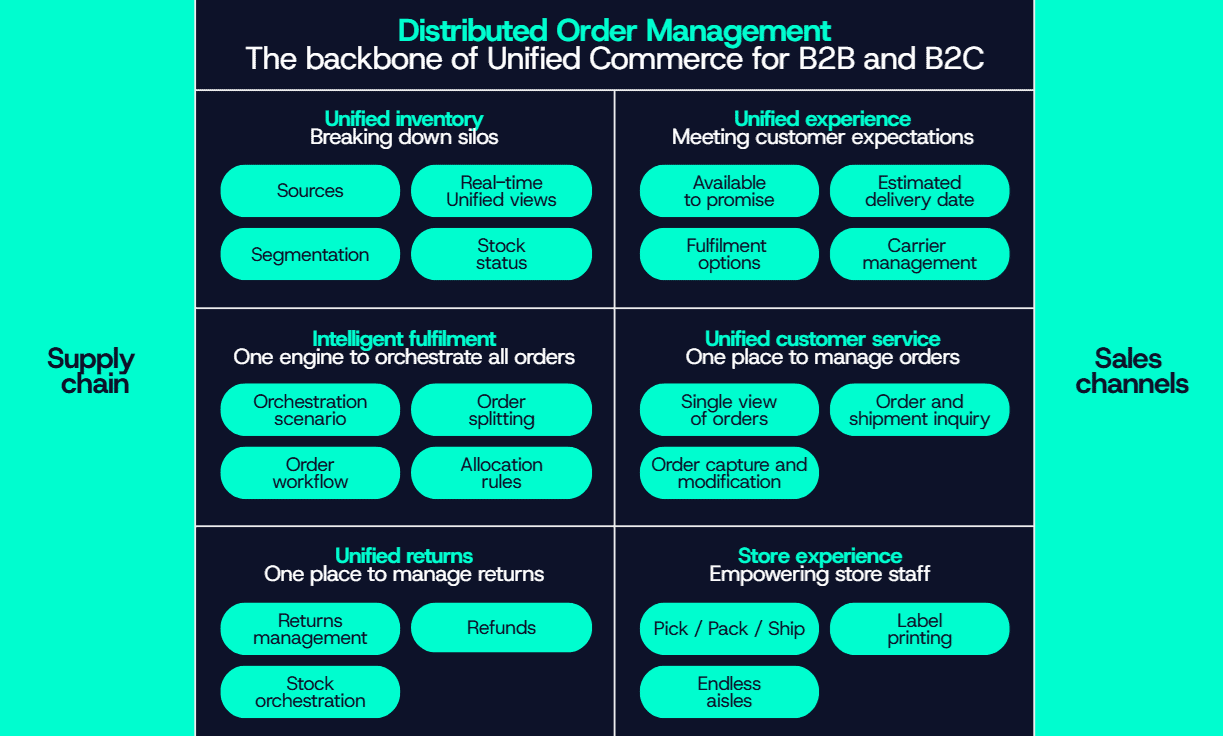
Unified commerce builds on the original omnichannel ambition by creating a single, intelligent platform for managing every aspect of the commerce operation. Rather than connecting disparate systems, it brings together all those core functions – inventory, customer data, product information, logistics and order fulfilment – into a single foundation.
This ensures consistency not only in terms of what the customer sees, but also in how each order is processed, fulfilled and supported, which yields five key advantages:
- The commerce experience is consistent across all channels
Product data, such as pricing, descriptions and availability, is uniform and accurate wherever the customer engages. Promotions are the same online, in-store and throughout marketplaces, creating a trusted and familiar brand experience. - Inventory is both centralized and smart
Real-time inventory visibility across all warehouses, stores and partners enables brands to allocate inventory with precision. This improves availability, supports flexible delivery options, and helps reduce waste or overstocking. - Customer profiles are accessible and reliable
Whether a customer is shopping on an e-commerce website, in a retail store, or through a B2B portal, they benefit from the same loyalty rewards, account history and personalized service. Every interaction is informed by a single view of the customer. - Order fulfillment is driven by a single orchestration engine
All orders, regardless of origin, follow the same fulfillment logic and service standards. This simplifies operations, increases agility and ensures that customer promises – in terms of timing, availability and service – are consistently delivered in accordance with brand or business expectations. - Fragmented systems become fully connected commerce
Unified commerce gives brands a powerful operational foundation to scale with confidence, adapt quickly and deliver consistently across all channels. It moves the organization beyond coordination to true integration, where all commercial logic, systems and touchpoints operate from a single source of truth.
How Unified Commerce Delivers Its Benefits (And Why DOM Is the Engine Behind It)
Unified commerce moves an enterprise beyond the coordination of siloed touchpoints to true operational integration. Rather than maintaining disconnected rules engines, pricing models, or inventory pools for each sales channel, brands operate from a single, shared system of record.
This single foundation allows organizations to balance global consistency with local flexibility across three core operational pillars, as the following mechanisms are unlocked:
- Centralized Strategy with Local Adaptability
Commercial decisions, including pricing structures, product catalog rules, and promotions, are managed centrally and executed consistently across online, in-store, and marketplace channels. At the same time, the architecture remains adaptable to local currencies, regional regulatory requirements, and dynamic market conditions. - Tailored Personalization for B2B and B2C
Unified customer profiles turn account history and loyalty data into strategic assets. Whether engaging a consumer on a Direct-to-Consumer (DTC) site or a corporate buyer in a B2B portal, customer service teams and digital channels can deliver precise, context-aware personalized experiences. - Intelligent Enterprise-Wide Inventory Allocation
Instead of locking stock into channel-specific siloes, inventory is pooled and dynamically allocated based on demand forecasts, real-time sales data, customer tier priorities, and fulfillment strategies. Whether processing an individual retail transaction or a high-volume B2B shipment, every allocation decision balances customer satisfaction against fulfillment costs.
In short: Unified commerce defines the strategy and DOM delivers it. It is the technology layer that translates the promise of a unified customer experience into everyday operational excellence.
The strategic advantage of adopting a single OMS for B2B and B2C
Guillaume Vanbrugghe, Leading Product marketing, OneStock:
Today’s B2B businesses face growing complexity in order management, yet many still rely on outdated systems – ranging from traditional ERPs and custom-built tools to manual workarounds like spreadsheets. These legacy solutions struggle to meet the rising expectations of today’s digitally savvy B2B customers.
Forward-looking organizations are investing in cloud-native, composable, and best-of-breed Order Management Systems (OMS) that drive agility and growth. These modern OMS solutions can handle B2B specific requirements like:
- Connecting multiple sales channels to the OMS
- EDI, e-mail, B2B commerce, sales rep tools
- Configuring inventory availability across multiple sales channels
- Managing different types of quantities for inventory: e.g. palette, carton, linear meter, weight
- Segmenting inventory, ensuring it is appropriately allocated based on your business requirements
- Providing real-time inventory views to any channel, considering on hand, in movement, and future inventory
- Automating order orchestration
- Processing large orders with hundreds or even thousands of order lines
- Considering the promise in the allocation process, to ensure the estimated time
- Managing complex fulfilment scenarios: orders with multiple delivery addresses, order allocation per order line, orchestration per wave, consolidation
- Being flexible in terms of inventory and order workflows to accommodate changes: e.g. ETA changes on incoming Purchase Order, changes in delivery date needs, buyer approval etc.
- Delivering personalized experience
- Providing a tailored promise with available delivery options exclusively for specific customer segments
- Managing inventory availability and allocation rules specific to customers, e.g. fill or kill, requested delivery date, min fill rate percentage, etc.
- Prioritizing certain customers over others during the order allocation process
- Allocating orders for certain customers to specific stock location depending on items’ attributes (such as lot number, or country of origin)
- Centralizing order management
- Managing B2B specificities on order management, e.g. displaying large quantities of orders lines, supporting large or bulk order modifications / cancellations
- Real time customer communications for critical changes like delivery date
B2B order management includes managing and fulfilling the orders for:
- Multi-channel retail brands: from their wholesale customers
- Manufacturers, distributors and CPG companies: from their business customers
For retailers operating across both B2C and B2B channels, adopting a unified commerce strategy powered by a single OMS brings several strategic and operational advantages:
- Enhanced Inventory Visibility
- A centralized OMS provides real-time, enterprise-wide inventory visibility. This enables more accurate fulfillment promises and reduces stockouts or overstocking scenarios.
- Increased Inventory Exposure
- Shared inventory pools between channels allow you to expose the same stock to both B2C and B2B buyers, increasing sell-through rates and reducing excess inventory.
- Reusable Services and Architecture
- By building order and inventory services on a common architecture, retailers can leverage modular, reusable components – accelerating time-to-market for new features and reducing duplication of effort.
- Lower Total Cost of Ownership (TCO)
- Maintaining a single OMS platform reduces infrastructure, integration, and support costs compared to managing separate systems for each channel.
- Unified Data and Real-Time Control Tower
A single data repository enables advanced analytics, real-time performance dashboards, and centralized exception handling. This acts as a ‘control tower’ to proactively manage supply chain, customer experience, and service levels.
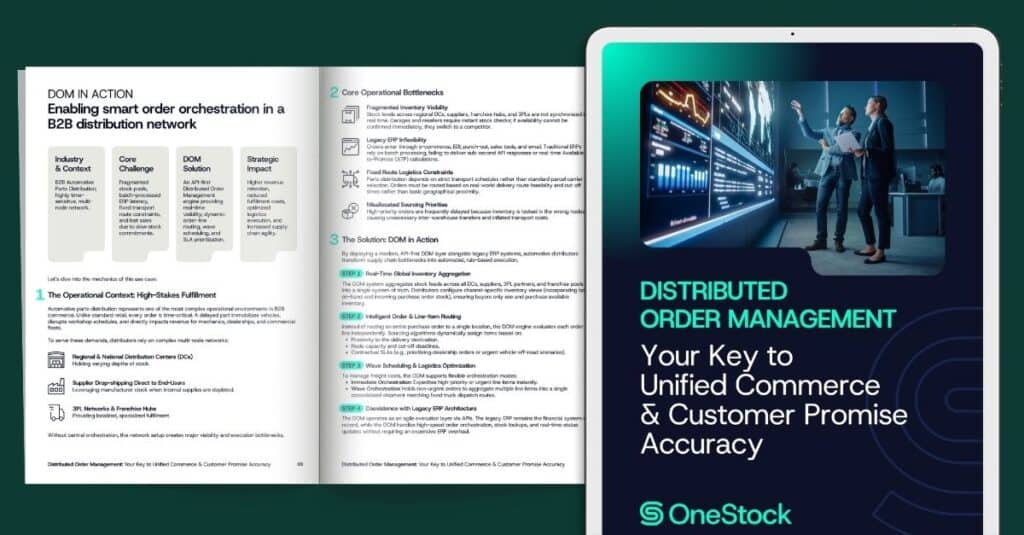
DOM in Action: Enabling smart order orchestration in a B2B distribution network
Industry & Context
B2B Automotive Parts Distribution; highly time-sensitive, multi-node network.
Core Challenge
Fragmented stock pools, batch-processed ERP latency, fixed transport route constraints, and lost sales due to slow stock commitments.
DOM Solution
An API-first Distributed Order Management engine providing real-time visibility, dynamic order-line routing, wave scheduling, and SLA prioritization.
Strategic Impact
Higher revenue retention, reduced fulfillment costs, optimized logistics execution, and increased supply chain agility.
Let’s dive into the mechanics of this use case:
1. The Operational Context: High-Stakes Fulfillment
Automotive parts distribution represents one of the most complex operational environments in B2B commerce. Unlike standard retail, every order is time-critical. A delayed part immobilizes vehicles, disrupts workshop schedules, and directly impacts revenue for mechanics, dealerships, and commercial fleets.
To serve these demands, distributors rely on complex multi-node networks:
- Regional & National Distribution Centers (DCs): Holding varying depths of stock.
- Supplier Drop-shipping Direct to End-Users: Leveraging manufacturer stock when internal supplies are depleted.
- 3PL Networks & Franchise Hubs: Providing localized, specialized fulfillment.
Without central orchestration, this network setup creates major visibility and execution bottlenecks.
2. Core Operational Bottlenecks
- Fragmented Inventory Visibility: Stock levels across regional DCs, suppliers, franchise hubs, and 3PLs are not synchronized in real time. Garages and resellers require instant stock checks; if availability cannot be confirmed immediately, they switch to a competitor.
- Legacy ERP Inflexibility: Orders enter through e-commerce, EDI, punch-out, sales tools, and email. Traditional ERPs rely on batch processing, failing to deliver sub-second API responses or real-time Available-to-Promise (ATP) calculations.
- Fixed Route Logistics Constraints: Parts distribution depends on strict transport schedules rather than standard parcel carrier selection. Orders must be routed based on real-world delivery route feasibility and cut-off times rather than basic geographical proximity.
- Misallocated Sourcing Priorities: High-priority orders are frequently delayed because inventory is locked in the wrong nodes, causing unnecessary inter-warehouse transfers and inflated transport costs.
3. The Solution: DOM in Action
By deploying a modern, API-first DOM layer alongside legacy ERP systems, automotive distributors transform supply chain bottlenecks into automated, rule-based execution.
Step 1: Real-Time Global Inventory Aggregation
The DOM system aggregates stock feeds across all DCs, suppliers, 3PL partners, and franchise pools into a single system of truth. Distributors configure channel-specific inventory views (incorporating both on-hand and incoming purchase order stock), ensuring buyers only see and purchase available inventory.
Step 2: Intelligent Order & Line-Item Routing
Instead of routing an entire purchase order to a single location, the DOM engine evaluates each order line independently. Sourcing algorithms dynamically assign items based on:
- Proximity to the delivery destination.
- Node capacity and cut-off deadlines.
- Contractual SLAs (e.g., prioritizing dealership orders or urgent vehicle-off-road scenarios).
Step 3: Wave Scheduling & Logistics Optimization
To manage freight costs, the DOM supports flexible orchestration modes:
- Immediate Orchestration: Expedites high-priority or urgent line items instantly.
- Wave Orchestration: Holds non-urgent orders to aggregate multiple line items into a single consolidated shipment matching fixed truck dispatch routes.
Step 4: Coexistence with Legacy ERP Architecture
The DOM operates as an agile execution layer via APIs. The legacy ERP remains the financial system of record, while the DOM handles high-speed order orchestration, stock lookups, and real-time status updates without requiring an expensive ERP overhaul.
4. Strategic Business Impact
Implementing DOM-driven orchestration transforms fulfillment into a strategic market advantage:
- Higher Revenue Retention: Delivering on exact promise times builds buyer trust, driving repeat orders from garages and resellers.
- Lower Operational Expenses: Automated line-item routing and wave aggregation minimize inter-warehouse freight transfers and split-shipment costs.
- Greater Supply Chain Agility: New distribution hubs, suppliers, or 3PL networks can be onboarded seamlessly via API integrations.
- Lower Customer Support Overhead: A centralized ‘control tower’ gives service teams real-time visibility across all order states, reducing inbound WISMO (‘Where Is My Order?’) inquiries and enabling instant order modifications.
DOM in Action: Optimizing Multi-Brand and International Order Promises in High-End Retail
Industry & Context
High-End and Luxury International Retail; multi-brand and multi-country e-commerce and boutique networks.
Core Challenge
Inconsistent delivery promises, high ‘Where Is My Order?’ (WISMO) inquiry volume, rigid customer service systems, and slow return processing.
DOM Solution
A modern DOM platform delivering live checkout promises, centralized lifecycle visibility, dynamic order editing, and automated reverse logistics.
Strategic Impact
Reduced order cancellations, higher revenue retention, lower customer service overhead, and elevated customer lifetime value.
Let’s take a look at high-end retail in more detail:
1. The Operational Context: Uncompromising Customer Expectations
High-end and luxury brands operate in a competitive international landscape where brand differentiation relies on exceptional service. As social commerce and multi-brand marketplaces expand, luxury shoppers expect the same concierge-level experience online as they receive in physical boutiques.
In this segment, the primary operational hurdle is rarely basic inventory storage; rather, it lies in executing precise pre-purchase promises, maintaining real-time order visibility, and providing flexible post-purchase customer care across global markets.
2. Core Operational Bottlenecks in Luxury Commerce
- Inconsistent Customer Promises: Failing to display accurate product availability and Estimated Delivery Times (EDT) during checkout leads to fulfillment delays, cart abandonment, and frequent order cancellations.
- High Support Ticket Volume (WISMO): Without centralized tracking updates across global carriers and local boutiques, shoppers frequently contact support with ‘Where Is My Order?’ inquiries.
- Rigid Post-Purchase Support Systems: High-value customers frequently request last-minute order adjustments, such as shipping address changes, line-item cancellations, or adding promotional gifts and samples. Legacy systems lack real-time editing capabilities, forcing support teams to reject requests or issue full order cancellations.
- Friction in Returns and Refunds: Luxury consumers expect instant refunds and effortless exchanges. Manual reconciliation delays refund processing and keeps returned products out of active inventory for extended periods.
3. The DOM Solution: Transforming the Luxury Customer Journey
A next-generation DOM platform acts as a central control tower, connecting front-end sales touchpoints, store networks, regional warehouses, and carrier networks to manage the order lifecycle.
Step 1: Precise Pre-Purchase Delivery Promises
During product browsing and checkout, the DOM aggregates stock feeds across boutiques, regional distribution centers, and partner locations to display real-time Available-to-Promise (ATP) inventory. By integrating carrier schedules and processing constraints, the system calculates precise Estimated Delivery Times (EDT) early in the buyer journey, building trust and raising checkout conversion rates.
Step 2: Automated Order Tracking and WISMO Reduction
Once an order is captured, the DOM consolidates tracking data into a single repository. Automated update triggers and self-service tracking portals provide customers with real-time status visibility, drastically reducing inbound customer support calls.
Step 3: Dynamic Post-Purchase Servicing
The DOM provides customer support teams with direct access to a centralized order control tower. Support representatives can modify shipping addresses, alter delivery methods, issue line-item cancellations, or attach personalized gift options to live orders prior to warehouse dispatch.
Step 4: Streamlined Cross-Channel Returns and Restocking
The DOM extends orchestration rules directly to reverse logistics:
- Cross-Channel Flexibility: Connects store POS and digital systems, allowing online purchases to be returned or exchanged in local boutiques.
- Automated Refunds: Triggers instant refund processing as soon as a returned item is scanned by a carrier or store associate.
- Rapid Stock Re-Orchestration: Automatically routes returned merchandise back into local sellable inventory pools, allowing items to be resold at full retail price faster.
4. Strategic Impact and Executive Insight
Implementing a DOM-driven order lifecycle strategy allows high-end retailers to combine premium customer care with profitable backend operations:
- Higher Revenue Retention and Repeat Sales: Reliable delivery promises and flexible post-purchase servicing foster brand loyalty and protect repeat purchase rates.
- Reduced Order Cancellations: Accurate stock displays and precise EDT estimates minimize order backlogs and customer cancellations.
- Lower Operational Costs: Self-service tracking and dynamic order editing reduce support ticket resolution costs.
- Accelerated Inventory Adjustments: Automated ‘returns workflows’ process returned merchandise back into active stock quickly, preserving gross margins.
Conclusion: The Path Forward for Next-Generation Commerce
The operational scenarios explored throughout this white paper demonstrate a fundamental truth: legacy ERP systems and batch-processed omnichannel workflows can no longer keep pace with the modern fulfillment complexity demanded by today’s customers. To counter this, unified commerce establishes an overarching business strategy by creating a single, shared system of record; Distributed Order Management (DOM) serves as a real-time operational engine to execute it.
Whether managing the time-critical, multi-node logistics of B2B automotive distribution or delivering accurate checkout promises and flexible post-purchase care in luxury international retail, DOM bridges the gap between backend supply chain constraints and front-end customer commitments.
To unlock true fulfillment agility, precision, and profitability, brands must look beyond basic order routing and embrace the next generation of DOM technology. This modern architecture rests on five critical operational pillars:
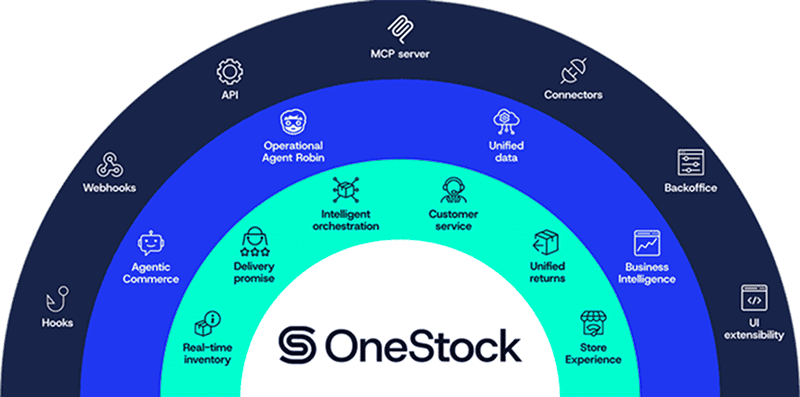
- API-First and Event-Driven Orchestration: Enabling real-time, sub-second decision-making across complex fulfillment networks, and integrating seamlessly alongside legacy infrastructure without requiring disruptive IT overhauls.
- Real-Time, Dynamic Inventory Management: Aggregating stock feeds across distribution centers, physical stores, suppliers, and 3PL partners into a single view; ensuring every unit of stock is fully optimized across all sales channels.
- Predictive Delivery Promise Capabilities: To calculate live Available-to-Promise (ATP) stock and Estimated Delivery Times (EDT) during checkout, adjusting fulfillment decisions proactively rather than reactively to eliminate backorders and cart abandonment.
- Advanced Business Rules and AI-Driven Recommendations: Utilize multi-criteria algorithms and intelligent automation to route every order, or individual order line, at the lowest possible fulfillment cost while meeting strict customer service level agreements.
- Reverse Orchestration: Dynamically adjust reverse logistics and return flows based on demand fluctuations, customer preferences, and operational constraints, and rapidly route returned items back into active, sellable stock to protect profit margins.
Retailers, manufacturers, and B2B distributors that fail to modernize their order management capabilities will continue to struggle with fragmented inventory, bloated fulfillment expenses, and eroding customer trust. Conversely, forward-thinking organizations that invest in next-generation order orchestration will establish a scalable, future-proof foundation, ensuring that every order, across every channel, is fulfilled with speed, precision, and lasting profitability.