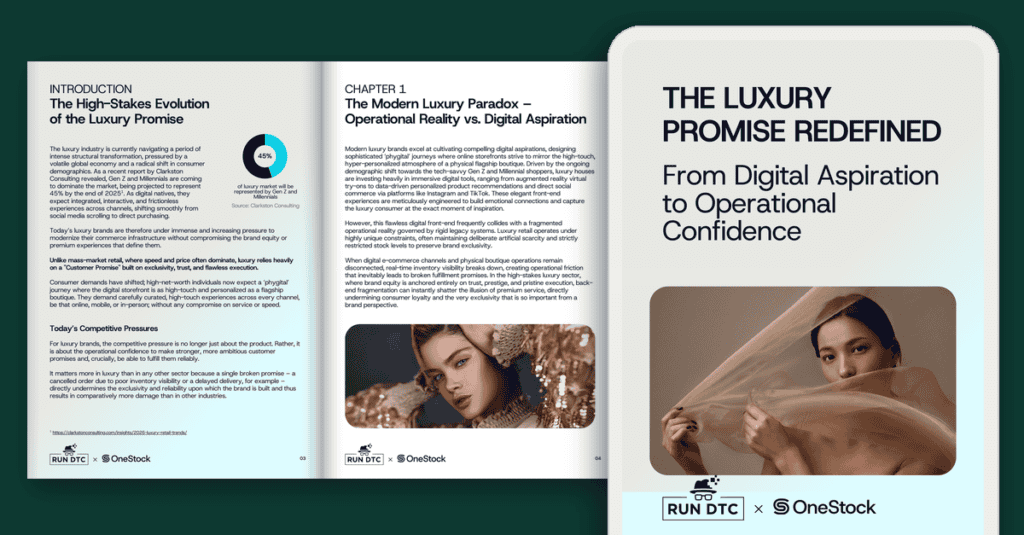
Introduction: The High-Stakes Evolution of the Luxury Promise
The luxury industry is currently navigating a period of intense structural transformation, pressured by a volatile global economy and a radical shift in consumer demographics.
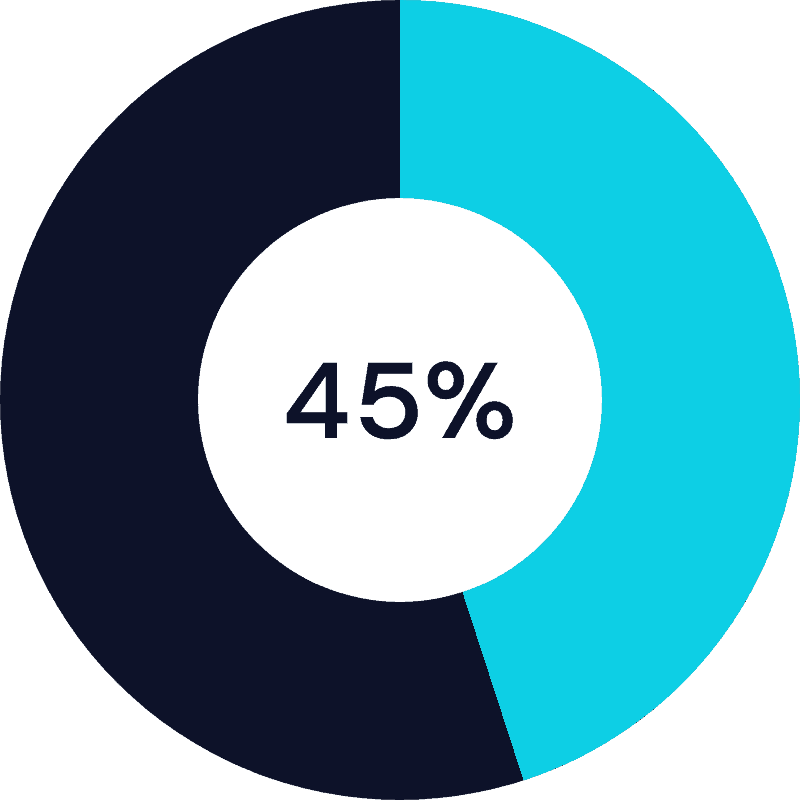
Source: Clarkston Consulting
As a recent report by Clarkston Consulting revealed, Gen Z and Millennials are coming to dominate the market, being projected to represent 45% by the end of 2025. As digital natives, they expect integrated, interactive, and frictionless experiences across channels, shifting smoothly from social media scrolling to direct purchasing.
Today’s luxury brands are therefore under immense and increasing pressure to modernize their commerce infrastructure without compromising the brand equity or premium experiences that define them.
Unlike mass-market retail, where speed and price often dominate, luxury relies heavily on a “Customer Promise” built on exclusivity, trust, and flawless execution.
Consumer demands have shifted; high-net-worth individuals now expect a ‘phygital’ journey where the digital storefront is as high-touch and personalized as a flagship boutique. They demand carefully curated, high-touch experiences across every channel, be that online, mobile, or in-person; without any compromise on service or speed.
Today’s Competitive Pressures
For luxury brands, the competitive pressure is no longer just about the product. Rather, it is about the operational confidence to make stronger, more ambitious customer promises and, crucially, be able to fulfill them reliably.
It matters more in luxury than in any other sector because a single broken promise – a canceled order due to poor inventory visibility or a delayed delivery, for example – directly undermines the exclusivity and reliability upon which the brand is built and thus results in comparatively more damage than in other industries.
Chapter 1: The Modern Luxury Paradox – Operational Reality vs. Digital Aspiration
Modern luxury brands excel at cultivating compelling digital aspirations, designing sophisticated ‘phygital’ journeys where online storefronts strive to mirror the high-touch, hyper-personalized atmosphere of a physical flagship boutique. Driven by the ongoing demographic shift towards the tech-savvy Gen Z and Millennial shoppers, luxury houses are investing heavily in immersive digital tools, ranging from augmented reality virtual try-ons to data-driven personalized product recommendations and direct social commerce via platforms like Instagram and TikTok. These elegant front-end experiences are meticulously engineered to build emotional connections and capture the luxury consumer at the exact moment of inspiration.
However, this flawless digital front-end frequently collides with a fragmented operational reality governed by rigid legacy systems. Luxury retail operates under highly unique constraints, often maintaining deliberate artificial scarcity and strictly restricted stock levels to preserve brand exclusivity.
When digital e-commerce channels and physical boutique operations remain disconnected, real-time inventory visibility breaks down, creating operational friction that inevitably leads to broken fulfillment promises. In the high-stakes luxury sector, where brand equity is anchored entirely on trust, prestige, and pristine execution, back-end fragmentation can instantly shatter the illusion of premium service, directly undermining consumer loyalty and the very exclusivity that is so important from a brand perspective.
The Complexities of the Luxury Ecosystem
Luxury retail is therefore challenged by those unique operational constraints that legacy systems are no longer equipped to handle. Senior decision-makers face several critical hurdles that require consideration and can be summarized as follows:
- Limited Inventory & Artificial Scarcity: Luxury brands often operate with highly restricted stock levels to maintain exclusivity. Disconnected ecommerce and store operations often lead to poor inventory visibility, which creates friction and results in broken fulfillment promises.
- Premium Fulfillment Expectations: The luxury consumer does not just want their item; they expect it to be delivered with a level of service that reflects the price tag. Inefficient fulfillment leads to margin loss and a rapid weakening of customer trust.
- Global Demand vs. Localized Service: Scaling globally while maintaining premium service standards is a key challenge for senior decision-makers. Brands must navigate global demand while ensuring that fulfillment feels local, exclusive, and high-touch.
- Elevated Customer Service: Modern luxury requires a ‘concierge’ or white-glove level of service at every touchpoint. Personalization has evolved from broad segments to precise, data-driven, one-to-one client relationships. High-touch technology, including services such as remote video appointments with real advisors or offering virtual/in-store appointments, is being used to bring boutique-level service into the digital world. If the back-end orchestration is disconnected from the front-end experience, associates cannot provide the level of service required to keep the customer promise.
Chapter 2: Orchestrating the Promise – Composable Commerce for Luxury
The role of technology
Technology can act as the digital nervous system that closes the gap between digital aspiration and operational reality. It does this by replacing fragmented, siloed data with a single, real-time source of truth.
For many luxury houses, this requires a structural rethink. Historically, digital experience and supply chain have been run as separate disciplines. As customer-facing ambitions have grown, legacy ERP and WMS infrastructure has struggled to keep pace, and inventory has stayed locked in disconnected systems across boutiques, warehouses and regions.
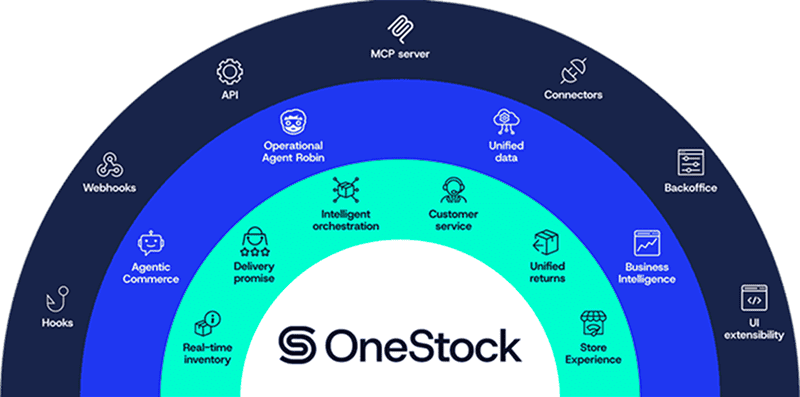
A composable approach changes this. A brand can build on a modern commerce platform such as Shopify, add OneStock’s distributed order management to orchestrate inventory and fulfillment across its wider network, and work with a specialist integration partner such as RunDTC to connect it all. The result is a connected data layer in which every channel, boutique and distribution hub works from the same real-time view of stock.
Modern commerce for luxury: Shopify
Shopify gives luxury brands a modern commerce platform that spans the online storefront, checkout, point of sale, inventory, international selling through Shopify Markets, and B2B. It lets brands launch and evolve premium experiences quickly and with strong brand control, so the digital expression of the house matches its physical heritage.
Orchestration at scale: where OneStock fits
As a luxury house grows, it adds boutiques, concessions, warehouses, logistics partners and new regions. The challenge then shifts from selling the product to orchestrating every unit of scarce inventory across a complex network, much of it still managed in legacy ERP and WMS systems.
OneStock provides a distributed order management layer for that complexity. It unifies inventory across all locations and applies intelligent orchestration rules. This lets luxury brands make ambitious customer promises, and keep them, without sacrificing service or exclusivity.
Key OneStock capabilities for luxury retail:

Increase loyalty & AOV through flawless experiences: Enable unified order management to power high-touch services like in-store appointments and VIP fulfillment.

Prevent oversells to protect reputation: Ringfence scarce inventory with real-time unified stock visibility. By applying intelligent safety buffers, brands can achieve significant online order increases during peak periods without compromising boutique presentation.

Endless Aisle and clienteling: Turn every interaction into a sale, even when an item is not physically present. Enable associates in-store to serve customers immediately without complex training.

Boutiques as fulfillment hubs: Turn stores into fulfillment centers to shorten delivery times and lower costs.

Consistent fulfillment across geographies: Centralize inventory and fulfillment rules across every stock location, so growth into new regions doesn’t multiply operational complexity.

Fast time to value: Rapid deployment means services such as Buy Online, Pickup In-Store (BOPIS) can scale within months.
RunDTC: An Integration Partner to Power the Stack
RunDTC is a specialist commerce integration partner that helps luxury brands scale on Shopify with confidence. As a Shopify Platinum Partner with deep expertise in direct-to-consumer (DTC) commerce architecture, RunDTC takes on the complex integration work behind that growth.
As a brand’s footprint grows, operational complexity grows with it. Legacy ERP and WMS systems typically become the bottleneck, unable to keep pace with what luxury retail demands.
RunDTC handles the end-to-end technical implementation. It connects OneStock with Shopify and the brand’s existing systems, giving brands a dedicated layer for the inventory orchestration and fulfillment logic that becomes mission-critical at scale. Brands don’t need to manage multiple vendor relationships or risk misalignment between systems: RunDTC owns the integration, so the entire stack performs as a single, coherent commerce engine.
“As luxury brands scale, the complexity of orchestrating inventory and fulfillment across every stock location and channel grows right alongside them. At RunDTC, our work with Shopify and OneStock is about making sure operational precision keeps pace with that growth – so every customer interaction reflects the full precision and craft the brand stands for.”
— Paul Zaengle, CEO, RunDTC
Operational synergy
This connected architecture turns complex operational data into a powerful tool for clienteling and customer service. When store associates and ecommerce channels share real-time visibility of unified stock levels, the risk of overselling exclusive or scarce items drops sharply. Premium delivery promises can be made, and kept, with confidence.
The result is a fragmented logistics ecosystem turned into a fluid, responsive brand experience. It shows how the luxury experience customers see depends on the precision of the architecture they don’t.
Looking to the AI-Influenced Future
A connected stack also lays the foundations for emerging AI requirements. Next-generation AI tools can predict what a customer wants or curate personalized recommendations. But those tools are compromised if the systems underneath cannot confirm stock availability in real time.
An AI engine might recommend a bespoke item to a VIP client. If that item is actually sold out because inventory is disconnected, the AI has simply accelerated a broken promise. A unified data layer ensures that customer-facing AI tools are fueled by operational reality.
Today, OneStock’s intelligent order orchestration uses real-time business rules to route orders and protect scarce inventory. Establishing this unified data foundation also future-proofs the house for predictive AI. By centralizing global inventory and fulfillment patterns now, luxury brands lay the groundwork for machine learning models that could eventually forecast regional demand surges, optimize safety buffers automatically, and pre-allocate rare pieces before a boutique advisor even logs in.
Chapter 3: The Commercial Impact of Operational Confidence
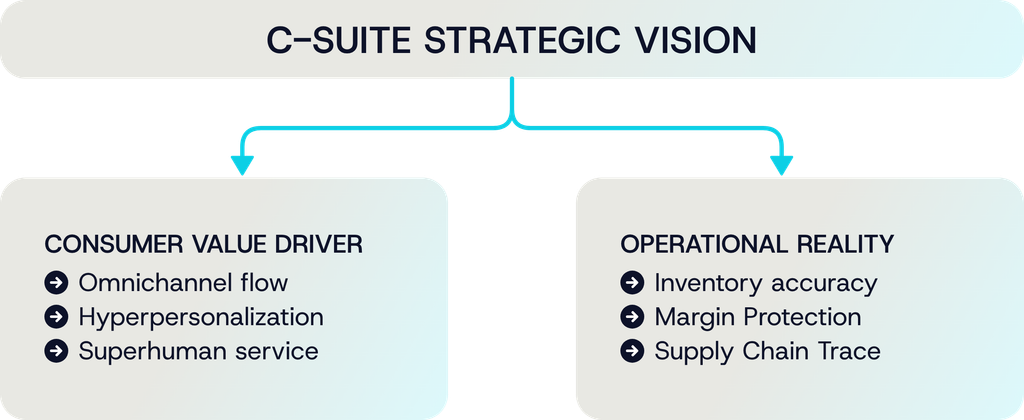
Investing in technology within the luxury sector is no longer an optional line item for ‘digital experimentation.’ Rather, it is a fundamental requirement for operational survival and brand preservation. As the market navigates structural demographic shifts and economic volatility, the line between a brand’s front-end prestige and its back-end infrastructure has completely vanished.
Modern luxury consumers do not measure value by price alone; they evaluate the integrated ecosystem of storytelling, emotional connection, and flawless execution. Any operational friction (such as stock inaccuracies, delayed delivery, or repetitive data requests) breaks the luxury illusion and disappoints customers.
Replacing fragmented legacy infrastructure with a modern, composable architecture addresses four key business value drivers:
- Inventory optimization and allocation precision: Luxury relies on artificial scarcity. Data-driven predictive analytics ensure the right product is available in the right boutique, in the right quantity, at the exact right time, eliminating both costly overstocks and missed sales opportunities.
- Client advisor enablement: Technology acts as an extension of the boutique team. Equipping associates with real-time stock visibility and AI-driven clienteling tools transforms store associate enablement into a substantial competitive advantage.
- Omnichannel cost control: Managing a seamless flow across digital, mobile, and brick-and-mortar storefronts introduces significant fulfillment expenses. Intelligent routing and modern order orchestration keep these back-office costs in check while maintaining premium delivery standards.
- Supply chain traceability and authenticity: Particularly important in high-end jewelry and watches, this technology can enable end-to-end provenance tracking. For example, a feature such as AI-powered image recognition could cross-reference catalogs to verify authenticity, protecting the brand against counterfeiting while supporting sustainability goals.
What a Composable Stack Means for Luxury Brands
Bringing together Shopify, OneStock, and RunDTC moves luxury brands away from a ‘technical integration’ story toward a ‘commerce success’ story.
The commercial benefits can be clearly articulated and summarized as follows:
- Higher conversion and stock efficiency: Better availability directly translates into higher sales and stronger margins.
- Elevated customer loyalty: Keeping a strong customer promise builds the trust necessary for long-term luxury relationships.
- Agility and innovation: Brands can now innovate at the speed of the consumer, rather than being held back by legacy system limitations.
In this way, modernizing the stack with Shopify + OneStock – integrated by RunDTC – eliminates the technical debt that currently prevents luxury brands from deploying new experiences, services and AI at scale.
Clean, structured, real-time data is the literal lifeblood of artificial intelligence. Legacy, siloed retail systems trap data in isolated pockets, making it impossible to train clienteling or inventory algorithms effectively. Investing in a composable architecture today ensures that when the house is ready to deploy autonomous client advisors or generative AI styling tools, the core commerce data layer is already clean, connected, and ready to scale without costly re-platforming.
Industry Perspective: Proof Points
Unified inventory and intelligent orchestration let brands make stronger customer promises, and keep them. In luxury retail, flawless execution is not just an aesthetic but a measurable business result, as the following OneStock customers show.
For instance, Longchamp unified its inventory and order orchestration on OneStock to roll out premium omnichannel services across its international store and ecommerce network. Meanwhile, on the high-touch service front, Hobbs bridged the digital divide through virtual clienteling, resulting in 35% of all customer appointments being booked virtually and generating over $250k in additional revenue.
By turning stores into fulfillment hubs, Hackett and Pepe Jeans saw peak online orders rise 50% and 100% respectively, while fulfilling UK orders from local stores rather than a central warehouse in Spain cut average delivery times from 8 days to 2.5 days.
Furthermore, Orlebar Brown transformed store associate enablement into a distinct competitive advantage, utilizing intuitive Ship-from-Store and Order-in-Store workflows to empower teams while centralizing inventory rules to streamline complex global expansion.
In another example, ba&sh deployed OneStock in just three months, with Ship-from-Store going on to generate a 22% increase in online revenue.
These results show that when every channel works from real-time, unified inventory, the commercial return is fast and measurable.
Conclusion: Building the Future of Luxury Retail
In short, luxury brands need the operational confidence to fulfill every promise they make to their most valuable customers, however complex their network becomes.
To echo our introductory point: unlike other sectors of retail, where speed and price often dominate, luxury relies on a “Customer Promise” built on exclusivity, trust and flawless execution.
A composable approach, with Shopify and OneStock integrated by RunDTC, gives luxury brands a modern foundation to scale globally without sacrificing the service, exclusivity or confidence that define their brand promise. By moving beyond fragmented legacy systems to a unified, real-time view of inventory and fulfillment, brands can finally bridge the gap between digital aspiration and operational reality.
About RunDTC
Working with global brands such as Steve Madden, Dooney & Bourke, Samsonite, and Ariat, RunDTC enables our clients to move quickly and grow faster by elevating and optimizing the Commerce, Marketing, Product Information, and Order Management systems and processes that drive their businesses.
Combining our decades of brand operator and agency experience with our extensive platform expertise, RunDTC crafts the unified commerce solutions that support the multi-touchpoint, personalized customer journey brands strive to deliver.
Learn more at www.rundtc.com