Omnichannel Order Management is Critical for Scale and Growth
Today’s shoppers expect connected, consistent retail experiences. 75% of customers shop both online and in-store, with more people than ever using cross-channel services: for example, 29% buy online and pick up in-store.
You’ll see real numbers and KPIs against which you can benchmark your omnichannel capabilities.
We’ll also share ideas and inspiration for creating best-in-class customer experiences, so you can become an omnichannel leader.
But while customers are moving seamlessly between channels, delivering on these expectations is still a challenge for retailers.
Many merchants need help managing complex stock pools and making products available to customers while balancing supply and demand.
Intelligent order management is central to delivering great omnichannel customer experiences, meeting shopper demands and maximising profits.

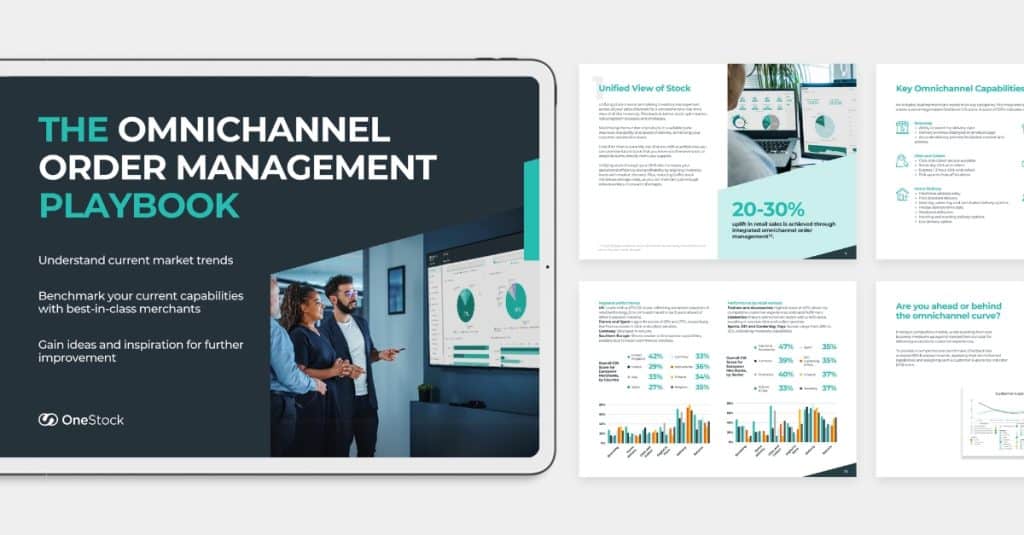
This ebook will look at how and why merchants need to invest in order management to connect with the omnichannel shopper.
What’s the Cost of a Poor Omnichannel Experience?
While most retailers have optimised the browsing and exploration element of the purchasing journey, omnichannel order management is a different challenge.
Many retailers still fall short of customer expectations, with significant consequences:
- Up to 82% of consumers have experienced out of stocks over the last 12 months (online and in-store)
- 69% of online buyers turn to a competitor if the desired item is not available
- 55% choose another store if the item they are looking for is out of stock in-store
- Almost half of omnichannel consumers will shop elsewhere if they feel delivery times are too long
Meanwhile, behind the scenes:
- Inventory distortion (stockouts and overstocks) cost retailers nearly $1.8 trillion in 2023. That’s roughly the size of Brazil’s entire GDP!
- 4 in 10 merchants struggle with inconsistent fulfilment processes across channels
- At least 30% of all products ordered online are returned9; returns cost retail companies around 6% of total RRP
- 31% of online retailers cite order splitting as the costliest aspect of order fulfilment
There’s no point getting customers to the checkout if you can’t then deliver what they want, when and where they want it, with a good profit margin for your business.
So let’s look at how you can enhance your order management capabilities.
Part 1- The Opportunity
How Can Order Management Drive Omnichannel Sales Growth?
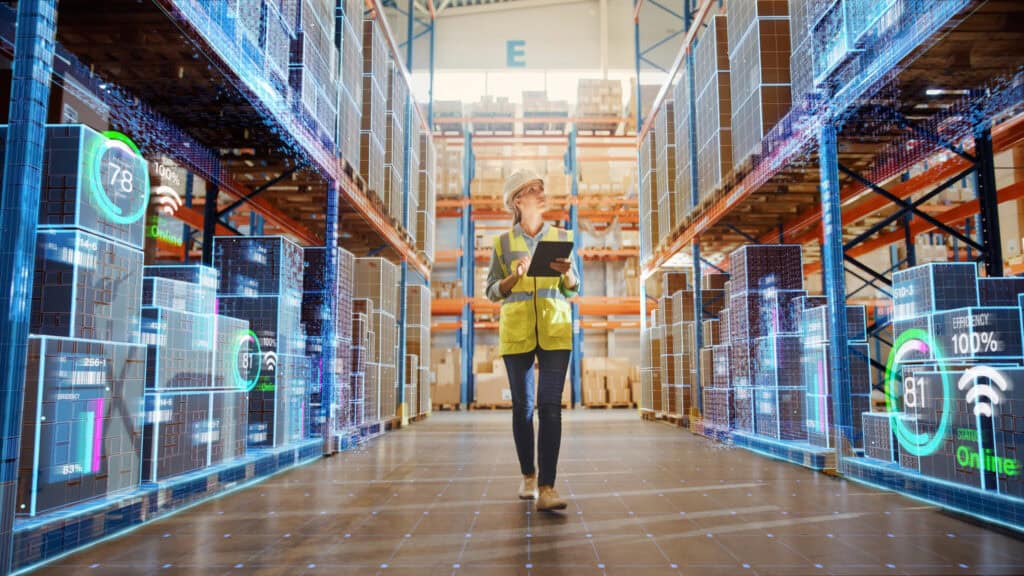
Today’s retail leaders are investing in technology to gain a complete view of stock, integrate and automate order management, and fulfil orders quickly, cost-effectively, and sustainably.
By connecting new channels and moving to a unified stock pool, your business can introduce cross-channel services that make fulfilment, deliveries and returns more convenient for your customers – and more profitable for your business.
Let’s look in the following paragraphs at some examples of the value that a truly omnichannel order management can yield.
Unified View of Stock

Unifying stock means centralising inventory management across all your sales channels for a comprehensive real-time view of all the inventory. This leads to better stock optimisation, reducing both excesses and shortages.
Maximising the number of products in a sellable state improves availability and speed of delivery, enhancing your customer satisfaction levels.
Even if an item is currently out of stock, with a unified view you can promise future stock that you know you’ll receive soon, or dropship items directly from your supplier.
Unifying stock through your OMS also increases your operational efficiency and profitability by aligning inventory levels with market demand. Plus, reducing buffer stock minimises storage costs, as you can maintain just enough extra inventory to prevent shortages.

More Delivery Options and More Precise Customer Promises
Shipping doesn’t necessarily need to be quick, but it should be predictable: 62% of consumers say an accurate estimated delivery date is more important than fast shipping.
At the other end of the scale, some consumers are happy to choose slower delivery options with a lower climate footprint: something you can offer with comprehensive delivery information. If incentivised, 83% of consumers would opt for slower, more sustainable shipping for online purchases.
Calculating and displaying real-time delivery data gives your customers the confidence to make purchases; statistics show that businesses offering precise delivery times increase their conversion rates by up to 10%.
Precise delivery information has been proven to increase shopper satisfaction, reduce customer service enquiries and improve conversion rates. You can even roll-out value-add services, like allowing customers to filter goods available for delivery in the next 24 hours.
Plus, you can use your delivery data to propose multiple delivery options, giving customers greater choice and convenience. This includes options like same-day and next-day home delivery; two-day or faster delivery options produce a 10.5% uplift in conversion rates and an 8.9% increase in repeat purchases.

Be Able to Fulfil & Deliver Online Orders from Stores

Out of stocks are many customers’ biggest irritant. Yet the average online unavailability rate is still 18% at the beginning of the season and 35% during the clearance period.
Being able to have stores fulfilling online orders immediately improves availability for your online customers and can positively impact your store network. This capability:
- Increases website conversion rates
- Utilises stock not selling in-store for ecommerce orders
- Speeds up stock replenishment
- Increases the productivity of store associates (hundreds of online orders can be fulfilled by store associates each day)
- Enables cost-effective international fulfilment because orders can be delivered from a local store

Offering Click and Collect & Reserve and Collect Services

Adding click and collect and reserve and collect services are another way to offer convenient customer delivery options that drive revenue for your business.
Click and collect gets goods to customers quicker than home delivery. The average time to fulfil an order in-store is 1.2 days versus 1.8 days in warehouse. Plus, it generates additional footfall and creates cross-selling opportunities when customers are collecting their orders.
There are also operational benefits to rolling out click and collect as it drastically reduces fulfilment costs compared to home delivery, and managing this service centrally through your OMS ensures click and collect fulfilment doesn’t impact store sales or service levels.

Sell In-Store Products That Are Not Available in That Specific Location

Out-of-stocks and limited product availability can be incredibly frustrating for bricks and mortar shoppers.
Order in store services gives these consumers the ability to order products even when they’re not available at the shelf edge.
As a retailer, offering order in store capabilities will enable your business to:
- Capture (easy) sales that would otherwise have been lost
- Leverage stock from across all your channels
- Allow customers to build mixed baskets
- Provide a new, convenient way to buy or reserve products
- Create a new type of store with very little or no stock (showroom experience) where people can see or try goods before ordering them digitally

Allow In-Store Returns
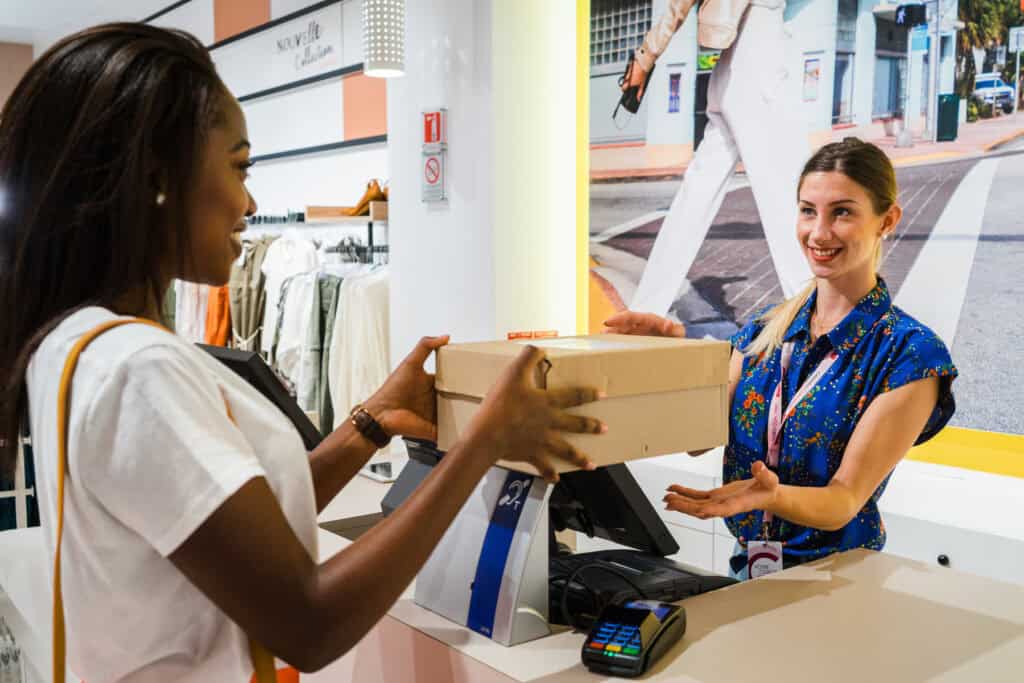
Returns are an Achilles heel for many merchants. 9.1% of orders are returned on average24, rising to 25.9% in fashion and apparel.
But many merchants don’t allow online orders to be returned to the store because of internal challenges around logistics, processing, accounting and accountabilities.
By implementing in-store returns, retailers reap the associated benefits:
- Increase store footfall
- Generate further sales: up to 40% of customers make additional purchases when they return an item to the store
- Utilise your retail associates to process returned items
- Allow returned goods to be sold immediately without being sent to the central warehouse

Easily Add Marketplaces as New Sales Channels
8 in 10 online retail journeys currently start on marketplaces. By integrating marketplaces into your omnichannel order management strategy, you can:
- Introduce your brand to a wider customer base
- Test new products and markets with minimal risk
- Increase your sales reach without causing out-of-stocks
- Serve marketplace customers with the same efficiency as direct ecommerce orders
Day to day, your OMS also creates real-time links between your marketplaces and other sales channels to show available stock and how inventory is moving.
Based on this data, you can decide what products are available to sell on Amazon or other marketplaces, in what quantity, and whether to allocate stock from other channels if your marketplace quota runs out.
But adding new channels can cause technical challenges — for example, compatibility issues with your existing ERP, CRM or inventory management software — and increase operational overheads due to the need to synchronise inventory across multiple platforms.
Integrating stock control through your OMS simplifies IT architecture, allowing you to run lean and easily add new marketplaces.

Part 2 – Benchmark Yourself Against the Omnichannel Curve
Are You Ahead or Behind the Omnichannel Curve?
In today’s competitive market, understanding how your business measures up against competitors is crucial for delivering exceptional customer experiences.
To provide a comprehensive benchmark, OneStock has analysed 300 European brands, assessing their omnichannel capabilities and assigning each a Customer Experience Indicator (CXI) score.

Key Omnichannel Capabilities
An industry-leading merchant excels in six key categories. We measured and weighted merchants’ capabilities in all six categories to create a percentage-based OneStock CXI score. A score of 100% indicates a retailer offers all the services listed across the six categories.
Browsing
- Ability to search by delivery date
- Delivery promise displayed on product page
- Accurate delivery promise for basket content and address
In-Store Delivery
- Reserve and collect service available
- Same day reserve and collect
- Appointment booking available
- Order in store service
Click and Collect
- Click and collect service available
- Same day click and collect
- Express 1–3 hour click and collect
- Pick up and drop off locations
Delivery Tracking
- Delivery information provided
- Delivery time estimate
- Redirection/reschedule capabilities
- Driver location tracking
- Proof of delivery
Home Delivery
- Predictive address entry
- Free standard delivery
- Next day, same day and nominated delivery options
- Precise delivery time slots
- Weekend deliveries
- Morning and evening delivery options
- Eco delivery option
Returns
- Seamless online returns (web and app)
- In-store return services
- Collection and drop-off options
- Pre-printed return labels
- Label-less returns
CXI Scores: How Do You Compare?
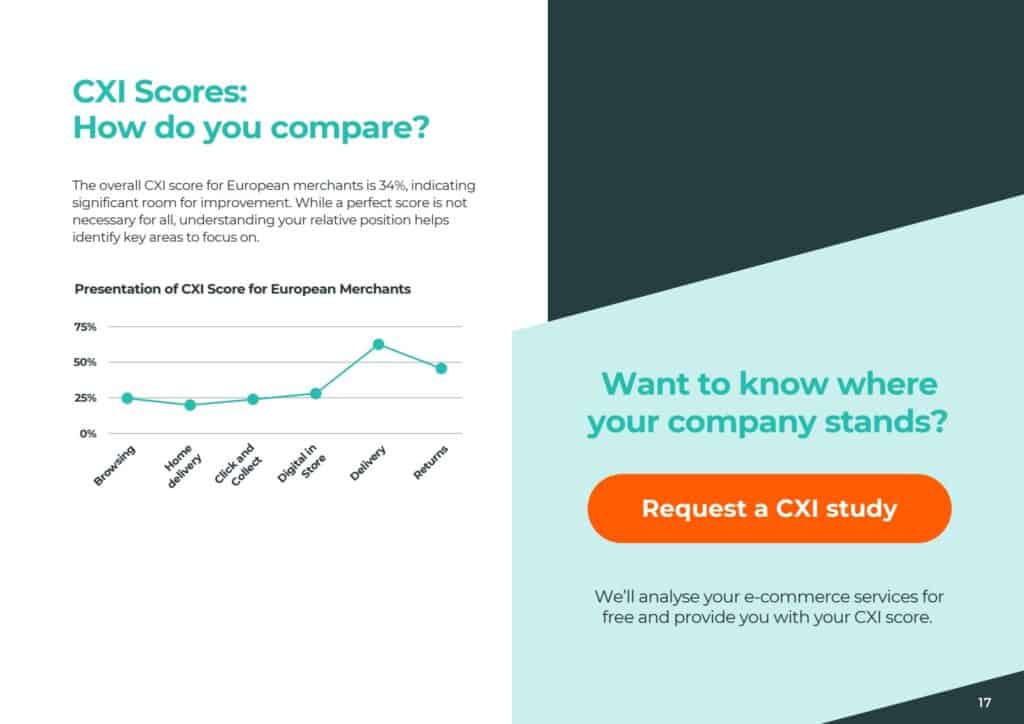
The overall CXI score for European merchants is 34%, indicating significant room for improvement. While a perfect score is not necessary for all, understanding your relative position helps identify key areas to focus on.
Want to know where your company stands?
We’ll analyse your e-commerce services for free and provide you with your CXI score.
Regional Performance
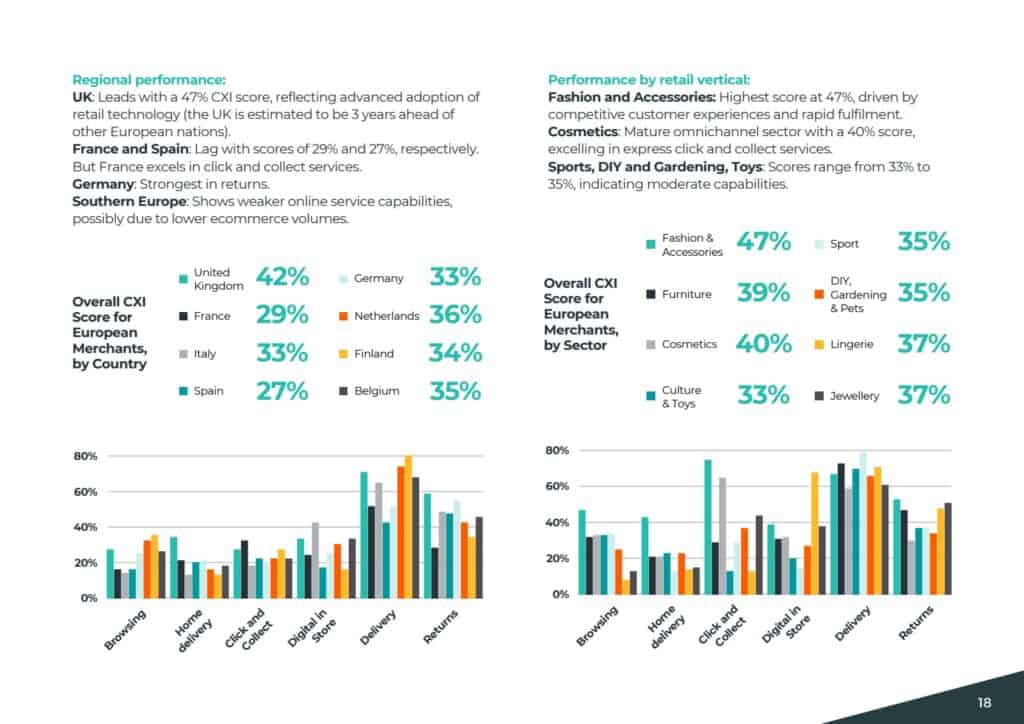
UK: Leads with a 47% CXI score, reflecting advanced adoption of retail technology (the UK is estimated to be 3 years ahead of other European nations).
France and Spain: Lag with scores of 29% and 27%, respectively. But France excels in click and collect services.
Germany: Strongest in returns.
Southern Europe: Shows weaker online service capabilities, possibly due to lower ecommerce volumes.
Performance by Retail Vertical
Fashion and Accessories: Highest score at 47%, driven by competitive customer experiences and rapid fulfilment.
Cosmetics: Mature omnichannel sector with a 40% score, excelling in express click and collect services.
Sports, DIY and Gardening, Toys: Scores range from 33% to 35%, indicating moderate capabilities.
Part 3 – Creating Best-in-Class Order Management
How Modern and Successful Is Your Current OMS?
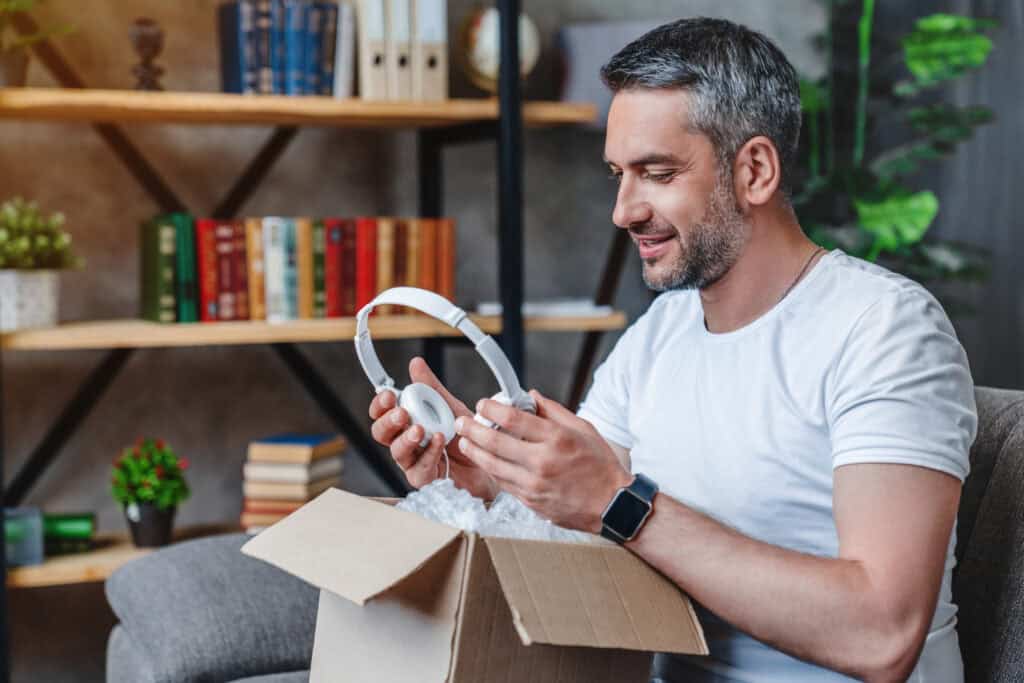
Everything starts from the OMS (Order Management System) which is the tool in charge of managing orders in the best way possible to both reduce costs and frictions for retailers, and providing faster, more convenient delivery options for customers, creating a seamless shopping experience.
Your company is probably already using a best-of-breed OMS or some sort of OMS functionalities which maybe have been custom-made.
Whether you’re leading the industry or chasing the pack, there’s always room to improve your omnichannel order management strategy and enhance customer satisfaction. Compare your key KPIs with some of the best-in-class users of OneStock OMS in the next chapter.
Some Key Capabilities of an Advanced OMS
A modern OMS software will enable your business to:
Maximise fulfilment speed by enabling competitive order orchestration.
Provide ambitious new delivery options such as one day delivery, one-hour click and collect and cross border deliveries using advanced order orchestration.
For example, French retailer Petit Bateau has used OMS software to improve UK ecommerce delivery times from 10 days to 2 days, despite having no local warehouse capability.
And English retailer Pets at Home, which successfully launched the option Click & Collect in 1 hour, now fulfils 24% of their e-commerce orders via the one-hour option.

Easily and regularly modifying orchestration rules to get the best of every season.
For example, your order orchestration strategy can change during peak periods (prioritising warehouses as store teams are too busy with customers) or during the last day of the sales period (prioritising stores that need to clear their stocks).
Being able to simply modify orchestration rules, without needing intervention from the IT team for instance, is a big plus also for teams wanting to be flexible. Many OneStock customers confirm that they modify orchestration rules a few times per year as this helps them achieving better optimisation of their stocks.
Limit split orders.
Splitting orders can lead to additional preparation and delivery costs, which reduce margins and is normally a bad experience on customer side. There are certain scenarios where it’s unfortunately necessary to split shipments (for instance when it’s the only way to meet the delivery demands of a high-value customer) but you can slightly reduce the frequency and cost of split orders using OMS software with advanced orchestration rules. To give you an example of possible benefit, as an average for all OneStock customers, only 3.7% of click and collect orders in 2023 have been split.
Have a tool which is really used by store associates.
Gain deeper understanding of your operations
by analysing omnichannel order management performance. An advanced OMS system includes reporting and analysis tools that give merchants valuable insights on order management, stock points, items, delivery promises and more. Important KPIs to track and analyse include fulfilment speed and splits per stock point, cancellation rates and reasons, web-to-store and store-to-web performance for each geographic zone, store and time period. Does your current set up provide you with these KPIs?
Minimise order cancellations
by removing inventory errors, enhancing cross-channel fulfilment capabilities and preventing stores over-promising orders. Advanced OMS software can significantly reduce order cancellations compared to less modern systems, for several reasons. The most important factors include ease of use for all internal users and stakeholders, gamification that encourages field users to fully engage with the application, and the flexibility and depth of orchestration rules. For example, warehouse availability issues can be addressed by introducing ship-from-store services, or an order that can’t be fulfilled by one store can be transferred to another.

Unlock Your Full Omnichannel Potential
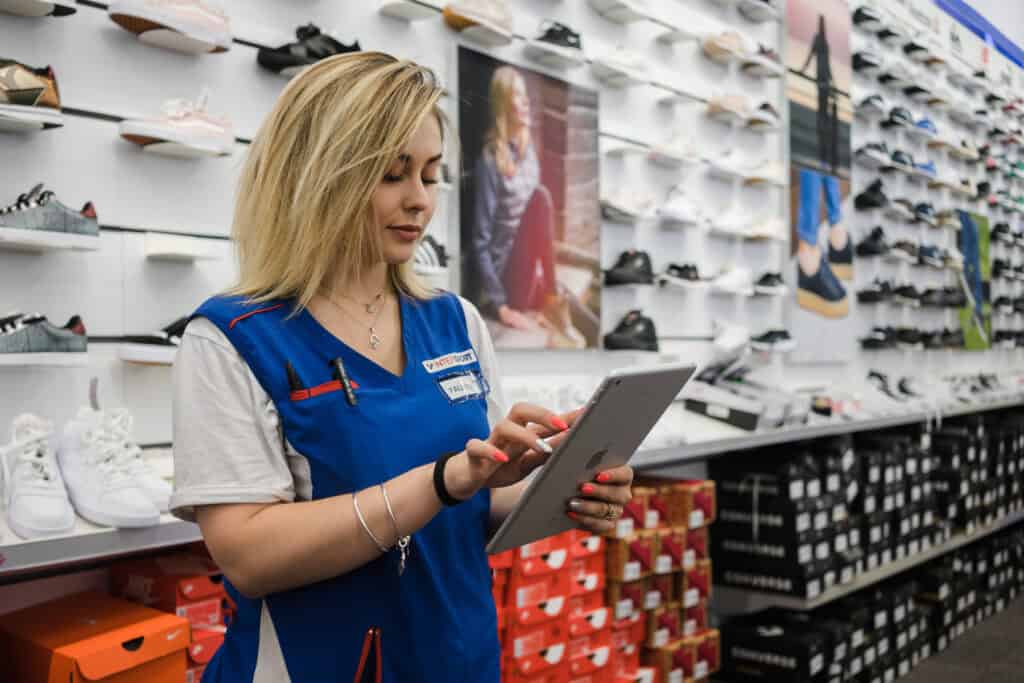
Intelligent order management software is helping merchants to optimise order management and build seamless omnichannel customer experiences.
OneStock OMS streamlines operations and reduces the costs associated with omnichannel fulfilment by enabling merchants to select the best delivery option based on total available stock across all channels.
Our software centralises order visibility and releases stock from local limitations to maximise sales opportunities, while identifying areas for omnichannel optimisation.