Introduction: From Marketing Claims to Verifiable Action
The great outdoors is having a serious moment right now, which is backed up by market data, with the global industry valued at $57.61 billion in 2024 and forecast to rise to $77.55 billion by 2032.
Whether it’s seasoned wilderness purists upgrading their high-performance technical gear or just urban adventurers looking for escape, the outdoor gear scene is booming. According to recent Intel Market Research, over 52% of adults in North America now engage in outdoor recreation annually, thus creating sustained demand for high-quality gear; and the trend towards wellness and nature-based tourism has further accelerated market expansion. [1]
However, in combination with the above average growth in this sector, there are other noteworthy trends that brands will need to consider as these converge to uniquely shape the competitive landscape in this space.
One of the major observations, as a paper published by ScienceDirect explains, is how “outdoor companies are increasingly using marketing to advocate sufficiency-oriented consumption.”[2] In turn, this fuels a virtuous cycle, where more informed and more environmentally conscious consumers actively demand higher standards and greater accountability from the brands from which they buy.
For these consumers, sustainability is no longer a brand ‘value-add.’ Crucially, it’s part of the purchase decision – and, perhaps even more importantly, central to long-term loyalty. They expect the brands they buy from to not only minimize harm, but to protect the trails, the oceans, the mountains, and the ecosystems that their products are built around and for the brands to demonstrate their progress in these areas. As a report by Garrison Everest reveals, by 2026, over 70% of outdoor consumers are expected to prioritize purchasing from companies with credible environmental commitments. As such, brands will expand efforts in circular economy practices, regenerative sourcing, and transparent carbon footprint reporting.[3]
However, as ISPO, the world’s most influential trade event for the sporting goods, points out, “There is still a lot to do. The outdoor industry has made impressive progress in the area of sustainability in recent years and is setting new standards for the entire apparel industry in many respects. But despite these positive developments, we are only at the beginning of a comprehensive transformation that affects all aspects of the value chain and is being driven forward by new legal requirements.”[4]
The outdoor industry has thus reached an inflection point where sustainability is no longer a differentiator but a fundamental requirement for market access and consumer trust. This means that operationalizing sustainability, embedding it into the core mechanics of inventory, fulfillment, and customer data, is now more urgent than ever in the shift from looser marketing claims to evidencing demonstrable action.
Meanwhile, Artificial Intelligence (AI) is fast becoming an essential component for navigating this transformation, providing a backbone for such activities as managing the vast, fragmented datasets required for global regulatory compliance or end-to-end value chain visibility.
The Economic Imperative: Efficiency and cost reduction as the twin engines of sustainability
For senior retail leaders navigating today’s margin-compressed market, environmental stewardship cannot be treated as an isolated cost center. Instead, the mandate to reduce carbon footprints has become inextricably linked to the immediate commercial need for cost reduction and operational efficiency. True operational accountability requires a dual victory: achieving aggressive decarbonization while simultaneously rooting out the hidden financial drains of legacy retail.
By embedding AI and advanced data automation into the core of the business, forward-thinking brands are no longer choosing between profitability and purpose.
Rather, they are leveraging intelligent systems to optimize inventory, slash logistics expenses, and mitigate the margin-damaging impact of product returns – establishing a baseline of economic resilience that will be detailed throughout this paper.
From sustainability claims to operational accountability
Ultimately, a shift towards operational accountability rather than claims alone allows outdoor brands to turn environmental responsibility into a scalable, margin-protecting strategy – one that perfectly balances the consumer’s need for speed with the planet’s need for protection. In practice, achieving this balance requires a targeted transformation across three interconnected areas:
- The Rise of the ‘Active Stakeholder’ Consumer
Modern outdoor consumers are no longer passive buyers and sustainability has become a key purchase driver, but so too has the demand for proof and the need for brands to build ever deeper trust in the face of consumer skepticism. - Solving the ‘Hidden’ Sustainability Challenge: Inefficiency
Operational inefficiency is one of retail’s largest hidden sustainability hurdles. Strategic operationalization turns these challenges into a commercial advantage, while also setting the right foundations for increasing regulatory scrutiny. - Bridging the Intention-Action Gap
While many consumers intend to buy sustainably, ‘market design’ often makes the unsustainable choice the default. But, by operationalizing data, brands can more effectively design experiences that encourage lower-impact customer decisions, such as picking up in-store or selecting consolidated delivery.
The result is a more resilient, commercially credible model that fully satisfies the demands of the modern, environmentally conscious consumer without compromising the speed or convenience they expect.
Chapter 1: The Rise of the ‘Active Stakeholder’ Consumer
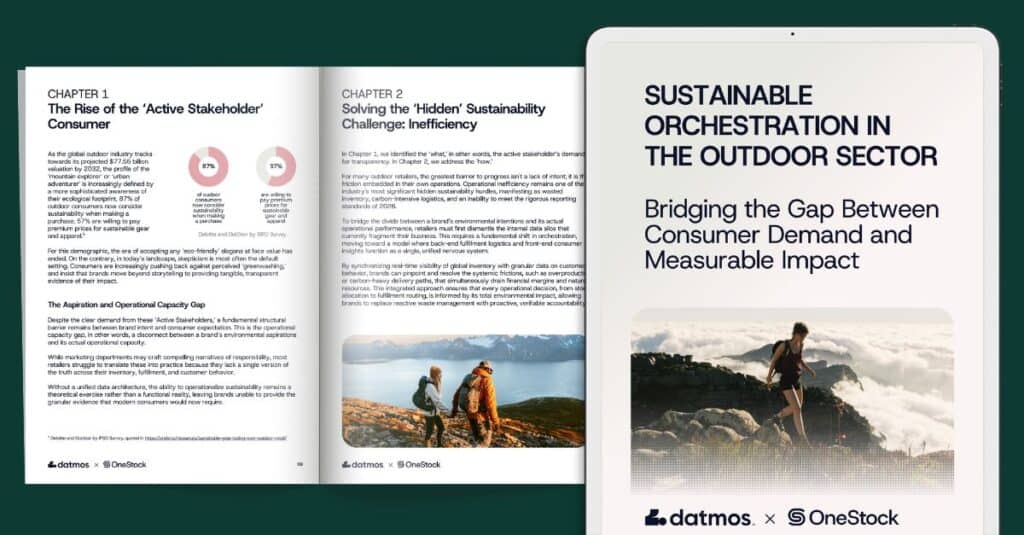
As the global outdoor industry tracks towards its projected $77.55 billion valuation by 2032, the profile of the ‘mountain explorer’ or ‘urban adventurer’ is increasingly defined by a more sophisticated awareness of their ecological footprint. 87% of outdoor consumers now consider sustainability when making a purchase. 57% are willing to pay premium prices for sustainable gear and apparel.[5]
For this demographic, the era of accepting any ‘eco-friendly’ slogans at face value has ended. On the contrary, in today’s landscape, skepticism is most often the default setting. Consumers are increasingly pushing back against perceived ‘greenwashing,’ and insist that brands move beyond storytelling to providing tangible, transparent evidence of their impact.
The Aspiration and Operational Capacity Gap
Despite the clear demand from these ‘Active Stakeholders,’ a fundamental structural barrier remains between brand intent and consumer expectation. This is the operational capacity gap, in other words, a disconnect between a brand’s environmental aspirations and its actual operational capacity.
While marketing departments may craft compelling narratives of responsibility, most retailers struggle to translate these into practice because they lack a single version of the truth across their inventory, fulfillment, and customer behavior.
Without a unified data architecture, the ability to operationalize sustainability remains a theoretical exercise rather than a functional reality, leaving brands unable to provide the granular evidence that modern consumers would now require.
This lack of unified visibility has tangible consequences for both the planet and a brand’s commercial credibility. Without a holistic view of end-to-end activities, retailers cannot accurately identify the systemic inefficiencies, such as fragmented stock or high-return purchase paths, that drive avoidable emissions and waste. Ultimately, this data vacuum prevents brands from optimizing stock levels or, for example, lowering their carbon output at the source.
From defensive marketing to transparency
For the active stakeholder consumer, this represents a failure of transparency; if a brand cannot see its own operational impact, it cannot make credible sustainability promises, leaving its market position vulnerable to more agile, data-driven competitors.
Brands that fail to provide demonstrable action risk more than just a lost sale; they risk severe reputational damage and the erosion of trust within a community that is highly connected and increasingly vocal. To bridge this trust gap, retailers must find ways to operationalize their sustainability claims, embedding data and transparency into the core mechanics of the customer experience.
The Role for AI: Providing the “tangible, transparent evidence” demanded by active stakeholders is often a data processing hurdle. AI acts as a critical engine here, capable of parsing and verifying large, fragmented supply chain datasets that would be impossible to manage manually. By synthesizing thousands of data points from diverse global suppliers, AI turns a brand’s ‘data vacuum’ into a verifiable asset, allowing retailers to move beyond static claims to provide the real-time, granular material facts that build long-term trust.
By recognizing the consumer as an active stakeholder, outdoor brands can transition from defensive marketing to a model of transparency. This sets the foundation for the next stage of the transformation: addressing the ‘hidden’ sustainability challenges that reside deep within the retail operation itself.
Chapter 2: Solving the ‘Hidden’ Sustainability Challenge: Inefficiency
In Chapter 1, we identified the ‘what,’ in other words, the active stakeholder’s demand for transparency. In Chapter 2, we address the ‘how.’
For many outdoor retailers, the greatest barrier to progress isn’t a lack of intent; it is the friction embedded in their own operations. Operational inefficiency remains one of the industry’s most significant hidden sustainability hurdles, manifesting as wasted inventory, carbon-intensive logistics, and an inability to meet the rigorous reporting standards of 2026.
To bridge the divide between a brand’s environmental intentions and its actual operational performance, retailers must first dismantle the internal data silos that currently fragment their business. This requires a fundamental shift in orchestration, moving toward a model where back-end fulfillment logistics and front-end consumer insights function as a single, unified nervous system.
By synchronizing real-time visibility of global inventory with granular data on customer behavior, brands can pinpoint and resolve the systemic frictions, such as overproduction or carbon-heavy delivery paths, that simultaneously drain financial margins and natural resources. This integrated approach ensures that every operational decision, from stock allocation to fulfillment routing, is informed by its total environmental impact, allowing brands to replace reactive waste management with proactive, verifiable accountability.
The Friction of Fragmentation: Data Silos and Overproduction
The most pervasive hurdle in modern outdoor retail is the lack of a ‘single version of the truth’ across inventory, customer and other data. When these systems are fragmented, operational visibility is limited, leading to a number of environmental and commercial consequences, which include:
- Overproduction Risks: Poor stock visibility and inaccurate forecasting often lead to overproduction, a massive source of industry waste.
- Managing Volatility: Seasonal volatility, characterized by shorter winters and unpredictable weather, creates significant inventory risk. Without intelligent inventory and order orchestration, brands cannot respond effectively to these demand shifts, leading to excess stock that eventually requires carbon-intensive clearance cycles or disposal.
- Real-Time Solutions: By establishing real-time stock visibility, retailers can improve sell-through rates and significantly reduce the risk of overproduction, ensuring that gear is manufactured and moved only when and where it is needed.
The Role of AI: AI-driven demand forecasting offers a sophisticated alternative to traditional, static models. By integrating complex external datasets, such as multi-year climate patterns, local trend shifts, and real-time social sentiment, machine learning can predict stock requirements with significantly higher precision. This means gear can be manufactured in direct alignment with actual demand, mitigating the inventory risks posed by seasonal volatility.
The Carbon Cost of Inefficient Fulfillment
In the race to balance speed with sustainability, traditional fulfillment models often default to the most carbon-intensive paths.
- Logistics Inefficiency: Disconnected logistics systems increase both operational costs and total carbon output; retailers can resolve this by establishing a single version of the truth across all inventory points to orchestrate more efficient delivery routes.
- Localized Orchestration: Routing orders exclusively from distant distribution centers creates unnecessary emissions and transit delays. One way in which this could be addressed is by enabling ship-from-store models, which reduce carbon output by routing orders through the closest local fulfillment point rather than distant distribution centers.
- Consolidation and Last-Mile: Reducing split shipments and encouraging low-impact choices like Click & Collect (BOPIS) mitigates the high environmental impact of last-mile delivery while simultaneously increasing store footfall.
Case in Point: Patagonia’s “Place” Strategy
An essential aspect of Patagonia’s “Place” strategy is its commitment to ethical logistics. The company ensures that its product supply chain aligns with its sustainability goals by design, not by accident. Every aspect, from sourcing raw materials to distribution channels, is engineered with reduced carbon emissions in mind. This benchmark demonstrates that “Place” is not just about where a product is sold, but how it is moved, turning distribution into a core component of the brand’s environmental promise.
The Returns Crisis and Customer Influence
Sustainability is as much about influencing the customer journey as it is about optimizing the warehouse. One of the largest ‘hidden’ carbon drivers in e-commerce remains the high rate of returns, which causes avoidable emissions and erodes profit margins.
- Predictive Reduction: Customer behavior data can be used to predict and reduce high-return journeys before they occur, allowing brands to address the root causes of return-driven waste.
- Informing the Purchase: Currently, consumers often face limited sustainability data at the point of purchase. This gap might be bridged by surfacing richer product transparency data, including sourcing and footprint signals, for example, directly within the storefront.
- Incentivizing Green Choices: By designing storefront experiences that reward lower-impact decisions, such as selecting consolidated delivery or in-store pickup, brands can align customer behavior with their broader environmental goals.
- Crowdsourced Validation: Leverage reviews to provide useful purchase information for customers regarding specific products (e.g. Size validation, fit, quality, etc.) to inform the customer to get the right product on the first order.
Case in Point
Patagonia exemplifies this operational shift through a customer-conscious approach to its shipping practices, encouraging consumers to opt for slower shipping methods when they check out online to help reduce carbon footprints. This aligns with sustainability efforts seen in Metrobi Baltimore courier operations, where prioritizing delivery density and optimized routing over raw speed significantly lowers the total environmental impact of the last mile.
From Claims to Accountability
As regulatory scrutiny intensifies, the pressure to prove sustainability claims with measurable action has moved from the marketing department to the C-suite. Brands can no longer treat sustainability as a narrative alone; they must embed it into their retail operations to ensure commercial credibility and long-term loyalty.
By combining operational efficiency with customer insight, outdoor brands can transform sustainability from a cost of compliance into a scalable competitive advantage. The result is a resilient operating model that meets the ‘Active Stakeholder’s’ demand for transparency without compromising the speed or convenience of the modern retail experience.
Chapter 3: Bridging the Intention-Action Gap - From Operational Efficiency to Commercial Advantage
While Chapter 2 focused on the ‘how’ of internal operationalization, in Chapter 3, we now address the ‘final frontier’: the consumer’s point of purchase.
Even with a highly optimized back-end, many retailers fail to bridge the ‘Intention-Action Gap,’ the phenomenon where consumers express a strong desire for sustainability but default to less eco-friendly behaviors due to the convenience or speed of traditional retail design.
To solve this, outdoor brands must move from being passive observers of customer choice to active facilitators of sustainable behavior. By leveraging the combined strengths of inventory, product, order and customer behavioral data, brands can transform the customer journey so that the ‘green’ option also becomes the most rewarding choice.
1. Re-Designing the Digital Storefront for Impact
Most ecommerce platforms are historically optimized for speed and conversion, without regard for environmental cost. Bridging the gap requires a fundamental redesign of the user experience to prioritize lower-impact decisions.
- Incentivizing Green Choices: By using customer behavior data, brands can design storefronts that reward sustainable decisions, such as offering loyalty points for consolidated delivery or highlighting the carbon savings of in-store pickup.
- Surfacing Real-Time Transparency: Skepticism is countered when brands provide granular data at the moment of decision. Sourcing and footprint signals might be surfaced directly within the shopping journey, ensuring that the ‘Active Stakeholder’ not only has the tangible proof they demand but is also empowered to make more informed choices.
- Orchestrating the Promise: Sustainability claims are only as good as the fulfillment that follows. Real-time visibility is required to make and keep high-integrity promises, such as accurate availability for local Click & Collect (BOPIS), which reduces the environmental cost of last-mile delivery.
Action-sports and outdoor retailer evo provides a clear model of how digital commerce design can shift from passive transactional platforms to active facilitators of ethical consumerism. Through its community impact initiative, the brand transparently surfaces a key commitment directly on its storefront: purchasing any evo-branded product automatically directs 2% of the sales revenue toward its philanthropic partners and youth outdoor programs.[6]
By integrating this choice directly into the product discovery and checkout path, evo provides a seamless mechanism that influences shopping behavior through value alignment. Rather than relying on high-friction, post-purchase donation prompts, this strategy embeds community support directly into the consumer’s primary decision matrix.
It serves as a prime operational example of re-engineering the digital experience to empower the ‘Active Stakeholder’ consumer, demonstrating that when brands provide clear, structured choices to support environmental and social initiatives at the point of purchase, shoppers are far more likely to successfully bridge their own intention-action gaps.
2. Turning Sustainability into Economic Resilience
The transition from sustainability as a narrative to sustainability as a discipline creates a measurable, scalable commercial advantage. When sustainability is operationalized, environmental gains align directly with financial performance.
- Margin Protection through Return Mitigation: High return rates are not only a carbon driver but a primary source of margin erosion. By using predictive data to reduce high-return journeys before they occur, brands can protect both their profits and the planet.
- Inventory Efficiency as Resilience: In an era of seasonal volatility and unpredictable weather, intelligent inventory and order orchestration is essential for long-term survival. Optimized stock levels mean fewer markdowns, improved sell-through, and a significant reduction in the waste associated with overproduction.
- Lowering Operational Costs: Smarter fulfillment paths, such as ship-from-store, don’t just lower emissions; they reduce the logistics costs associated with shipping products multiple times from distant warehouses.
The result of this transformation is a more resilient, commercially credible model that is also future ready for the application of AI use cases. By unifying inventory visibility, intelligent fulfillment, and customer data, outdoor brands can meet the dual demands of the modern era: providing the speed and convenience consumers expect without compromising the ecosystems they love.
Conclusion: The Modern Retail Operating Model
By 2026, the outdoor industry has moved past the era of sustainability as a peripheral brand narrative. Rather, sustainability has become a core operational discipline mandated by consumer expectation, regulatory necessity, and commercial survival. As this paper has explored, the greatest barriers to meaningful progress are the ‘gaps,’ which can be summarized as the disconnect between corporate intent and operational capacity; a divide created by fragmented data and legacy silos that prevents brands from providing the tangible proof modern consumers demand.
On the other hand, by unifying inventory visibility and intelligent fulfillment with deep customer insights, outdoor brands can instead operationalize sustainability at scale. This orchestration allows retailers to eliminate the ‘hidden’ environmental and financial costs of inefficiency, from overproduction and avoidable logistics miles to the carbon-heavy cycle of returns.
Ultimately, this transition represents a fundamental shift in the retail operating model. Brands that move from making claims to providing demonstrable action will secure a significant competitive advantage by:
- Building Deep Trust: Meeting the rigorous demands for transparency from the ‘Active Stakeholder’ consumer.
- Protecting Margins: Reducing the waste and costs associated with operational inefficiency and high return rates.
- Ensuring Resilience: Creating a flexible, data-driven model capable of navigating seasonal volatility and unpredictable market shifts.
The future of outdoor retail belongs to those who recognize that commercial success and environmental integrity are no longer in competition, but are two mutually beneficial outcomes. By orchestrating a future where speed and convenience meet measurable sustainability, Datmos and OneStock are helping brands protect the very environments that sustain their business and their community.
[1] https://www.intelmarketresearch.com/outdoor-gear-market-22331
[2] https://www.sciencedirect.com/science/article/pii/S2352550922000057
[3] https://www.garrisoneverest.com/outdoor-industry-marketing/outdoor-brand-marketing-predictions-and-digital-strategies-for-2026/
[4] https://www.ispo.com/news-article/sustainability/sustainable-transformation-what-the-sports-amp-outdoor-industry-needs-to-change
[5] Deloitte and Outdoor by IPSO Survey, quoted in https://endvr.io/resources/sustainable-gear-taking-over-outdoor-retail/
[6] https://www.evo.com/pages/community-impact