By Guillaume Vanbrugghe
Most omnichannel retailers will recognize the setup: orders flow through the order management system (OMS), payments flow through the ecommerce platform, and somewhere in the middle, a bridge between the two has been built. Fine, while it works. And then, suddenly, it doesn’t anymore.
The Challenge of Middleware
Of course, this is not surprising, given the everyday realities. A second brand is added. A marketplace. Three countries. A store network. Suddenly our bridge is carrying far more weight than it was ever designed to hold. Every post-purchase operation, every capture, every refund and every cancellation have to be routed through different web platforms that have no visibility of what the OMS has decided.
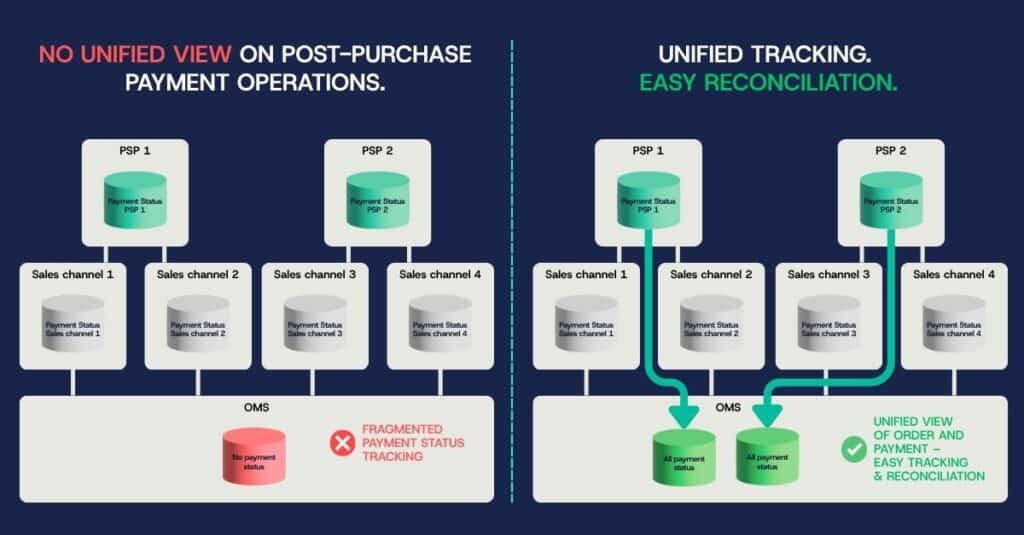
A familiar set of scenarios follow. Finance teams are logging into four different back-offices to find one payment status. Split orders become a special case. Partial refunds become a development ticket. And every new sales channel means someone has to re-explain the routing logic from the ground up.
It feels broken. But, what’s really happened, is everything has just become far more complex.
How To Overcome the Challenges of Middleware
To overcome these common challenges, it makes sense to manage post-purchase operations natively. OneStock, for example, can be connected directly to your payment provider, such as Adyen, with no ecommerce layer in between.
A native approach means no middleware, which brings with it its own additional benefits. There is, for instance, no custom development to maintain. No fragile mapping between logistics statuses and payment instructions. Instead, the OMS and the Payment Service Provider (PSP) speak directly. What happens in the fulfilment location is immediately reflected in what happens at the payment level.
Three Immediate Business Advantages Unlocked with OneStock
1. Capture requests when it makes sense for your business
You can place a capture request at any point in the OneStock order workflow editor: at shipment confirmation, at delivery, or at any custom status you wish to define. In other words, not when the website decides but when your operations warrant it.
For split orders, each parcel triggers its own capture independently.
It means no more approximations, and no more manual corrections at month-end.
2. One screen for everything payment-related
OneStock includes a dedicated payment interface: all statuses, across all channels and all orders, in one place.
Reconciliation can be triggered when an order is shipped but not captured.
Capture, refund, or partial refund can all be executed directly from that screen, without the need to open a PSP console or a brand back-office. Finance can trace what is happening. Customer service can act on it. Internal requests for information are eliminated.
3. Avoid expiring authorizations
Payment authorizations have a shelf life. On long fulfilment cycles, pre-orders, back-orders, or complex B2B flows, that shelf life can run out before the order ships.
OneStock, on the other hand, handles tokenization natively, so authorizations are automatically renewed before they expire. Hence, the order ships, the capture fires, no intervention required.
What Does Order Capture Look Like in Practice?
Let’s take the example of Maria, an omnichannel director at a European fashion retailer that covers four countries, two marketplaces, and a store network that was added eighteen months ago. Post-purchase operations were being handled the usual way: logistics events were being routed back through the e-commerce platform, translated into PSP instructions, and monitored across three separate back-offices.
It was working well enough when the business was simpler. But it wasn’t working well anymore.
At peak periods, the team was manually reconciling payment statuses on a significant share of split orders. This meant cross-referencing the OMS, the PSP dashboard, and the brand back-office to figure out what had been captured, what was pending, and what needed a refund. Authorization expirations on pre-orders were a quarterly headache. And the tech team had just been told that the addition of a fifth country would now mean another round of payment routing specifications.
Now, with OneStock’s native payment connectors, the operation follows the logistics event. It happens automatically, for every channel, every order type, and every fulfilment scenario. Maria’s team configure the capture trigger once per workflow. Tokenization runs in the background. The payment interface gives finance a single view across the entire operation.
The next country took only a week to set up, not a full quarter; a great example of what’s achievable when the right system owns the right operations.
How To Get Started with Direct Payment Connection
In OneStock, the direct payment connection is configured in Sales Channel settings and applied within the order workflow. The payment management interface is accessible directly from the OneStock back-office.
Native connectors are available for Adyen and other major payment providers.
👉 Get a demo