Agentic Commerce Hub

White paper | Readiness assessment | Article series | All content

From Connection to Commitment

AI agents don't browse.
They commit.

Commerce is being rewritten. AI agents now browse, compare and purchase on behalf of customers , evaluating availability, calculating delivery windows, making decisions in seconds.

This hub tracks what’s actually happening at the intersection of AI and commerce execution: the protocols reshaping how agents connect to retail systems, the operational challenges most organisations aren’t ready for, and the strategic decisions that will separate those who participate in agentic commerce from those who compete in it.

No hype. No speculation. Research, analysis and practical frameworks for retail digital, ecommerce and operations leaders navigating the shift. Right now.

Pinned - White Paper

How AI and Agentic Commerce
Are Reshaping Retail

42 pages covering protocols, promise integrity, the maturity model and the architectural shift every retail leader needs to understand.

Access the white paper -->
$ 0 B

Agentic AI
in retail by 2023

0 %

Executives raising
AI budgets

Featured Read

Why Agentic Commerce Needs Operational Truth

Protocols are accelerating the agentic commerce infrastructure. But they solve the connection problem, not the truth problem. Here’s why operational truth is the real battleground.

An OMS that serves as the system of truth for inventory availability, customer promise and order execution becomes the foundation for truly intelligent, agentic commerce

Read the full article -->

Read the latest articles on agentic commerce

Explore our articles and resources

AI as an Enabler of Real Retail Outcomes: Nextuple Order Management Gurus Webinar

As part of the Partner Power Up series within Nextuple’s community-focused group, Order Management Gurus, our VP of Strategy and Chief Evangelist, Karthik Marudur, sat down with Laxman Mandayam, Head of Customer Solutions & Co-Founder, Nextuple, to discuss the future direction of AI within the context of retail and Order Management System (OMS).

The interview opens with Laxman challenging Karthik on the notion of ‘AI first,’ and what this means to OneStock.

What Do We Mean by ‘AI First’?

As Karthik explains, AI is moving fast in retail, with conversations rapidly shifting from hype to outcomes, as he starts by pointing out that the mantra of ‘AI first’ only matters if it delivers measurable operational impact, and if it’s grounded in trustworthy commerce truth.

He continues, “At OneStock, ‘AI first’ is described less as a marketing label and more as an operating model. Internally, the company is already using agents to remove friction from everyday work.”

As an example, Karthik pointed to tools like “OneBot,” which helps teams respond to RFPs, build assets faster, and resolve product questions more efficiently. “That internal discipline,” he explains, “directly shapes how OneStock designs customer-facing agent experiences: start with real problems, prove ROI, then scale.”

National Retail Federation 2026

Recapping OneStock’s recent participation in the event, Karthik points out, “That pragmatism was also a major takeaway from NRF 2026. The team saw a noticeable change in tone across the event floor: retailers and vendors are talking far more about implementable use cases than theoretical possibilities.

Shopping agents, in particular, are gathering momentum, though the broader ecosystem is still early, with many platforms not yet open enough to support seamless integrations at scale,” he adds.

The Practicalities of Agentic Commerce

The interview turns at this point to agentic commerce and putting it in a very practical frame. Agentic commerce, as defined in the webinar, is crucially about AI agents guiding customers through both sides of the customer journey: pre-purchase discovery and decision-making, and post-purchase service.

Expanding on this, Karthik continues, “Before purchase, the agent experience becomes a conversational shopping assistant that doesn’t just recommend products, it recommends executable options, based on the customer’s preferences and real-world constraints like current availability and delivery windows.

After purchase, the same approach turns customer service into a simpler, more unified experience. Instead of forcing shoppers to piece together status across multiple screens, an agent can summarize the order lifecycle, highlight line-item changes, and provide tracking updates in one coherent interaction.”

Agents’ Dependence on Operational Truth

But one of the most important themes in the conversation was a discussion on what dependency agents have on operational truth. Availability, delivery promise, and order lifecycle data aren’t “nice to haves,” rather they determine whether an agent is genuinely useful or dangerously confident. If inventory is stale, promise dates are inaccurate, or order events lag behind reality, the agent will still answer in a definitive tone. The result, Karthik says, is predictable: missed SLAs, failed pickups, increased cancellations, and customers who lose trust quickly because the system sounded certain and turned out to be wrong.

To solve that, OneStock is cementing its role as the provider of trusted, real-time commerce signals that agents can reliably consume. In the interview, Karthik describes how OneStock is enabling both retailer-owned agents (embedded into brand experiences) and external agents (such as ChatGPT) by exposing operationally reliable data through MCP tooling. The idea, he explains, is to make trusted OMS capabilities (inventory availability, fulfillment status, delivery options) ‘query-able’ in a standardized way, so agents can interact with the truth of the order lifecycle rather than loosely inferred estimates.

Operational Efficiency and Return on Investment

The fastest return on investment, however, isn’t necessarily in futuristic shopping journeys; it’s in operational efficiency. The interview highlighted how AI’s most immediate impact often comes from reducing workload and latency for customer service and store teams. When agents can quickly retrieve order context, explain exceptions, and surface the next best action, they compress resolution cycles and reduce the costly ‘swivel-chair’ work that happens across disconnected systems.

Karthik also points here to OneStock’s differentiated fulfillment capability: “competitive allocation.” Instead of assigning an eligible order to a single store and waiting, the model sends the order to multiple eligible stores and allows the fastest to claim it – while applying guardrails to reclaim orders that stall and deprioritize stores that repeatedly decline. In the example referenced, Karthik cites an average claim time of just 13 minutes where competitive allocation comes into play, coupled with a meaningful reduction in cancellations, firmly positioning speed-to-commit as a lever for improving delivery outcomes.

From Individual Agents to Connected Agents

Looking ahead, the interview closes on Karthik’s forward-looking view of where this all goes next: not just individual agents, but connected agents, collaborating behind the scenes across systems. “That’s the direction OneStock is leaning into; tools and standards that let multiple specialized agents work together across the commerce lifecycle, while still being anchored to the same core requirement: operational truth.”

Because in agentic commerce, connection alone isn’t enough. If an agent can’t access reliable availability, promise, and lifecycle status in real time, it can’t be trusted to act – and trust is the currency that ultimately determines whether these experiences scale, he concludes.
Agentic Commerce Needs Truth, Not Just Connection

During this year’s NRF 2026 event, Google announced the introduction of the Universal Commerce Protocol (UCP).

This new standard is designed to do more than just connect systems; it was created to integrate the full complexity of a commerce journey into a seamless conversational experience.

UCP is to take into account the real world and the complexity of commerce.
Vidhya Srinivasan
Vice President and General Manager of Ads and Commerce, Google (Speaking at NRF 2026)

This represents a strong step forward. UCP provides the possibility of a shared language for agentic commerce, and it enables a world in which AI assistants can browse, compare, and transact on behalf of customers – and do that across retailers, platforms, and channels.

It is therefore part of the answer to addressing one of digital commerce’s most persistent challenges, namely that of fragmentation.

AI platforms don’t want to have to integrate bespoke one-on-one with every merchant out there, and merchants don’t want to have to give up any of their business-critical customizations to be able to participate. So, Google and Shopify joined forces so we could tackle this head on. That’s what makes UCP so powerful.
Mani Fazeli
VP Product, Shopify

While protocols standardize how agents connect to commerce systems, they cannot however guarantee that what those agents rely on is always true. And we have seen from our own experience that, in agentic commerce, truth is everything.

Agentic Commerce Depends on Trustworthy Information

In other words, AI agents do not ‘browse’ in the way that humans do, but rather they make decisions based on signals. They may rely on such information as availability, delivery dates, fulfilment options, or returns policies. These are inputs, as opposed to marketing messages. If those inputs are wrong, outdated, or overly optimistic, the entire experience is negatively impacted.

An agent that confidently places an order for an item that cannot ship, cannot arrive on time, or cannot be fulfilled as promised doesn’t only fail in the transaction, it damages trust in the system (and indeed the brand) that enabled it.

Agentic commerce fails when agents connect to unreliable operational truth.

The Hidden Risk: Promises Without Operational Reality

On the positive side, UCP standardizes how agents:

  • Discover products
  • Add them to carts;
  • And initiate checkout flows

However, this alone does not guarantee:

  • Accurate, real-time inventory availability
  • A reliable delivery promise calculation
  • Intelligent fulfilment decisions across locations
  • Transparent handling of splits, substitutions, or delays
  • Consistent post-purchase execution

The items on the latter list are not protocol problems – they are order management problems. And the danger of agentic commerce is that it can dramatically amplify these existing challenges.

OMS as a Key Foundation in a UCP World

If AI-driven commerce is to work at scale, there must be a source of truth behind the protocol (indeed any protocol), and that role belongs to the Order Management System.

OMS provides the operational guarantees that agentic commerce depends on, for example:

  • Real-time inventory visibility (So agents don’t sell what can’t be delivered).
  • Delivery promise management (So dates committed to at decision time can actually be met).
  • Dynamic order routing and intelligent order splitting (So fulfilment decisions are optimized but without confusing customers).
  • Multi-fulfilment orchestration (So agents can offer choice without introducing risk).
  • Exception handling and lifecycle visibility (So when things change, the system responds before trust is lost).

In an agentic world, we believe that the OMS isn’t just there to manage orders, but – most importantly – to protect promises.

And, as AI agents increasingly act on behalf of customers, brands will be increasingly judged on reliability. We can think of it this way: While UCP is a step forward in enabling the conversation, it is the OMS that ensures the outcome.

The winners in the new era of agentic commerce will not be those brands that promise the most, but the ones that only commit to what they can deliver, and to deliver that experience consistently. This goes beyond protocol alone, as all these additional factors are dependent on operational discipline, real-time intelligence, and systems designed to manage complexity without breaking trust.

Therefore, the brands that will enjoy the most success in the agentic commerce world will be those that understand the difference between connection, which enables commerce to take place; and delivery which earns trust. In other words, being able to make promises and then keep them as part of the customer experience. 

OneStock’s Role: Bridging the Gap

This is exactly where OneStock is stepping in. We are currently working on the integration of the UCP protocol in close collaboration with our two key partners, Shopify and Google.

Our goal is to empower retailers to enhance the agentic commerce journey by injecting operational reality directly into the process. By integrating UCP with the OneStock OMS, we provide the true customer promise – including real-time availability and precise delivery options – from the very first interaction on the product page all the way through to checkout.

Ultimately, relying on OneStock is a guarantee of a high-quality, sustainable conversational experience. By feeding clean, accurate data through the UCP protocol, we ensure that the AI agent remains credible over time, avoiding the hallucinations or errors that come from poor data.

  1. To achieve this, OneStock directly answers the UCP “Capability Check” request. Instead of generic estimates, we respond with valid, executable logistics options – specific shipping methods, accurate costs, and guaranteed dates – tailored to the customer’s precise context.
  2. Once the decision is made, the integration ensures a seamless transition to transaction. Upon receiving the “Session Complete” signal via the UCP protocol, the order is instantly injected into OneStock, triggering the fulfillment logic without friction or delay.
  3. Furthermore, this integration empowers agents to effectively manage the post-purchase journey, ensuring that the agent’s visibility doesn’t end when the order is placed. To support this, OneStock exposes a Unified Tracking endpoint that the agent can query at any time to retrieve live tracking links or precise status details, keeping the customer informed proactively.


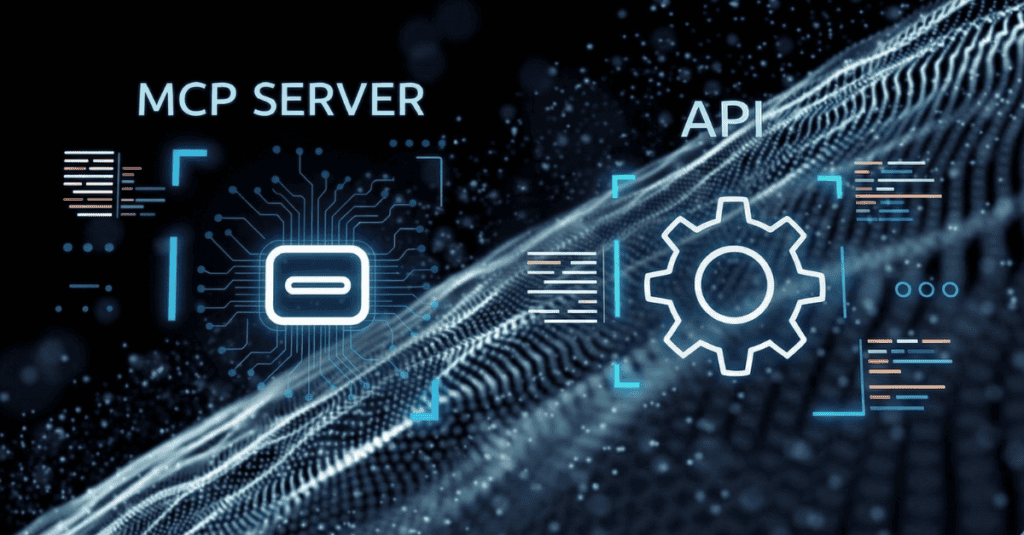
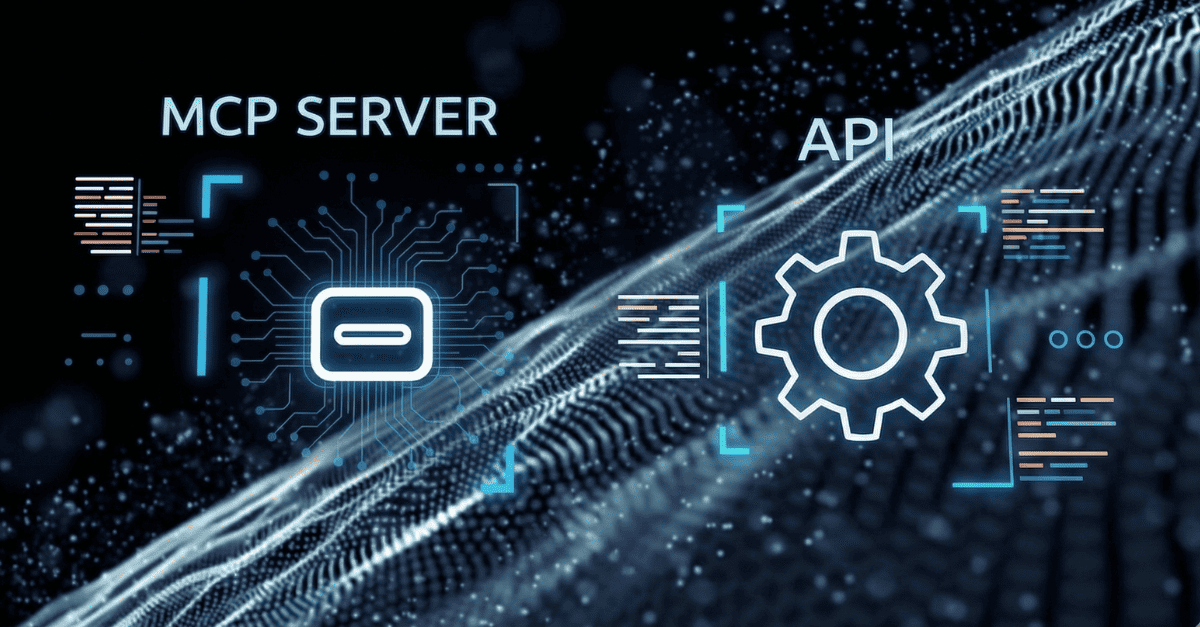
MCP Server: the game is changing, are we entering a post-API world?

For over a decade, APIs (Application Programming Interfaces) have been the universal language driving modern architecture.

From microservices to the composable principles championed by the MACH Alliance, APIs define how software systems talk to each other and exchange data.

What does the arrival of AI Agents mean for APIs?

But the arrival of AI Agents has introduced a new bold question:

Could tomorrow’s digital landscape become an MCP world, where the Model Context Protocol becomes the primary, intelligent way systems connect?

MCP, initially developed to let AI models safely and predictably interact with external tools, is quickly becoming a powerful new abstraction layer for all service-to-service communication. Like every disruptive technology before it, SOAP, REST, Events, its impact is set to extend far beyond its AI origins.

What makes MCP fundamentally different?

Before: Native AI integration and self-orchestration

  • The problem: Traditional APIs are like having a drawer full of different plugs (USB-A, HDMI, Lightning). Each one needs a custom integration.
  • The MCP solution: MCP provides a universal, open protocol for AI agents and services. It acts as the “USB-C port for AI.” Once a system speaks MCP, it can connect to any other MCP-compliant system instantly.

Now: Standard, unified interface: The USB-C of AI

  • The problem: APIs are for humans writing code. Complex tasks, like “Check stock, create an order, and send a shipping notification”, require a developer to manually write and sequence every step (orchestration).
  • The MCP solution: The protocol is built for AI agents. It facilitates real-time, two-way communication. The AI agent can simply state the goal (“Fulfill this order”), and the MCP server can manage the entire complex, multi-step workflow automatically, sending updates as events happen

Before: Declarative discovery: Plug-and-Play for services

  • The problem: With APIs, you need documentation to know exactly which endpoint (POST /orders/create) to use and how the data should be structured. If the API changes, your integration breaks.
  • The MCP solution: The system tells you clearly and dynamically what it can do (createOrder, getAvailability). This is declarative: the AI client asks, “What can you do?” and the server responds with an instant, machine-readable “menu.” No manual setup. It just works.

Now: Zero-Overhead integration (The developer dream)

MCP abstracts away the relentless technical friction of traditional APIs: no more debates over REST vs. GraphQL, no managing pagination rules, and far less time spent on versioning disputes. An MCP server shares its high-level capabilities, and the client (human or AI) uses them immediately.

How will MCP and AI change modern architecture?

The industry has clearly hit a wall of API complexity: thousands of endpoints, fragmented documentation, inconsistent patterns, and brittle, expensive integrations. MCP introduces a philosophical shift: from connectivity to capability orchestration.

Instead of building integrations around granular endpoints and data structures, we build around high-level actions, tools, and intents.

Traditional API (Code-Centric) Model Context Protocol (Intent-Centric)
Call: POST /api/v2/orders Tool: createOrder
Call: GET /inventory/sku_details/{sku} Tool: getAvailability
Result: Fragmented, low-level APIs Result: A cohesive capability graph


Will MCP replace APIs?

The short answer is: No, not immediately, but it will redefine where APIs sit in the stack.

APIs won’t disappear, they’ll be encapsulated.

MCP servers will become a new, intelligent interface layer built on top of existing APIs. A MCP server might execute several calls to your legacy REST APIs, ERPs, and OMS systems to fulfill a single createOrder tool request from an AI agent.

MCP servers will serve as:

  • AI-Ready Gateways on top of existing API infrastructure.
  • Secure Brokers that abstract and unify multiple, messy backends (like ERP, OMS, PIM, WMS).
  • Federated Orchestrators wrapping legacy systems.

By creating this universal, intelligent interface, MCP empowers AI to become a truly agentic force in enterprise, managing and automating complex, cross-system tasks with reliability.

MCP servers open the door to a new era of native AI integration. With a stable, declarative layer sitting above APIs, organizations can finally bring context to this data exchange, allowing them to experiment, innovate, and connect AI systems without the heavy lifting that comes with traditional integration work. It’s an early glimpse of a more adaptive, intelligent, and self-improving digital ecosystem.
Demi Tuck
Technical Product marketing Manager, Akeneo

Conclusion: MCP is not just a protocol, it’s a paradigm shift

We are moving into a world where systems are connected not through long, hand-crafted API integrations, but through declarative capability layers specifically designed for intelligent agents. The core question is no longer whether MCP will replace APIs; it is: which organizations will embrace the MCP layer early and secure a compounding architectural advantage?

OneStock, positioned as the Distributed Order Management System (DOM/OMS) at the center of retail complexity, recognizes that in an ecosystem driven by agentic channels and real-time demands, leveraging MCP is no longer optional, it is a strategic necessity to deliver truly unified commerce.

Our commitment to leading this shift is tangible:

Tooling the future: We are launching our MCP server in October 2025, equipped with robust tools for promise, inventory, and order management, facilitating seamless, intelligent connection with all AI agents and systems, while ensuring security through OAuth authentication, granular role management, and configurable access restrictions. (Find the OneStock MCP documentation here).

Foundational standard: OneStock is actively contributing to OnX (the Commerce Operations Foundation), an initiative built on the MCP protocol to define the new, common language for commerce operations. (See the OnX documentation here).

By pioneering on MCP protocol, OneStock is solving the complexities of cross-system operations with a unified, intelligent language. This anchors two critical pillars of our AI vision, relying on our MCP server:

OMS as the key enabler for Agentic Commerce: Turning the OMS into the intelligent hub that allows us to provide a comprehensive pre-purchase and post-purchase agentic experience, driving higher conversions and superior customer service. Read this on this topic on our blog.

An agent connects to multiple MCP servers, not just one : A common misconception is to think of an agent as being bound to a single MCP server. In reality, an agent operates across multiple MCP servers, each exposing a specialized domain of knowledge or capability.

Algolia’s MCP plays a different but equally critical role in agentic commerce. It gives AI agents safe, governed access to real-time retrieval so they not only get accurate product and content data, but also act within the right business rules and contexts. Paired with OMS intelligence from OneStock’s MCP, agents can participate reliably in full commerce workflows.”
Nate Barad
VP Product Marketing, Algolia

The future of retail is agentic, and its language is MCP. Organizations that wait will be building custom integrations for a world that is already moving toward plug-and-play intelligence. The time to adopt this new standard is now.

OneStock & AI: Shaping the next generation of commerce 

What is the OneStock AI vision?

It’s already a cliche to say that the potential for Artificial Intelligence to transform retail is huge, but at OneStock our philosophy is clear: AI will only become truly valuable when it solves real business problems. 

This is why our AI vision is built around three strategic pillars, each engineered to drive measurable impact and higher profitability for retailers. 

  • Pillar 1: Enabling the future of agentic commerce – The next revenue engine
  • Pillar 2: Massively increase operational efficiency – The cost saver
  • Pillar 3: Make better decisions for profitability – The optimizer 

And this entire vision is underpinned by a single, game-changing architectural innovation: the OneStock MCP Server.

Agentic commerce is no longer looking like a passing trend; it’s a fundamental structural shift in how consumers will shop and transact and leading analysts agree: McKinsey & Company reports on how generative AI is reshaping the customer experience across commerce.
Further, as Emily Pfeiffer from Forrester describes in her blog , ”Is Agentic Commerce a Thing?”, this dynamic manifests itself in two main forms:

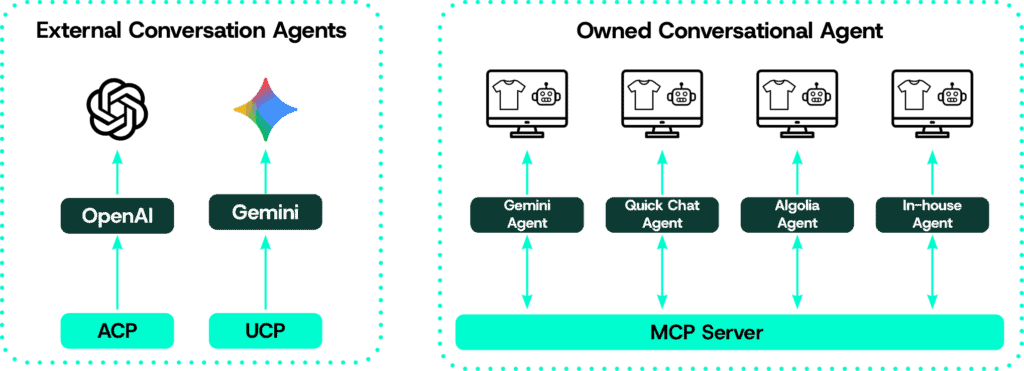
  • As external Agent Experiences: those that happen outside your brand on general platforms (e.g., via ChatGPT, Gemini, or Perplexity)
  • As owned Agent Experiences: those embedded within your brand’s own channels, giving you full control over the customer journey and data.

What is the role of DOM in an agentic commerce world?

As a Distributed Order Management System (DOM/OMS), OneStock is a key enabler for this new channel. It is the master source for inventory availability, the customer (or delivery) promise, and the order lifecycle.

By providing this critical, real-time data through the new MCP Server tools (for owned agents) and a robust product data feed (for external agents), OneStock allows AI agents to propose a complete and awesome pre-purchase and post-purchase experience.

What does the agentic commerce ecosystem look like?

OneStock is only one critical component within this new intelligent ecosystem. The agentic experience is only as powerful as the unified data that sits behind it.

Therefore, other components are just as important in this ecosystem:

Product Information Management (PIM) solutions, such as Akeneo, provide the enriched product data (specifications, attributes, imagery) necessary for the agent to provide complete product information and unify it across all sales channels.

IT leaders don’t realize yet that they’re now on the hook for go-to-market performance. With the rise of AI, product data is the GTM strategy, and if it isn’t complete, accurate, and trusted, you just won’t sell anymore. IT’s role has historically been about ensuring systems could enable customer interactions, but in the world of agentic and conversational commerce, IT is becoming responsible for the business performance of these interactions.

Search engines, such as Algolia, provide the essential real-time tools for improving the search experience and unifying it across all channels.

Agentic commerce requires more than a unified search experience — it requires unified retrieval. Agents can only take meaningful action when they can access accurate, real-time product data within the right context. With Algolia’s AI Retrieval Platform and Agent Studio, we ensure agents don’t simply generate or converse; they retrieve the right information and deliver consistent product discovery across every channel.

Marketplace platforms also play a key role. Mirakl, for example. With years of experience orchestrating complex eCommerce platform ecosystems, connecting thousands of sellers, managing distributed catalogs, and facilitating seamless transactions, they’ve built deep expertise in the infrastructure challenges that agentic commerce will need to solve.

This foundation positioned them to launch Mirakl Nexus, a neutral infrastructure designed to connect merchants to AI agents, enabling autonomous discovery, transactions, and post-sales management across platform ecosystems.

We've witnessed an interesting evolution with our clients. They initially came to us to manage their marketplace ecosystems, orchestrating more than 100,000 third-party sellers and billions of products. As they saw the value of that orchestration, they asked us to apply the same rigor to their own supplier networks and product catalogs. This progression revealed a fundamental truth: whether it's a marketplace seller, a B2B supplier, or an internal catalog, the challenge is the same: making fragmented commerce ecosystems work seamlessly together. Agentic commerce simply raises the stakes. Now, AI agents need to navigate these complex ecosystems autonomously, which makes robust orchestration infrastructure not just valuable, but essential

AI is just as crucial for internal and customer-facing teams as it is for the end-consumer experience. As an industry, it’s imperative we continue to improve the daily experience of retail teams to gain time, reduce errors, and cut operating costs. The MCP server facilitates the creation of AI agents that solve specific, common pain points across the organization

  • For Business Users: Faster system configuration and instant and actionable AI-driven insights from operational metrics
  • For Customer Service: Agent tools for quicker searching and filtering and for instant cross-system action on orders, thus speeding up resolution times.
  • For Store Associates: Guided fulfillment agents for faster, more accurate in-store picking and packing.
  • For System Integrators: Better monitoring and behavioral understanding and a standardized MCP interface for faster development and integration.

Every AI-driven action relies on product information that is complete, consistent, and trustworthy, yet creating a foundation of reliable product data is one of the biggest problems businesses face today; Gartner estimates that poor data quality costs organizations an average of $12.9 million annually, while Forrester links fragmented data to lost revenue, slower time-to-market, and higher return rates. AI becomes a force multiplier in both directions. When fed inaccurate or inconsistent data, it accelerates the impact of those problems, making bad decisions faster, amplifying operational inefficiencies, and eroding profit margins. But when AI operates on clean, enriched, and well-structured product data, its value compounds: forecasting becomes sharper, personalization more effective, inventory decisions more precise, and the customer experience more profitable.This is why investing in trustworthy product data is one of the most strategic moves a business can make today. High-quality product information powers AI, ensuring every automated action and every predictive model is grounded in truth. In this way, reliable product data becomes the quiet engine behind AI-driven profitability.
By Akeneo

The future of order management is predictive and self-optimizing. Leveraging advanced AI models, OneStock is intensely focused on capabilities that directly boost your bottom line:

  • Smarter Stock Reliability: Automatic safety stock and buffer adjustments based on real-time demand and proactive anomaly detection.
  • Promise Accuracy Optimization: Dynamic fine-tuning of delivery estimates based on historical carrier and warehouse performance.
  • Intelligent Fulfillment Orchestration: Auto-rerouting of at-risk orders and optimizing routing logic for the highest margin.
  • Predictive Operational Forecasting: Anticipating order volumes and resource needs to optimize staffing and warehouse operations.

The architectural foundation: The OneStock MCP Server

Pillars 1 and 2, Agentic Commerce and Operational Efficiency, require a new kind of foundation. Traditional API-based architectures were never designed for the dynamic, multi-step orchestration required by AI agents.

They are too often based on manual workflows and fragile and costly integrations.

Conclusion: AI needs to – and can – solve real business problems

OneStock’s AI strategy is built on a clear, pragmatic vision: to enable agentic commerce, increase operational efficiency, and improve profitability, all powered by a modern, unified architecture ready for AI.

As a pioneer of the Model Context Protocol (MCP), OneStock is providing the architectural foundation for the next decade of commerce. The future of retail is agentic.


When Intent Becomes Action: The Rise of Agentic Commerce

Introduction: The Shift from Browsing to Intent

The era of passive browsing is coming to a close. Agentic commerce represents a fundamental structural shift where customers use AI agents to execute complex tasks based on simple, natural intent. Recent insights published by the Boston Consulting Group indicate that AI shopping agents are rapidly reshaping digital commerce.

This evolution in the use of AI represents a change beyond just recommending products; it acts as a personal shopping concierge that can verify stock, guarantee delivery, and even place the order autonomously. This shift is happening both outside the brand (referred to as External Agents) and within owned channels (where customers interact with Owned Agents). To discover more, see this blog post from Forrester analyst Emily Pfeiffer.

The OneStock Imperative: Mastering Availability, Promise and Order Lifecycle

For the Agentic Commerce experience to be a complete and genuine evolution beyond traditional browsing, AI agents must operate on more than inference or probability – they must rely on real-time, trustworthy data, across the entire customer journey, both pre-purchase and post-purchase.

This is where the customer promise becomes critical: it’s not just about what can be sold, but what can be confidently delivered, when it can be delivered and how it was promised. As part of this, OneStock, in its role as a true distributed order management solution, acts as the key enabler of the promise. It serves as the single, authoritative source for inventory, order lifecycle, and delivery commitment data, ensuring that every agent interaction and the information acted upon is grounded in operational truth.

By aligning customer intent with executable fulfillment capabilities, OneStock enables retailers to replace hopeful recommendations with guaranteed outcomes, thereby turning AI-led conversations into promises that are consistently and reliably kept.

The two critical methods for delivering this data are:

  1. MCP Server Tools: For internal (Owned) agents that require secure, real-time, bi-directional communication to execute complex commands. An MCP server can be thought of as a secure bridge between AI agents and core commerce systems. It enables agents to access real-time inventory, order, and delivery promise data, and to execute actions safely, ensuring every response given to the customer is based on what a retailer can actually fulfill.
  2. Product Data Feeds & Protocols: For external platforms (like OpenAI) and protocols (such as UCP and ACP) that require periodic, structured information relating to product availability and fulfillment options.

What Are Concrete Use Cases for Agentic Commerce?

Agentic commerce only delivers value when it can be translated into practical, executable scenarios.

Examining concrete use cases makes it possible to understand how customer intent, AI agents, and operational systems come together to create tangible outcomes across the purchase and post-purchase journey:

Use Case CategoryDescription & User IntentHow OneStock’s MCP Enables It
External Agent Transaction Intent (via ChatGPT): “Tell me if this pair of running shoes in size 10 can be delivered before my race on Saturday.”Product Data Feed
OneStock sends product feeds periodically (e.g., every 15 minutes) with real-time inventory, availability, and fulfillment information, following the external platform’s specifications. Response: “Yes, they are available. I can guarantee delivery by Friday, before 4:00 PM at your home, or you can collect them in our London store today in 2 hours.”
Owned agent : Pre-Purchase / Fulfillment PromiseIntent: “Can I purchase the product again as per my last order and when can it be delivered?”MCP Tools
The agent connects to the OneStock MCP Server using the customer context, retrieves order history, and calculates a new promise. Response: “Yes, for sure. Your last order included Hill’s Cat Food (2 units) and World’s Best Cat Litter (1 unit). They can be delivered this Friday before 4:00 PM.”
Post-Purchase / ServiceIntent: “My package is delayed. Can you automatically organize pickup from my local store rather than waiting?”MCP Tools
OneStock verifies the order status, checks the local store unified inventory, and executes the fulfillment route change instantly. Response: “Yes, no problem. I’ve rerouted your package. It will be available for pickup as two separate parcels at the London store, from tomorrow. Are you OK with this change?”

AI only creates value when it enables real business outcomes, not when it’s treated as a feature in search of a use case. An OMS that serves as the system of truth for inventory availability, customer promise, and order execution becomes the foundation for delivering truly intelligent, agentic commerce. This is the kind of AI first foundation that empowers retailers to unlock new levels of efficiency and customer experience.”

Klarissa Marenitch

Retail CTO
Cognizant

The Foundation: MCP Server and Product Data Feed as the Universal Language

The MCP Server and the complementary Product Data Feed are the non-negotiable architectural foundations for Agentic Commerce. They ensure that the complex intelligence of the DOM/OMS is accessible to any AI agent.

For this reason, OneStock proactively released its MCP server in October 2025, and is committed to compliance with all evolving product data feed formats. This commitment ensures retailers can confidently deliver a full-spectrum, future-proof agentic experience, managing everything from the initial customer intent (pre-purchase) through to complex service requirements (post-purchase). By adopting this standard early, OneStock guarantees its clients can secure a leading edge in the new era of intelligent commerce.

right body