By Guillaume Vanbrugghe
There’s nothing unusual about seeing the standard ‘3 to 5 business days’ delivery estimate when placing an order. Plenty of ecommerce sites use it, or a variation of it. The problem is, it doesn’t really tell you anything – well, nothing useful anyway. In fact, according to Gartner research published in March 2025, retailers display an average delivery window of as much as 6.7 days, when the actual average delivery time is 3.7 days. It’s clear, therefore, that we’re not facing a logistics problem. Rather, it’s an information problem – a challenge that has been left untouched for far too long.
While it’s positive that almost all retailers now show a delivery date at checkout, that date simply matches the end of their static shipping window 65% of the time. Meanwhile, only 6% of retailers display a delivery promise on the product page, crucially the moment at which the customer is actually deciding whether to buy. The rest leave their customers blind at this stage, to the detriment of the overall shopping experience.
More transparency means better conversion
When customers are left without the key information that they require, it’s likely that they will not complete a transaction – meaning there is an opportunity for higher conversion rates already sitting on the table. However, this opportunity is set to become much greater still.
As analyst Chap Achen, speaking at the 2026 Gartner Supply Chain Symposium in Barcelona, explains, as AI shopping agents take over product discovery, it is the fulfilment offer that becomes the primary ranking factor – that’s ahead of brand story, curation, or promotional context.
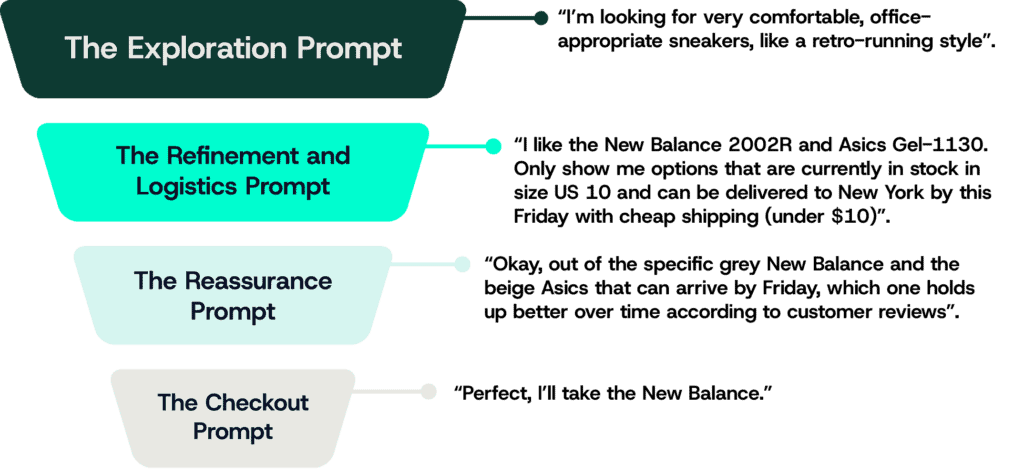
In other words, an agent that is asked to find, “Running shoes under €150 that I can get by Friday,” doesn’t respond to banners. Rather, it reads your delivery data and compares it, in real time, against every other retailer. This means that a vague delivery window is now not just a checkout conversion problem. In the agentic commerce world, it becomes a discoverability problem. For this reason, an accurate, structured delivery promise isn’t only positive for improving today’s conversion rates in the traditional sense. It’s the data that agents increasingly in the future will be reading to decide whether your product even shows up.
How OneStock delivers the right promise, at the right moment and keeps it
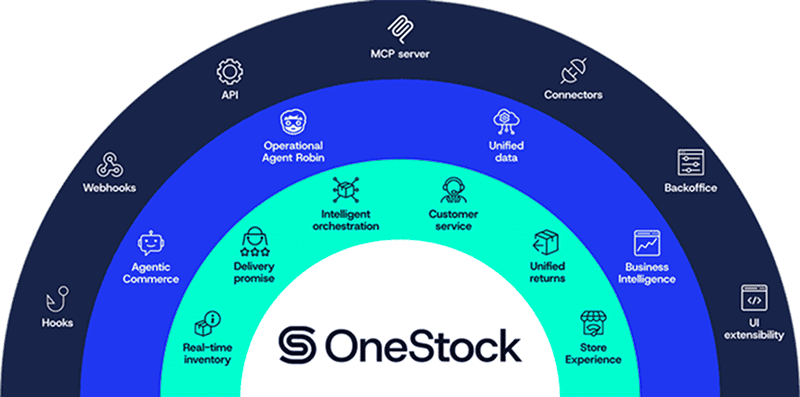
To overcome the challenge, OneStock provides its Delivery Promise solution. Delivery Promise calculates, in real time, the most accurate delivery scenario available for each customer and surfaces it across the entire purchase journey, via API or MCP, to any channel.
Additionally, the promise adapts according to where a customer is in their journey. On the product listing page, for example, it shows a concise availability signal – enough to guide a browsing decision without slowing the page. On the product detail page, it surfaces the full promise: mode, cost, and date – calculated for that specific item and that specific customer location. At checkout, it confirms the selected option and adjusts in real time based on the delivery address entered.
This represents a huge breakaway from the ‘3 to 5 working days’ tradition.
The calculation itself is based on the determining factors identified when an order arrives: unified stock position; warehouse and store preparation windows and opening hours; carrier routes; and the customer’s location. This means every variable in the loop can be considered, and accurate information surfaced at the moment the customer is making the decision to buy.
Let’s take a look at some examples according to the type of page on which the promise is displayed:
- On the product listing page: A customer in Paris browsing on a Wednesday morning will see, ‘Delivered tomorrow before 1pm’, next to each item. This has been calculated for that specific product, location and moment, rather than displaying a shipping policy or date range.
- On the product detail page: A customer browsing a back-order item will see the real restocking date factored in, as opposed to a generic delay. A customer in a 2-hour delivery zone will see that option surfaced automatically, priced and timed, rather than an asterisked footnote or a ‘Subject to Availability,’ notice. A customer near a store, meanwhile, will see live in-store availability. Again, in contrast to a generic ‘Available in Stores,’ notice, it will show that that specific product is on the shelf, right now, and ready to collect.
- At checkout: A customer with a standard cart might discover that their order must be shipped in two separate parcels because OneStock has determined that a single shipment isn’t possible. In this case, the two shipments are clearly displayed, with two dates and the details of the exact items in each shipment before they confirm. This avoids customer surprise at the door and mitigates the ‘Where’s the rest of my order?’ call to customer service
Additionally, for each delivery option, OneStock calculates the associated carbon footprint, so the retailer can display the ecological impact of each choice alongside the date and cost. The customer does not just see when their order arrives, but what that decision costs in environmental terms, so that they are empowered to make a genuinely informed choice.
The promise extends beyond the screen. OneStock carries it over into fulfilment orchestration, meaning that the commitment shown to the customer is exactly the one that the warehouse also receives. In other words, no discrepancies between what was displayed and what ships.
How OneStock Delivery Promise Works in Practice
The Delivery Promise looks different depending on who’s using it and what their customers need, which means examples are varied and wide-ranging.
- LKQ and Club Piscine have chosen to activate the promise from the product listing page, before the customer even clicks through to a product. Every item in the catalogue displays its availability status and a potential delivery date, calculated in real time. For LKQ, the promise factors in supply chain routes that vary by product and geography: the same item can have a different fulfilment path depending on where it’s ordered from, and the promise reflects that complexity accurately, each time. The customer experience remains simple despite the inherent complexities of the supply chain.
- Longchamp and Isabel Marant use it to surface real-time store availability directly on the product page. A customer browsing a bag will see whether it’s in stock at their nearest store, rather than a generic ‘Available in Stores’ label, based on a live availability signal calculated from the unified stock position. After activating this, Longchamp saw an impressive 12% increase in conversion rate.
- For Soeur, the promise surfaces a 2-hour delivery option via Uber Direct for customers in eligible zones. The option appears automatically, priced and timed, without any manual configuration per order.
- Maisons du Monde uses the split shipment capability. When a cart cannot be fulfilled in a single delivery, the promise surfaces two shipments at checkout, including dates, costs, and the exact items in each parcel, before the customer confirms.
- For ManoMano, the European marketplace leader in DIY, home and garden, OneStock handles around 40 API requests per second on the Promise endpoint. This delivers real-time ETA and cost calculations across product detail pages, basket, catalog pages, and Google Shopping. In 2026, ManoMano launched its ‘Delivery Single Source of Truth’ built on OneStock. This enables one promise to be generated from a single reliable source and distributed across every sales channel and at every step of the customer journey.
The other important factor is that these promises can be held. The same logic that drives the display also drives the fulfilment. Therefore, the stock location will not be in the position of receiving an order and having to figure out delivery afterwards. The order is received with the commitment already built in. These foundations will be vital as the trend toward agentic commerce continues.
How To Get Started with OneStock Delivery Promise
The Delivery Promise is activated as a module and configured against your existing stock locations, logistics routes, and carrier integrations. Available via API or MCP to any sales channel.
 Get a demo