ERP Replatform vs Distributed Order Management: Where Retailers Should Invest Next
Article by JJ Karambelas
In retail, investment decisions around core systems are rarely simple. With pressure to improve customer experience, reduce costs, and increase agility, many retailers are asking the same question:
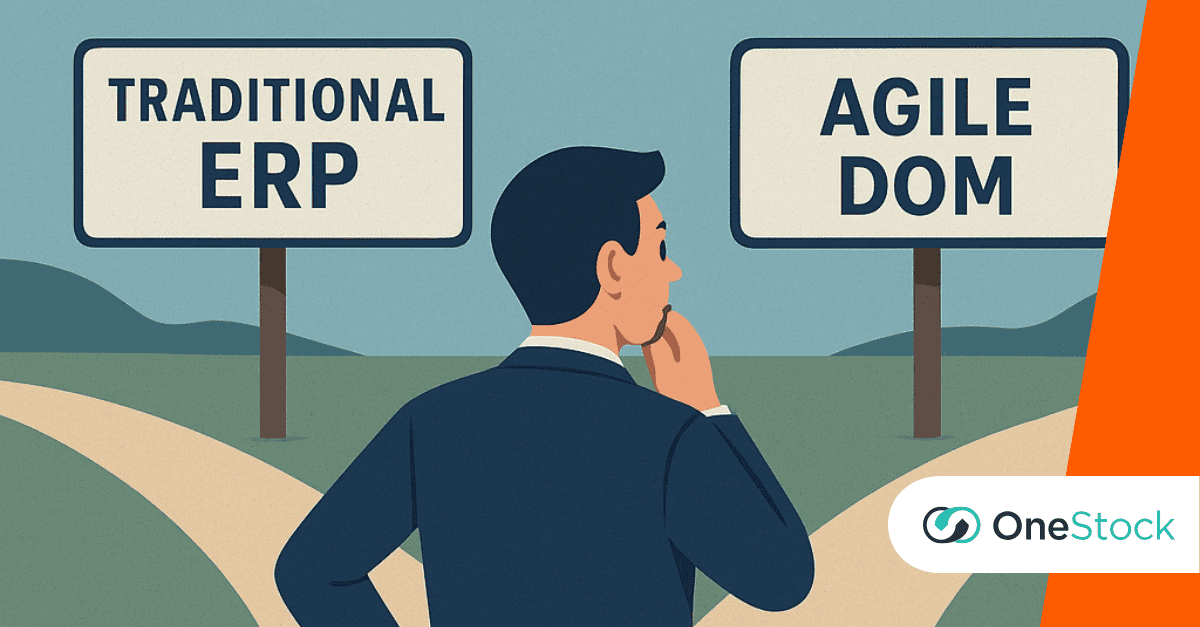
Should we replatform our ERP, or prioritise a Distributed Order Management (DOM) system?
It’s a critical choice. Both paths promise operational improvement, but the commercial and technical outcomes differ greatly.
ERP Replatforming: Strengths and Limitations
ERP systems are the backbone of most retailers (of certain sizes), centralising finance, HR, supply chain and procurement. Replatforming an ERP can be tempting when the current system feels outdated or inflexible.
Potential benefits of ERP replatforming:
- Modernises core finance and supply chain processes.
- May reduce technical debt if legacy versions are heavily customised.
- Offers long-term standardisation across the business.
Limitations and risks:
- Cost and timeline: ERP replatforms are expensive, risky, multi-year projects, often exceeding budget.
- Gartner notes an unparalleled negativity for ERP projects with **70% failing to meet business case goals, and 25% failing catastrophically.
- Limited impact on CX: ERPs aren’t built for real-time inventory orchestration, flexible fulfilment or omnichannel scenarios.
- Inflexibility: Even modern ERPs are not agile when it comes to rapidly deploying new fulfilment options (ship-from-store, marketplaces, endless aisle, etc.).
- Customisation risk: Retailers often end up rebuilding the same middleware to compensate for ERP limitations.
The reality is that ERP replatforming often delivers internal efficiency but little immediate value for the customer or top-line revenue growth.
**https://www.gartner.com/en/information-technology/topics/enterprise-resource-planning
Distributed Order Management: A More Direct Path to Customer Value
Distributed Order Management sits between front-end channels (eCommerce, POS, marketplaces) and the ERP, orchestrating inventory and orders across the entire network.
Key benefits of DOM:
- Real-time inventory visibility: Unify stock from warehouses, stores and drop-ship partners.
- Flexible fulfilment: Enable ship-from-store, click & collect, endless aisle and split shipments with minimal disruption to ERP.
- Revenue growth: Prevent stock-outs, reduce cancellations and increase conversion.
- Cost optimisation: Route orders to the most profitable fulfilment location, lowering logistics and markdown costs.
- Faster time-to-value: DOM can be deployed incrementally, delivering benefits within months, not years.
- Future-proof: DOM acts as a layer of agility, allowing you to change ERP, eCommerce or WMS later without disrupting fulfilment logic.
Realistic challenges of DOM adoption:
- Integration complexity: DOM needs clean integration with ERP, WMS, POS and digital sales channels, which can be time-consuming if those systems are legacy or fragmented.
- Change management: Store teams and fulfilment operations must adapt to new processes, e.g ship-from-store workflows or updated picking priorities.
- Upfront investment: While cheaper than ERP replatforming, DOM still requires significant investment in both technology and process change.
- Dependencies on accurate data: A DOM is only as good as the data it receives. Poor stock accuracy or delayed updates from legacy systems can limit its effectiveness.
- Selecting the right partners: DOM success is not just about installing software. It requires precise integration with existing systems. Selecting a DOM vendor and SI that have proven experience in decoupling order flows from specific ERP platforms ensures you avoid pitfalls and get value faster.
These challenges are real, but they are typically short-term hurdles, whereas the benefits compound quickly.
Commercial Comparison: ERP vs DOM
| Dimension | ERP Replatform | Distributed Order Management |
|---|---|---|
| Cost | High (multi-year, multi-million) | Moderate, modular implementation |
| Time to Value | 18–36 months | 4–9 months |
| Customer Impact | Low (back-office efficiency) | High (CX, fulfilment flexibility, conversion) |
| Agility | Limited, hard-coded processes | High, configurable fulfilment rules |
| Risk | High (disruption, scope creep) | Lower (layered approach, incremental rollout) |
| Dependency | Often locks you into vendor roadmap | Future-proofs ERP, WMS, and eCommerce choices |
A Balanced View: ERP and DOM in Context
There are scenarios where prioritising an ERP replatform is unavoidable, for example:
- The ERP is out of support and a security / compliance risk.
- Financial and supply chain modules are so outdated they constrain the business.
But even in these cases, prioritising DOM first makes sense both commercially and technically.
Commercially:
- DOM delivers measurable top-line value (conversion, reduced cancellations, increased order capture) within the same fiscal year, while ERP replatforms often take years before ROI is realised (if any).
- Early wins in fulfilment and CX can fund or justify later ERP transformation.
Technically:
- DOM decouples order orchestration and inventory availability from ERP, reducing dependency on ERP customisation and making future ERP replatforming easier.
- Retailers can roll out DOM incrementally, starting with eCommerce, then extending to stores, marketplaces and wholesales.
- Once DOM is live, ERP can be swapped in or upgraded beneath it with far less disruption.
An alternative option: Running ERP and DOM in parallel
- Retailers can stabilise or modernise finance and supply chain through ERP replatforming while deploying DOM to address customer-facing priorities.
- A layered approach ensures business continuity: DOM shields the front-end channels from ERP change, so fulfilment logic is not disrupted during migration.
- This approach lowers risk. ERP delays don’t block customer innovation, and DOM provides a safety net for fulfilment even if ERP milestones slip.
Again, integration expertise here is essential. Running DOM and ERP in parallel is only achievable with strong architectural design. A seasoned SI that has built middleware and decoupling layers around ERPs knows how to prevent ERP transformation delays from derailing DOM initiatives. The right combination of SI and DOM partner ensures the two programmes complement, rather than compete with each other.
Recommendation: Lead with DOM, Not ERP
Retailers don’t win customer loyalty through better finance systems. They win by offering reliable, flexible fulfilment, a consistent experience across every channel, and a predictable customer promise. DOM is the enabler of that.
By deploying a Distributed Order Management system first, retailers unlock immediate commercial impact – higher conversion, reduced fulfilment costs and greater customer satisfaction. All while de-risking any future ERP replatform by decoupling promise and fulfilment from back-office processes. DOM provides a flexible change management layer made to handle the scale and ever-changing complexity of customer-facing requirements.
The bottom line: If you have to choose where to invest first, DOM delivers more value, faster, with lower risk. And if you must run both transformations in parallel, DOM makes sure your customer experience remains shielded and profitable.