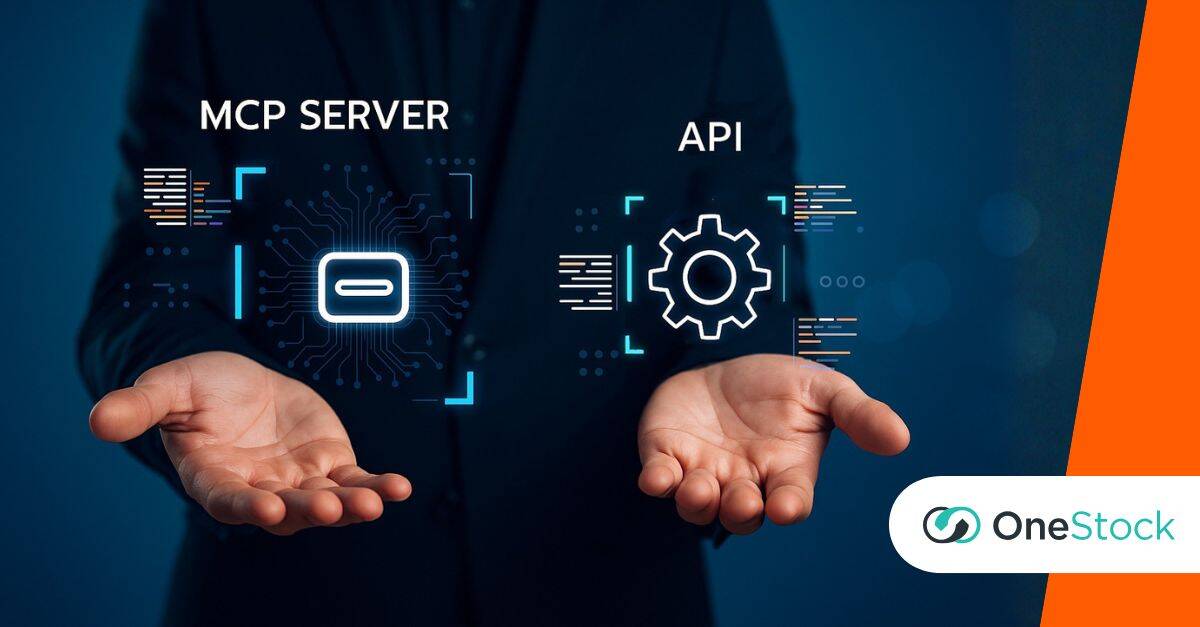
MCP Server: the game is changing, are we entering a post-API world?

AUTHOR
Guillaume Vanbrugghe
Leading Product marketing
OneStock
For over a decade, APIs (Application Programming Interfaces) have been the universal language driving modern architecture. From microservices to the composable principles championed by the MACH Alliance, APIs define how software systems talk to each other and exchange data.
But the arrival of AI Agents has introduced a new bold question:
Could tomorrow’s digital landscape become an MCP world, where the Model Context Protocol becomes the primary, intelligent way systems connect?
MCP, initially developed to let AI models safely and predictably interact with external tools, is quickly becoming a powerful new abstraction layer for all service-to-service communication. Like every disruptive technology before it, SOAP, REST, Events, its impact is set to extend far beyond its AI origins.
What makes MCP fundamentally different?
Native AI integration and
self-orchestration
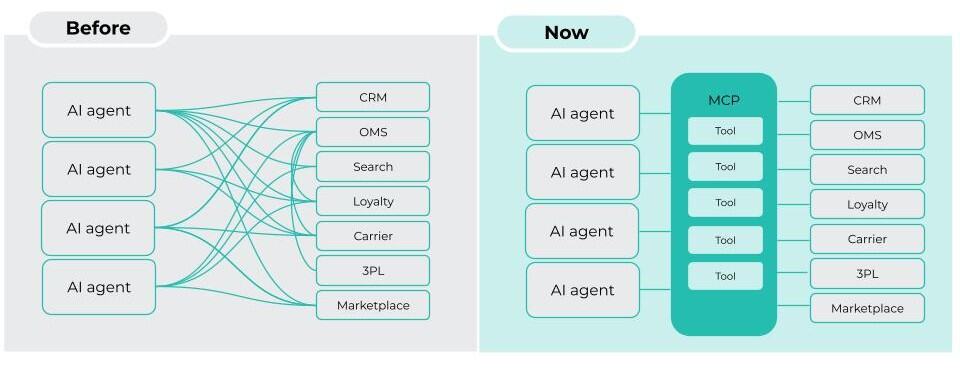
- The problem: Traditional APIs are like having a drawer full of different plugs (USB-A, HDMI, Lightning). Each one needs a custom integration.
- The MCP solution: MCP provides a universal, open protocol for AI agents and services. It acts as the “USB-C port for AI.” Once a system speaks MCP, it can connect to any other MCP-compliant system instantly.
Standard, unified interface: The USB-C of AI
- The problem: APIs are for humans writing code. Complex tasks, like “Check stock, create an order, and send a shipping notification”, require a developer to manually write and sequence every step (orchestration).
- The MCP solution: The protocol is built for AI agents. It facilitates real-time, two-way communication. The AI agent can simply state the goal (“Fulfill this order”), and the MCP server can manage the entire complex, multi-step workflow automatically, sending updates as events happen
Declarative discovery: Plug-and-Play for services
- The problem: With APIs, you need documentation to know exactly which endpoint (POST /orders/create) to use and how the data should be structured. If the API changes, your integration breaks.
- The MCP solution: The system tells you clearly and dynamically what it can do (createOrder, getAvailability). This is declarative: the AI client asks, “What can you do?” and the server responds with an instant, machine-readable “menu.” No manual setup. It just works.
Zero-Overhead integration (The developer dream)
MCP abstracts away the relentless technical friction of traditional APIs: no more debates over REST vs. GraphQL, no managing pagination rules, and far less time spent on versioning disputes. An MCP server shares its high-level capabilities, and the client (human or AI) uses them immediately.
Before, Now
Why this could reshape modern architecture?
The industry has clearly hit a wall of API complexity: thousands of endpoints, fragmented documentation, inconsistent patterns, and brittle, expensive integrations. MCP introduces a philosophical shift: from connectivity to capability orchestration. Instead of building integrations around granular endpoints and data structures, we build around high-level actions, tools, and intents.
| Traditional API (Code-Centric) | Model Context Protocol (Intent-Centric) |
|---|---|
| Call: POST /api/v2/orders | Tool: createOrder |
| Call: GET /inventory/sku_details/{sku} | Tool: getAvailability |
| Result: Fragmented, low-level APIs | Result: A cohesive capability graph |
This move is dramatically easier for both humans to understand and machines (AI) to consume. It allows architects to focus on business value rather than plumbing.
Will MCP replace APIs?
The short answer is: No, not immediately, but it will redefine where APIs sit in the stack.
APIs won’t disappear, they’ll be encapsulated.
MCP servers will become a new, intelligent interface layer built on top of existing APIs. A MCP server might execute several calls to your legacy REST APIs, ERPs, and OMS systems to fulfill a single createOrder tool request from an AI agent.
MCP servers will serve as:
- AI-Ready Gateways on top of existing API infrastructure.
- Secure Brokers that abstract and unify multiple, messy backends (like ERP, OMS, PIM, WMS).
- Federated Orchestrators wrapping legacy systems.
By creating this universal, intelligent interface, MCP empowers AI to become a truly agentic force in enterprise, managing and automating complex, cross-system tasks with reliability.

Conclusion: MCP Is not just a protocol, it’s a paradigm shift
We are moving into a world where systems are connected not through long, hand-crafted API integrations, but through declarative capability layers specifically designed for intelligent agents. The core question is no longer whether MCP will replace APIs; it is: which organizations will embrace the MCP layer early and secure a compounding architectural advantage?
OneStock, positioned as the Distributed Order Management System (DOM/OMS) at the center of retail complexity, recognizes that in an ecosystem driven by agentic channels and real-time demands, leveraging MCP is no longer optional, it is a strategic necessity to deliver truly unified commerce.
Our commitment to leading this shift is tangible:
Tooling the future: We are launching our MCP server in October 2025, equipped with robust tools for promise, inventory, and order management, facilitating seamless, intelligent connection with all AI agents and systems, while ensuring security through OAuth authentication, granular role management, and configurable access restrictions. (Find the OneStock MCP documentation here).
Foundational standard: OneStock is actively contributing to OnX (the Commerce Operations Foundation), an initiative built on the MCP protocol to define the new, common language for commerce operations. (See the OnX documentation here).
By pioneering on MCP protocol, OneStock is solving the complexities of cross-system operations with a unified, intelligent language. This anchors two critical pillars of our AI vision, relying on our MCP server:
OMS as the key enabler for Agentic Commerce: Turning the OMS into the intelligent hub that allows us to provide a comprehensive pre-purchase and post-purchase agentic experience, driving higher conversions and superior customer service. Read this on this topic on our blog.
An agent connects to multiple MCP servers, not just one : A common misconception is to think of an agent as being bound to a single MCP server. In reality, an agent operates across multiple MCP servers, each exposing a specialized domain of knowledge or capability.

The future of retail is agentic, and its language is MCP. Organizations that wait will be building custom integrations for a world that is already moving toward plug-and-play intelligence. The time to adopt this new standard is now.